Compare long-stay living with hotel service, kitchenette, and workspace

What should this comparison really clarify in everyday life?
If you live in one place for several weeks or months, the question of the accommodation label is not enough. What matters is whether the place practically supports your daily routine: can you work there with focus, withdraw, prepare simple meals, and arrive and depart without unnecessary detours?
That is exactly why comparing long-stay living with hotel service, kitchenette, and workspace makes sense. It does not only answer the question of which accommodation looks “nicer,” but which combination of service, privacy, and workability fits your real weekly rhythm. For remote workers, business travelers, and people in longer project phases, that is often the real difference between a good impression and an everyday-suitable solution.
An apartment is not automatically the better long-stay solution, and a hotel is not automatically only relevant for short trips. Serviced apartments and apartment hotels can also be suitable for longer stays if the facilities, processes, and retreat options fit. The useful comparison therefore does not start with the product name, but with the question of what you really need every day.
How do the three housing models differ in practice?
To classify offers clearly, it helps to look at use instead of marketing terms. In essence, three patterns can be compared:
Accommodation with hotel service
Here, the organized process is the focus. What matters is which service features are actually available and how clearly arrival, access, and daily organization are described. If you have little time for your own organization or appreciate a structured process, this can be helpful. For the comparison, however, the hotel category itself is not decisive, but whether service, quiet, and workspace fit together.
Serviced apartment with kitchenette
This variant combines more independence with a residential character. It is not only important that a kitchenette is available, but what you use it for in everyday life. Anyone who wants to organize breakfast, snacks, or simple meals themselves evaluates this differently from someone who only needs a kettle or reheating option. A kitchenette is especially valuable when it really makes your routine independent.
Furnished apartment or room with workspace
If work is the main focus, the workspace becomes the key feature. Then the desk, lighting, seating, and the question of whether the area is truly usable for a longer period matter. A good setup only helps if you can work there for several hours at a time and do not have to keep switching between bed, sofa, and table.
Which criteria are especially important for 28 to 179 nights?

For a long-stay comparison, you should rank the criteria by their effect on daily life. The following points help you distinguish offers not just by impression, but by usability:
How quiet is the accommodation for work and rest?
Quiet is not a side issue during longer stays. Check whether the location, layout, and room arrangement allow focused work and real breaks. This is especially important if you have many video conferences, longer writing phases, or want to switch off deliberately after work. A well-equipped workspace is of little use if the surroundings are too restless.
Is the kitchen option enough for your actual routine?
Do not only compare whether a kitchenette is mentioned, but what it allows you to do in everyday life. For some stays, it is enough to prepare breakfast and simple meals yourself. For others, it is important that refrigerator, storage surfaces, and cooking facilities work together. The right question is therefore: Does this kitchen option help me organize my everyday life the way I actually live it?
Is the workspace truly usable over a longer period?
A workspace is more than a table. If you work regularly, you should pay attention to surface area, seating comfort, and light. Especially during longer stays, it makes a big difference whether you only sit at a laptop for a short time or can actually spend half or a whole working day there. The more your stay is shaped by work, the higher this criterion should be weighted.
Does the cleaning rhythm match your privacy needs?
For 28 to 179 nights, the view of cleaning changes. Some want reliable service, others prefer as little intrusion into their personal space as possible. That is why it is worth taking a close look at when and how cleaning takes place. This helps you assess how much privacy you keep and whether the process fits your weekly rhythm.
How straightforward are access and arrival?
A stay does not begin only in the room, but already with arrival and check-in. Clarify how you receive keys or access data and whether the process is described clearly. For longer stays, this is especially important because a clear start makes the first few days more structured and avoids unnecessary follow-up questions.
What really makes total costs, location, and flexibility different?
In many comparisons, facilities and service are easy to spot quickly. More difficult is the question of what everyday life feels like outside the room. That is exactly where three additional checkpoints help.
Which location really saves you routes in everyday life?
A good location is not automatically the central location on the map. What matters is which routes you regularly cover in everyday life: to work, clients, projects, shopping, or public transport. If you are often out of the house, a location with short distances can be more important than a particularly generous workspace. If you work a lot in the apartment, you may need quiet more than perfect accessibility. The location should therefore match your usage profile, not just sound attractive.
Which costs matter in addition to the overnight rate?
When comparing, it is worth looking at the overall picture. An offer with kitchen use can feel different from one where you organize almost all meals externally. A well-tailored workspace can bring more value for longer project phases than a purely decorative room. Therefore, you should not only look at the visible price, but also at the everyday follow-up costs and the effort that results from the level of service, self-catering, and location.
How flexible is the housing model for your work rhythm?
Not every stay follows the same pattern. Some people work almost exclusively in the room during the day, others are out on several days. A model with hotel service can be practical if you need clear processes and little self-organization. An apartment with a kitchenette and workspace can fit better if you shape your day more independently. In this context, flexibility does not mean “more is always better,” but: Does the model fit your actual weekly schedule?
How does myroom24 help you make exactly this decision?
myroom24 bundles long-stay stays for 28 to 179 nights. That is helpful if you are not looking for a short trip, but planning a clearly defined period for work, a project phase, or a longer stay.
Through myroom24, you can specify your destination and length of stay and filter available long-stay accommodations by criteria such as price, location, and facilities. This means you do not start with a long list of results, but with the features that really matter for your comparison.
The platform also shows different types of accommodation, including rooms, apartments, and houses in commercial accommodation facilities such as hotels, hostels, serviced apartments, and holiday apartments. This is useful for this comparison because you are not only looking at a single housing model, but can compare different combinations of service, kitchen option, and workspace.
If an offer is marked as instant booking, it can be booked without prior approval from the host, subject to availability. That can be relevant if you want to plan your stay precisely and secure individual options directly.
How do you compare offers systematically without getting lost in details?
It is best to follow a fixed sequence so that many impressions turn into a clear decision:
- First define the must-have criteria. Do you absolutely need quiet, a kitchenette, or a real workspace?
- Then check the work profile. How many hours will you realistically work per day, and do you need a fixed place for that?
- Compare the location from an everyday perspective. Are your usual routes short, practical, and easy to plan?
- Assess the level of service. Do you want to hand over a lot of organization, or prefer more independence?
- Look at privacy. Does the cleaning rhythm match your desire for retreat?
- Finally decide based on the overall picture. Not every detail has to be perfect; what matters is that the combination fits your stay.
This helps you avoid letting photos or individual features dominate the decision. An offer with less service can be more suitable for your project phase than a very service-oriented room if it gives you more quiet and a better work environment. Conversely, a hotel offer with clear processes can be convincing if you have little time for self-organization.
Which model fits which usage scenario?
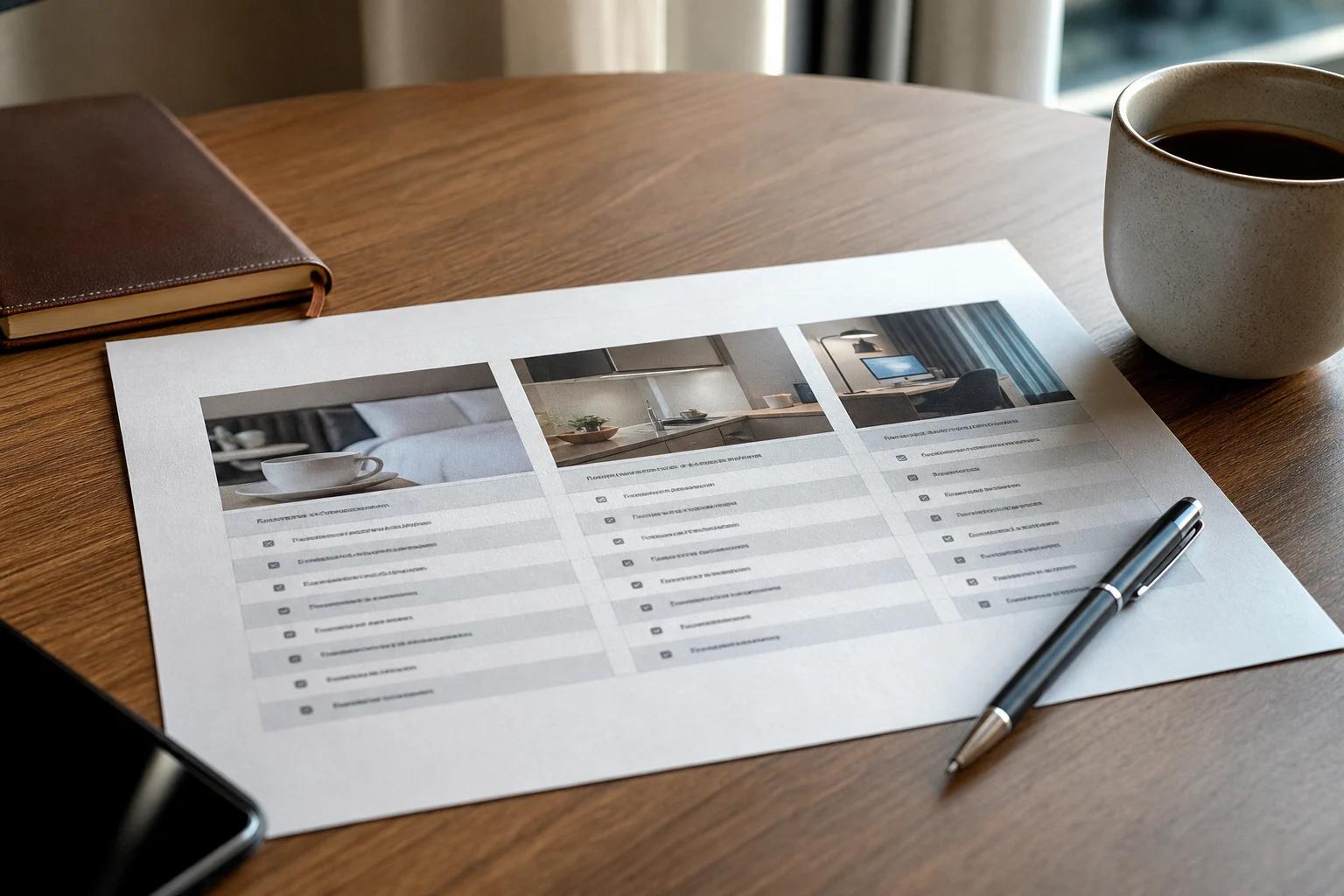
If you have many focused work phases during the day and want to organize simple meals yourself in the evening, an apartment with kitchenette and workspace is often especially obvious. You combine independence with a fixed work area.
If you are frequently on the move, have little time for your own organization, and appreciate clear processes, an offer with hotel service can make sense. Here it is important that you also pay attention to quiet and the usability of the workspace so that service does not come at the expense of everyday suitability.
If you are primarily looking for a functional place for a project phase where work, retreat, and simple self-catering should come together, it is worth looking at hybrid models such as serviced apartments or apartment hotels. They can fulfill the same long-stay function as an apartment, as long as the specific features match your daily routine.
Which documents and details should you place side by side before booking?
To keep the comparison reliable, you should note the same information for each offer:
- What length of stay is planned?
- How is the workspace described?
- Which kitchen option is specifically mentioned?
- How is access organized?
- Which service features are clearly stated?
- How is cleaning arranged?
- Does the location fit your typical routes?
With this short list, you compare not just the impression, but the everyday suitability. That is usually the decisive difference for longer stays.
Conclusion: What should you really decide in the end?
When comparing long-stay living with hotel service, kitchenette, and workspace, the goal is not to favor one model across the board. What matters is which combination of service, privacy, kitchen option, workspace, location, and cleaning rhythm fits your real everyday life.
If you check these points systematically, you can classify housing models objectively and choose the accommodation that is sensibly set up for your 28 to 179 nights. If you want to start the comparison right away, use the myroom24 accommodations and narrow the selection by duration, location, and facilities.
Frequently asked questions
How do I recognize whether a hotel service offer is suitable for longer workdays?
If the workspace is usable, quiet is present, and the service does not constantly interrupt your daily routine.
When is a kitchenette more important for my long stay than more service?
When you regularly cook for yourself or prepare meals and want to organize your routine more independently.
How do I assess the location correctly for 28 to 179 nights?
Based on your real daily routes: to work, appointments, shopping, and transport connections, not just the address.
What is the most important trade-off when workspace and privacy are central for me?
Then a permanently usable desk, a quiet environment, and a cleaning rhythm should fit together.
Which type of accommodation is more suitable if I need to decide a lot between meetings and projects?
A model with a clearly usable workspace and enough independence, often an apartment or serviced apartment if these features are met.