Temporary Accommodation for Families with Two Rooms and a Home Office Option: Long-Stay Checklist

Why is the room layout more important than the floor area alone?
When it comes to temporary accommodation for families with two rooms and a home office option, it is not the number of square meters alone that matters, but whether the rooms can take on different tasks. If one room is used permanently as a bedroom and the other as a living or work room, there are fewer daily rearrangements. This is especially helpful when one parent is working on video calls while children are sleeping, reading, or playing.
It is also crucial whether movement through the space can be organized without constantly having to step around things. Temporary accommodation feels much calmer in everyday life when work documents do not have to be put away every time and when children have a fixed corner for their belongings. Anyone looking for a furnished apartment for families should therefore not only look at the number of rooms, but also at how usable they are throughout the day.
Which functions should be separated in two rooms?
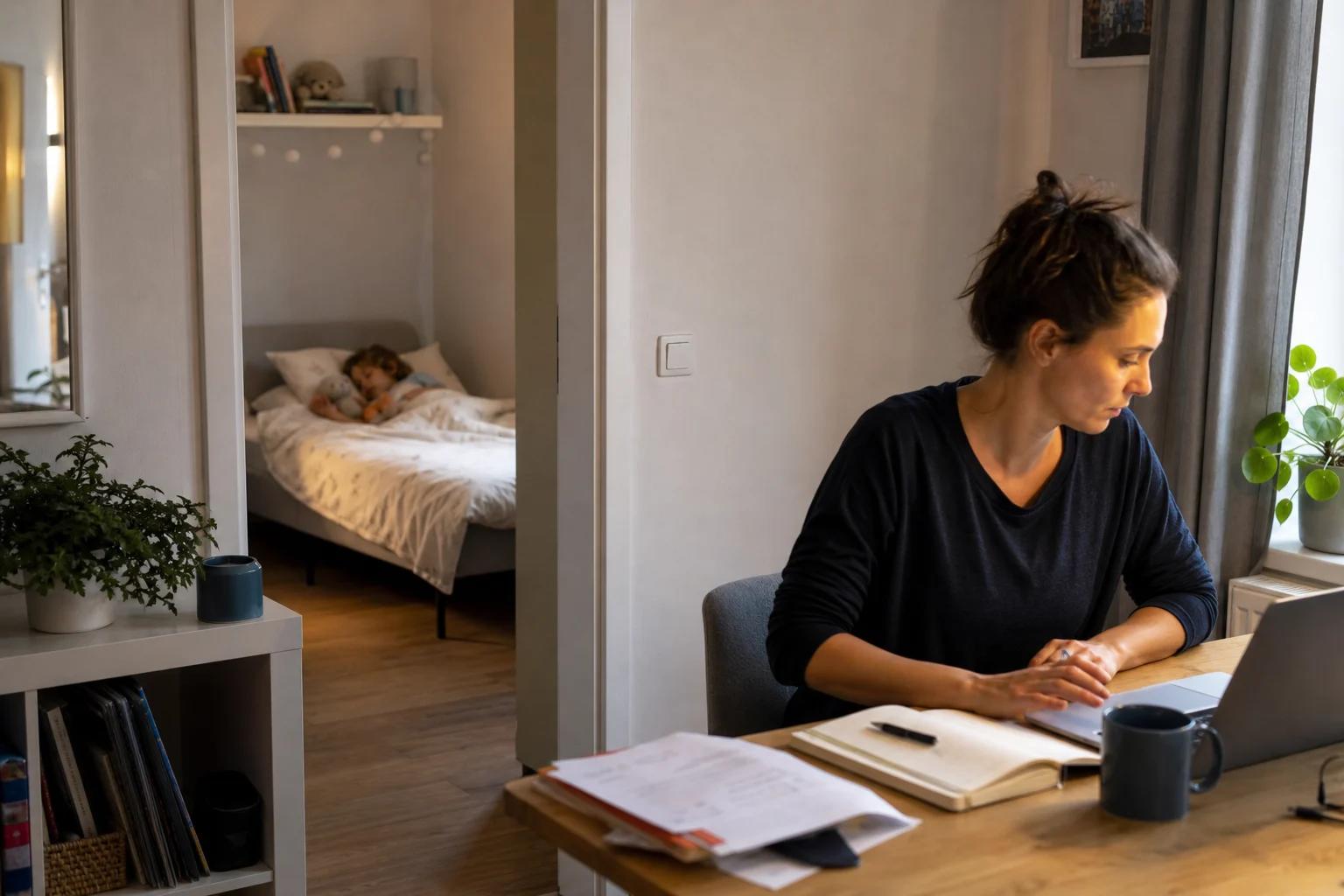
Sleeping and retreat
A separate sleeping area helps to keep different daily rhythms from working against each other. For families, this is important when a child goes to bed earlier or when the parents do not want to use the same room for work and relaxation every evening.
Working and learning
A home office does not require a large-scale office area, but it does need a work zone that does not have to be constantly converted for other purposes. A fixed table, a sufficiently quiet spot in the room, and space for a laptop, documents, and chargers prevent the living area from becoming a permanent makeshift solution.
Time together
The second room should not just be left over as a place to sleep, but should be deliberately planned for shared living. This can be an area where people eat, play, or work together for a short time. For families, this clear division of roles is often more important than an open-plan concept because it reduces everyday conflicts.
Which furnishing details are really relevant for everyday family life?
For two-room long-stay accommodation, the furnishings should answer three questions above all: Where do we work? Where do we store things? And where can individual family members retreat?
So look for more than just furniture in the photos. Helpful features include, among others:
- a table that works as a workspace and not just as a storage surface,
- enough storage space for clothes, toys, and documents,
- seating that remains usable over longer periods,
- a room layout that does not spread cables, laptops, and learning materials across the entire room,
- a location that fits daily routes when school, childcare, or work are relevant.
Anyone choosing transitional accommodation with a work area should also ask whether the room can be turned back into a living space after the workday. The less rearranging is needed, the easier it remains to plan everyday life with children.
Apartment, serviced apartment, apartment hotel, or hotel: what should families compare?

For a longer stay, an apartment, serviced apartment, and apartment hotel can all be suitable options. A hotel can also make sense if the room size, layout, and stay situation fit. What matters first is therefore not the label, but the specific combination of furnishings, services, location, and transparent total costs.
Families should compare whether the accommodation is more geared toward independent living or toward more service. Those who organize a lot themselves pay particular attention to room layout, storage space, and working options. Those who want to simplify certain routines are more likely to check which services are available and whether they fit the planned stay. In both cases, it is important not to overlook extra costs: especially for longer stays, it should be clear which services are included in the price and which may be charged separately.
Location also deserves more attention than a quick glance at the map. If routes to school, childcare, the station, or the workplace matter every day, a good location can be just as important in everyday life as an extra square meter. For families, an accommodation is convincing when it not only works inside, but also remains practical in its surroundings.
How does myroom24 help with this search specifically?
myroom24 is an online booking platform on which commercial accommodation providers offer accommodation for private and business users. For families with home office needs, this is especially helpful because you can specify the destination and length of stay and filter available long-stay accommodation by price, location, and furnishings. This makes the shortlist more closely aligned with real everyday needs.
For the context relevant here, myroom24 offers long stays from 28 to 179 nights. This is interesting when a transitional phase cannot be handled in just a few days, but has to be organized over several weeks or months. The range includes rooms, apartments, and houses in commercial accommodation facilities such as hotels, hostels, serviced apartments, and holiday apartments. So if you are not only looking for a classic apartment, you can compare different types of accommodation in one search.
Another practical feature is the instant booking label: such accommodation can be booked without prior approval from the host if available. If a move, a school change, or a new job start has already been scheduled, this can turn the search into a concrete booking decision more quickly.
Which checkpoints should families compare again before booking?
Before you book an accommodation, it is worth a final comparison with family reality. The most important questions are:
- Can sleeping and working happen at the same time without everyone constantly getting in each other’s way?
- Is there a clearly recognizable workplace that does not have to be taken down again on the first day?
- Is there enough storage space for clothes, children’s things, and work materials without the room feeling overcrowded?
- Does the location fit the daily routes that are actually needed during this phase?
- Are the costs transparent enough for you to assess the stay as a whole?
A good test is a typical weekday: if you imagine when someone will sleep, when someone will work, and when everyone needs to be in the same room together, it quickly becomes clear whether the accommodation really suits your situation or only works on paper.
If you want to compare such criteria in an organized way, start with the myroom24 accommodation and check the offers specifically for length of stay, location, and furnishings.
Frequently asked questions
How can I tell whether a work area in the living space is sufficient for a longer period?
It is sufficient if there is permanent space for a laptop, documents, and chargers and the area does not have to be rearranged every time. The important thing is that the workspace does not block family life.
How can I see that two rooms are really sensibly separated in family life?
They are sensibly separated if sleeping, working, and time together do not constantly require the same room. Then the daily routine needs less improvisation.
Which criteria should I use to compare an apartment, serviced apartment, apartment hotel, and hotel?
Compare room layout, services, location, and transparent total costs. The name alone says little about whether the accommodation suits your family.
Which details should I keep in mind before booking so that moving in goes smoothly?
Clarify in advance who sleeps where, where work will happen, and how much storage space you need. That way, you can see more quickly whether the accommodation works in everyday life.