Furnished apartment for 1 to 3 months: How people moving house can quickly find a suitable temporary solution

If you are looking for a furnished apartment for 1 to 3 months, you are usually in a transitional phase with fixed dates and little room to maneuver. Perhaps a new job is starting, your current apartment has already been canceled, or moving into your new home is delayed. In that case, it is less about an ideal long-term solution and more about ensuring that the accommodation realistically covers the period and works in everyday life without detours.
To keep the search manageable, it helps to take a clear look at the most important criteria: How long will the stay really be? Which furnishings will be needed every day? How quickly does the booking need to be made? Which location saves time and travel? And which type of accommodation fits your own situation? Anyone who answers these questions in advance will compare offers much more specifically.
For which transition situations is furnished accommodation useful?
A temporary accommodation is especially helpful when two phases of life do not flow seamlessly into one another. Typical examples are a job change, waiting for a new build, an internship, or a move with a gap between the old and the new apartment.
The real question is then not whether the accommodation looks “nice enough,” but whether it practically supports the transition period. If you need to leave early in the morning, you have different priorities than someone who mainly wants to sleep and work for several weeks. If you work from home, you are more likely to need a functional workspace than a purely short-term sleeping option.
It is therefore worth thinking concretely about how the accommodation will be used before searching: Will it only be needed for overnight stays, or will you need to live, cook, and work there normally for several weeks? This distinction is often more helpful than the wording in the listing alone.
Which term really fits: 1 month, several weeks, or 3 months?
The duration is the first checkpoint because it decides whether an offer fits your time frame at all. If you only need about a month, a solution that covers exactly that period makes sense. For a longer transition, living temporarily for 3 months may be more suitable if the need is already roughly foreseeable today.
What matters is not only the length itself, but also planning certainty. Anyone who calculates too tightly comes under pressure when extending the stay or has to move again. Anyone who plans too generously may take on time that is not actually needed. It therefore helps to note the realistic period once before searching: When does the need begin, when is it likely to end, and how much buffer is actually necessary?
The search wording itself can also help. Anyone specifically searching for 1 month furnished living narrows the selection differently than someone searching generically for accommodation. This is especially useful when a precise date is already fixed and the temporary solution should not be thought of too broadly.
Which furnishings does temporary accommodation need in everyday life?

With a furnished apartment, it is not enough that furniture is present. What matters is whether the furnishings really support everyday life for the intended period. A good check question is therefore: Which things would you use regularly in the coming weeks?
Pay attention to points such as these:
- Is there a decent place to sleep?
- Is there a place to work or write?
- Is there storage space for clothes, documents, or luggage?
- Is there a cooking option if you do not want to eat out every day?
- Is the setup sufficient for the duration of the stay without requiring you to add much yourself?
Anyone looking for a furnished apartment instead of a hotel usually wants more independence in daily life. In that case, not every single furnishing is equally important, but everyday usability is. A small kitchen, for example, can be relevant if you are staying for several weeks and do not want to rely on restaurants or delivery services every day.
Which location is most suitable for 1 to 3 months?
For short to medium stays, the location quickly becomes a decisive criterion. Over a few days, a longer commute often matters little, but over weeks and months it does. That is why it is worth looking at the actual routes in everyday life and not just the postal address.
Helpful guiding questions are: How far is the way to work or the training location? How good is the connection to trains or public transport? How often do you need to travel between the accommodation and other fixed places? If you have regular appointments, a functional location is often more important than a particularly central address.
The question of peace and predictability also matters. Anyone organizing a lot during a transition phase often benefits from a location that simplifies routes and does not add extra burden. A seemingly good location is therefore not automatically the best choice if it causes long detours in everyday life.
How do hotel, holiday apartment, and furnished temporary living differ?
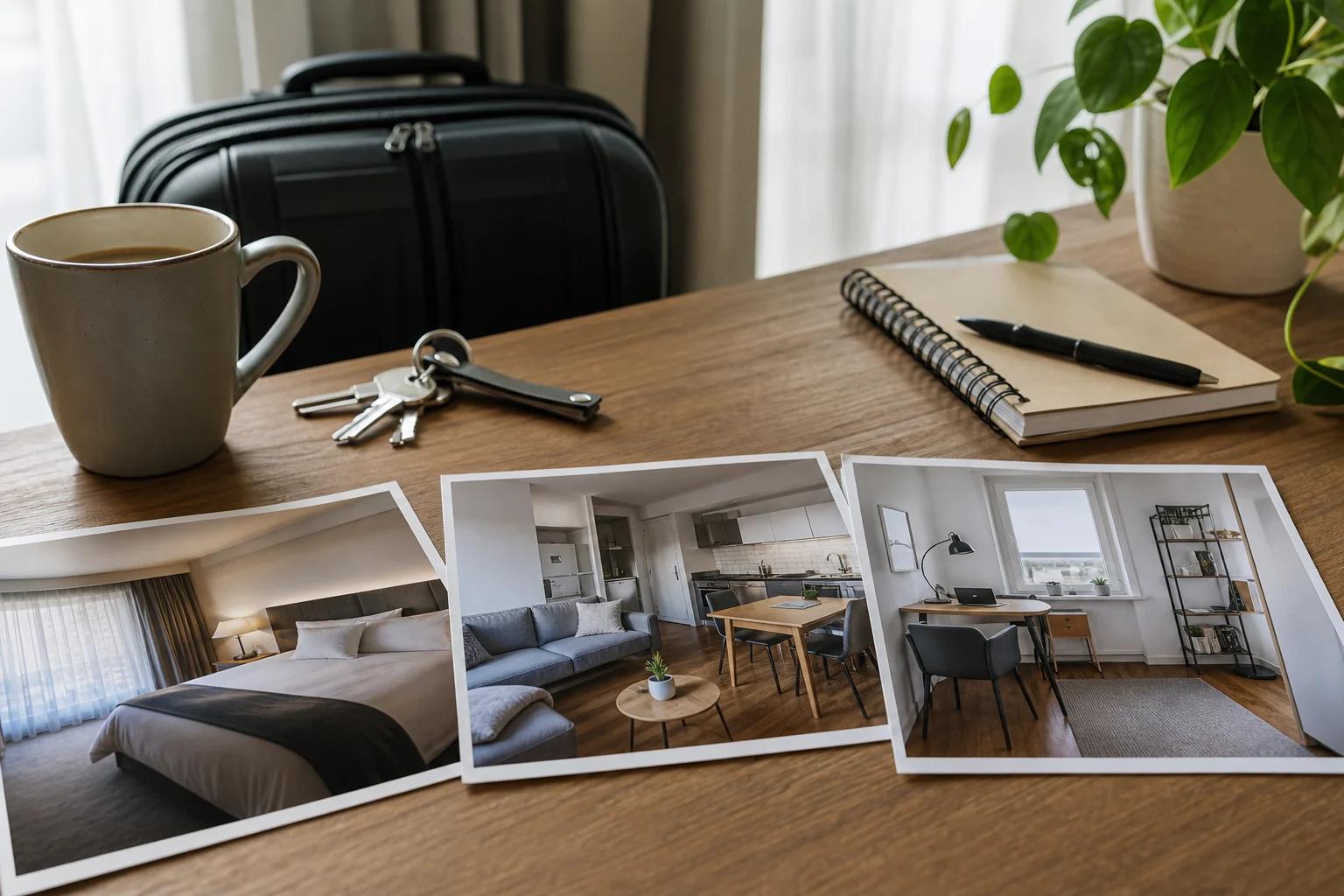
The three types of accommodation serve different purposes, even if they appear similar at first glance.
Hotel: A hotel is usually geared toward short, service-oriented stays. For 1 to 3 months, this can make sense if you want to organize very little and short-notice availability is the priority. For longer phases with an independent daily routine, however, this model can reach its limits in practice.
Holiday apartment: A holiday apartment is particularly suitable when self-catering and an independent daily routine are important. It can fit a temporary stay if the furnishings and location match the need.
Furnished temporary living: This form sits between a hotel and a classic rental apartment. It is designed for living in furnished accommodation for a limited period and for taking the most important everyday functions into account.
The better choice therefore depends less on the term than on the concrete situation: Do you need structure, more independence, or a very fast solution?
How myroom24 can help when searching for temporary accommodation
myroom24 is an online booking platform on which commercial accommodation providers offer accommodations for private and business users. For people in transition situations, this is helpful because the search can be narrowed down according to clear criteria instead of checking every accommodation individually.
The offer includes rooms, apartments, and houses in commercial accommodation facilities such as hotels, hostels, serviced apartments, and holiday apartments. The long stays offered via myroom24 cover 28 to 179 nights. This very range is relevant for many temporary living situations when the stay lasts longer than a few weeks but is clearly limited in time.
Users can specify their destination and length of stay and filter available long-stay accommodations by criteria such as price, location, and furnishings. Anyone looking for temporary accommodation can therefore focus the selection on the factors that really matter in everyday life. In suitable cases, an accommodation marked for instant booking can also be booked directly, provided it is available and does not require prior approval from the host.
Which decision helps most in practice?
If you are torn between several options, a short three-step approach helps:
- Define the period – How many weeks or months do you realistically need?
- Define minimum requirements – What must the accommodation absolutely provide in everyday life?
- Compare by use rather than by label – Which type of accommodation best covers your situation?
An example: Anyone needing a temporary solution because of a job change usually pays more attention to routes, timing, and the working day. Anyone waiting to move into a new build is more likely to check the predictable duration and the question of how independently the stay should be organized.
If you clarify these questions in advance, you will not decide based on the nicest listing, but on the actual benefit for your period. A suitable overview is provided by myroom24 accommodations if you want to narrow your search by duration, location, and furnishings.
Frequently asked questions
How do I know whether I should plan for 1 month or rather 3 months?
Base your decision on the realistic end date of your transition, not on the desired date. If the move-in, project end, or apartment handover is still uncertain, only plan as much buffer as is truly necessary for organizational reasons.
When is a hotel solution rather impractical for a longer transition?
When you want to live independently for several weeks or months. Then kitchen facilities, storage space, and a practical everyday routine often matter more than classic hotel services.
Which furnishings are often more important for a month than for a short stay?
Above all, cooking facilities, storage space, and a place to work. These points become more relevant with a longer stay because you are not using the accommodation only for sleeping.
What should I document when moving in if I am only staying for a few months?
Compare the accommodation with the booked details and note any existing damage or missing furnishings with the date and a specific description. Report deviations to the responsible contact. Even for a temporary stay, this documentation helps clarify questions when you leave.
What should be clarified first when looking for temporary accommodation: location, term, or furnishings?
First the term, then the minimum requirements in everyday life, and only after that the fine-tuning through location and furnishings. That way you compare offers according to your actual need.