Comparing long-term stays with a balcony or terrace: when outdoor space really pays off for long stays

What changes during a long stay compared with a short trip?
For longer stays, accommodation becomes more of an everyday place. Then it is not only about whether it looks nice outside, but whether the outdoor area fits into your daily routine. Anyone staying for several weeks or months will assess accommodation differently than on a vacation trip: you may work on site, take calls, cook more often yourself, and need space for short breaks.
That is exactly why it makes sense to want to compare long-term stays with a balcony or terrace rather than orienting yourself only by the mere existence of an outdoor area. The real comparison only begins with the question: what exactly does this area bring you in everyday life?
A balcony or a terrace can be helpful if you regularly go outside for a moment to clear your head, eat something, or switch between two work blocks. But if you only look at the area occasionally, other features are often more important: a quiet workspace, good accessibility, reliable WLAN, storage space, and a kitchen that really fits your usage habits.
Which everyday situations make outdoor space truly valuable?
Not every long-stay situation places the same demands. Outdoor areas are especially relevant when your stay consists of several recurring routines and you deliberately divide the living space into functional areas.
1. When you work from home or in a hybrid setup
Anyone who spends a lot of time at a desk often benefits from a clear change between focused work and short breaks. An outdoor area can help because it makes a change of setting possible without much effort. This is especially true if you have many video conferences, longer writing phases, or changing work blocks.
Even so, the interior remains the decisive part of the accommodation. If the table is too small, the chair impractical, or the WLAN not stable enough, a balcony does not solve that basic problem. The outdoor area is then only an addition, not a replacement.
2. When you stay in one place for longer and build routines
During project stays, transition phases, or longer assignments, a fixed daily pattern often emerges: coffee in the morning, appointments or work during the day, dinner, reading, or phone calls in the evening. An outdoor area can support this structure if it is easy to reach and actually usable.
3. When you are traveling with several people
Families or teams do not automatically benefit from more outdoor space either. What matters is whether the outdoor area is suitable for everyday use: can it be used without disturbing the interior? Is there enough privacy? Is it suitable for conversations, short breaks, or breakfast outside? If not, it remains more of a visual feature than a functional part of the accommodation.
Which criteria determine the real value of a balcony or terrace?

An outdoor area only becomes a relevant criterion when it is not just available, but also practical in your specific situation. For that, it is worth taking a look at details that are often only indirectly visible in listings.
Privacy and sight lines
If you want to feel undisturbed outside, size is not the only factor; visibility matters too. A balcony facing the street works differently from a terrace facing the courtyard. Anyone who wants to work, read, or eat there should therefore pay attention to privacy screening, distances to neighbors, and whether the space can really be used comfortably.
Noise, shade, and weather
A nice outdoor area is of little use if traffic, neighbors, or wind make it barely usable. For everyday use, three points are therefore crucial:
- How loud is the surroundings at typical times of use?
- Is there sun, shade, or both at the hours when you want to be outside?
- Is the area still usable in changeable weather?
Especially with an outdoor area long-term stay, this perspective helps because a balcony or terrace only offers real added value if you can use it not just in theory, but regularly.
Access and connection to the living space
It is also important how directly the outdoor area is connected. Access from the living area is often more practical in everyday life than a route through several areas. If you can only reach the area with effort, the likelihood that you will actually use it decreases.
Furnishings and type of use
For the comparison, it is not enough to look at “balcony” or “terrace.” Instead, ask what the area is suitable for: going outside briefly, eating, making calls, reading, or placing plants. A small, well-laid-out area may be enough for that. A larger area, on the other hand, brings little benefit if it stays empty or is impractically laid out.
When are location, WLAN, and kitchen more important than the outdoor area?
There are situations in which the outdoor area is more of a secondary factor. That is not a disadvantage of the accommodation, but a question of priorities.
Location
If you commute daily, attend customer appointments, or have to coordinate family routes, the location often affects your stay more strongly than a nice outdoor area. Then what matters is how quickly you can get from the accommodation to your destinations and how well the connection fits your schedule.
WLAN and workspace
For longer stays, a functioning interior is usually the central benchmark. A balcony only helps if the actual work routine functions reliably indoors. So pay attention to questions such as: Is there a quiet place? Is there enough space for a laptop and documents? Can work be separated from the private area?
Kitchen and self-catering
Anyone who cooks for themselves more often will judge accommodation mainly by the kitchen. In that case, a well-usable cooking area is often more important than an outdoor area that is rarely used. This is especially true when you are not just overnighting, but really living in the accommodation in everyday life.
How do you compare a balcony and a terrace in a listing in a sensible way?
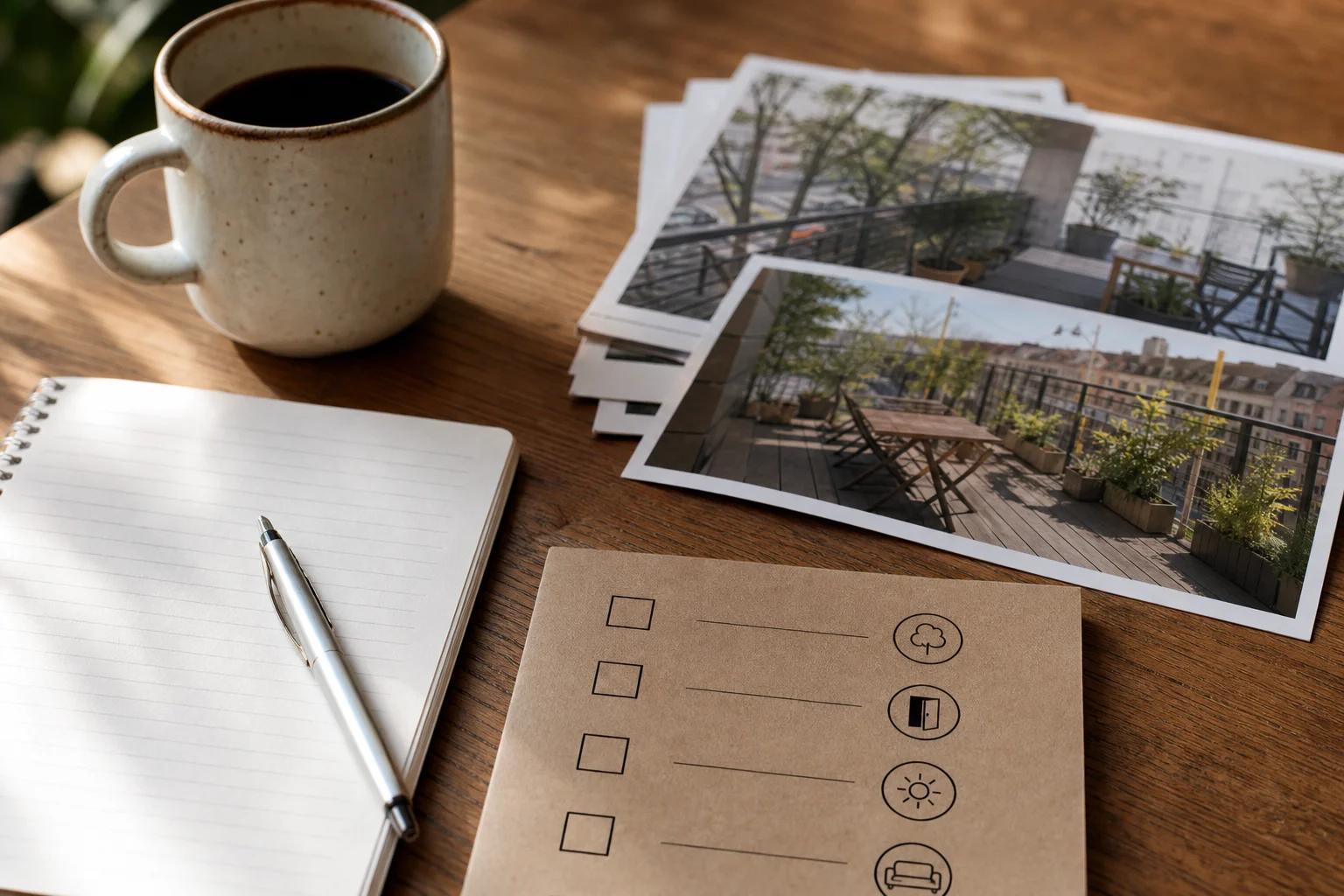
When reading listings, a simple order helps. This prevents a single feature from overshadowing other points as a decision criterion.
Step 1: Clarify your intended use
Do you only want fresh air outside briefly, or should the area be used regularly for meals, phone calls, or short breaks? This question separates comfort from real everyday usefulness.
Step 2: Check the connection between inside and outside
The easier the access, the more likely it is that the area will be integrated into the daily routine. If you first have to unlock doors with effort, go up stairs, or walk through several doors, the practical value drops.
Step 3: Pay attention to the surroundings
A balcony on a noisy street must be assessed differently from a terrace in a sheltered inner area. What matters is not the label, but usability at the right time of day.
Step 4: Compare it with the interior
Sometimes accommodation with a slightly smaller outdoor area is the better choice if the interior is quieter, more sensibly laid out, or better equipped. Especially with a furnished apartment with balcony, the added value only becomes clear in the interaction of all rooms.
How myroom24 helps with this comparison in practical terms
myroom24 is an online booking platform where commercial accommodation providers offer accommodation for private and business users. The range includes rooms, apartments, and houses in commercial accommodation facilities such as hotels, hostels, serviced apartments, and holiday apartments. For long-term stays, myroom24 provides 28 to 179 nights.
For the comparison, it is helpful that you can specify your destination and length of stay and filter available long-term accommodation by criteria such as price, location, and equipment. This allows an outdoor area to be evaluated together with the features that really matter for your stay. Accommodation marked as instant booking can be booked without prior approval from the host, subject to availability.
Especially with offers that include a balcony or terrace, this helps you better assess whether the outdoor area is just an extra detail or whether it really makes a difference in your specific routine. myroom24 therefore does not support the process with a blanket recommendation, but with the search and filter options that structure the comparison.
When is the comparison most useful?
Comparing a balcony and a terrace is especially important when you stay in one place for a longer period and organize your stay around work, rest, and self-catering. Then you should not only look at the outdoor size, but at the practical benefit in everyday life.
If, in the end, you are torn between several options, do not decide first by the label “balcony” or “terrace,” but by the questions: Can I use the area regularly? Is it quiet enough? Does it fit my work or family routine?
If you want to check suitable options, start with the myroom24 accommodation and compare the offers based on your most important criteria.
Frequently asked questions
When is a balcony more useful than no outdoor area for longer work stays?
When you use it regularly for short breaks, phone calls, or a clear change between work blocks. Then it noticeably complements everyday life.
How can I tell whether a terrace in a listing description is really suitable for everyday use?
Pay attention to access, visibility, noise, and weather. Only when the area is quiet and accessible at your times of use does it become practically usable.
Which question is more important for a balcony or terrace than the pure size?
Whether you actually use the area regularly in your typical daily routine. A small, well-located area can be more useful than a large, impractical one.
When should I prioritize location, WLAN, and kitchen over the outdoor area for a long stay?
When commuting, home office, or self-catering shape your daily life. Then location, workspace, and kitchen often determine much more strongly how well the stay works.