Temporary Accommodation in Munich for Families During Renovation or Refurbishment
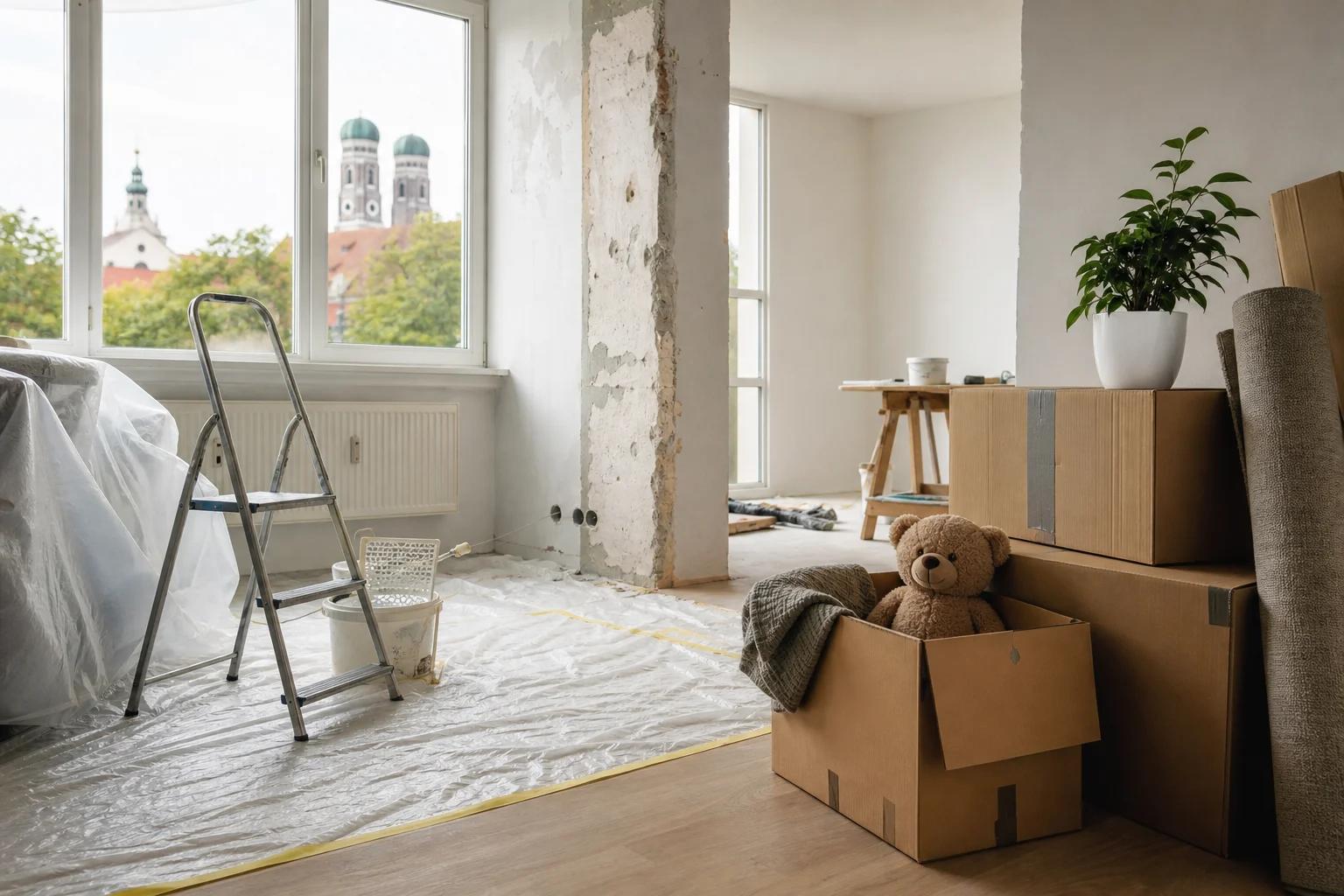
When is temporary accommodation in Munich really useful for families?
Temporary accommodation in Munich for families during renovation or refurbishment becomes relevant when your own home is temporarily not usable in the way family life requires. This can happen, for example, if the kitchen, bathroom, or bedroom are temporarily out of use, if several contractor appointments shape the daily routine, or if dust, noise, and restricted areas make living at home too complicated.
For families, this phase is not just about finding any accommodation. What matters is whether the interim solution really reflects everyday life: Who takes the children where in the morning, how do meals and bedtimes work, and how much organizational effort remains alongside the renovation? The clearer these questions are answered, the easier it is to choose the right temporary apartment.
It helps to organize your own situation into 3 points before starting the search: Does part of the apartment remain usable, or does the family have to move out completely? Is the period relatively easy to plan or still open? And is what is needed mainly more space, more structure, or more support with organization? This classification saves time later when making a choice.
Which location makes family life easier in Munich?
For a family interim solution, a central address is not automatically the best choice. What matters more are the routes that are actually needed every day: daycare, school, childcare, shopping, doctor’s appointments, and, if applicable, the way back to the renovated apartment or to the construction site. If accommodation looks good on paper but in everyday life involves transfers, long waiting times, or impractical connections, it quickly becomes exhausting.
Why repeated routes matter more than a short distance
For families, what counts is the route that is traveled or walked again and again. Accommodation can be close to the construction site and still be impractical if the daily drop-off route to childcare becomes much longer. Conversely, a slightly more distant address may make more sense if it keeps the morning and evening routine stable. Especially with children, the more reliable route is often more important than the shorter straight-line distance.
How public transport and the daily rhythm fit together
In Munich, access to public transport should fit the family’s routine. This is especially helpful when one parent is coordinating appointments, running errands, or also dealing with the renovation. Good connections are not only convenient, but they also reduce the planning effort on days when many things are happening at once anyway.
What makes the surroundings practical in everyday life
In addition to transport links, it is worth looking at the immediate surroundings. A supermarket, pharmacy, and other everyday services within reach make spontaneous errands easier. For families with small children, it may also be important whether the area is quiet enough in the evening so everyone can retreat after a full day. A quiet location does not replace living space, but it often improves the usability of a temporary apartment.
How many rooms and what layout are really sensible?

The question of the right number of rooms depends not only on the number of people, but also on the daily routine. A family with toddlers, school-age children, or teenagers often needs different solutions because bedtimes, study periods, and retreat options look different.
When a compact floor plan can be enough
A single living or sleeping room can only work if the temporary phase is very clearly limited and everyone in the household has a similar rhythm. As soon as one child needs to go to bed earlier, homework needs to be done, or one parent needs to work or make calls in peace, a single room quickly becomes cramped. In that case, the problem is less the size of the space and more the lack of separation in daily life.
Why separate areas make everyday life more stable
Accommodation with separate sleeping and living areas, or with multiple bedrooms, is more practical. That way, part of the family can sleep while others are still reading, working, or preparing for the next day. A furnished apartment in Munich with children is therefore especially convincing when it not only offers space, but also better reflects different phases of the day in spatial terms.
Why storage space is often underestimated during a transition
Families usually bring more than just clothes during a transition. Toys, school materials, strollers, sports bags, and everyday items need space. If storage space is lacking, extra handling and clutter quickly arise. That is why not only the number of rooms, but also the availability of wardrobes, storage areas, and sensible furnishings should be considered.
Apartment, serviced apartment, aparthotel, or hotel: What fits the renovation phase?
For longer stays, an apartment, serviced apartment, aparthotel, and hotel are not rigid opposites. Serviced apartments and aparthotels are just as suitable for long stays as an apartment, if the layout, services, and location fit family life. So the deciding factor is not the category alone, but which form best reflects your own situation.
Apartment: useful when self-organization is the priority
A furnished apartment often works well when the family wants to manage its daily life largely on its own. Then the kitchen, storage space, sleeping arrangements, and a layout that enables routines are especially important. Anyone organizing a lot themselves during the renovation phase benefits from an environment in which not every part of the day depends on additional requirements.
Serviced apartment and aparthotel: suitable when individual services provide relief
A serviced apartment or aparthotel can make sense if, in addition to living space, extra services are offered and certain tasks become easier as a result. For families, this is particularly interesting when the renovation already requires enough coordination and certain organizational steps can be handled more easily on site. Even here, however, size, layout, and location still need to fit the family.
Hotel: also a possible solution for families
A hotel can also be suitable for longer stays if room size, location, and the services offered match the family’s needs. Depending on the property, this can be especially practical when clear routines, service, and a well-connected area are more important than apartment-like self-organization. The right choice therefore does not depend on the label, but on the concrete use in everyday life.
What you should really compare in the costs
More important than a single base price is looking at the total costs and the scope of services. Families should check what is included in the stay and what additional items may arise, such as cleaning, parking, laundry, or extra people. This makes it possible to compare accommodation objectively instead of looking only at the obvious number.
How myroom24 helps with the search for a family interim solution
myroom24 is an online booking platform where commercial accommodation providers offer accommodation for private and business users. For families in Munich, this is especially useful when the search criteria are already clear: the destination and length of stay can be specified, and available long-term accommodation can be filtered by criteria such as price, location, and amenities.
What is especially important for renovation and refurbishment phases is the clear duration: the long-term stays offered through myroom24 cover 28 to 179 nights. This makes it possible to search specifically for an interim solution for the intended period without being distracted by offers outside this range.
The range includes rooms, apartments, and houses in commercial accommodation facilities such as hotels, hostels, serviced apartments, and vacation apartments. In addition, accommodations marked as instant booking can, if available, be booked without prior approval from the host. This allows families to narrow down the selection systematically instead of checking each individual option separately and without filters.
Which booking details should be clarified before moving in?

Especially with children, a well-organized transition is important. That is why it is worth clarifying not only the accommodation itself before booking, but also the process: When is move-in possible, how does the key handover work, and how is departure organized? If furniture or personal belongings also need to be collected from the old apartment, that schedule should be factored in as well.
What matters when the renovation timeline is uncertain
If the exact completion date of the work is still open, it should be clarified in advance how an extension is handled. Families benefit from knowing how early they need to ask and whether the existing accommodation can continue to be used if needed. This reduces the pressure of having to search all over again in the middle of the project.
Which questions are especially worth asking before moving in
The most helpful questions are concrete ones about the process: How is the handover appointment arranged? Is there a clear contact person? How flexible is the arrival time? And how are sleeping arrangements and storage space for children organized? The better these points are clarified in advance, the more calmly the family can start the transition phase.
Conclusion: Which decision families in Munich should make now
Anyone living temporarily in Munich during renovation or refurbishment should not base their choice on a single feature. What matters is the combination of a location that works for everyday life, a suitable number of rooms, the right type of accommodation, and a clearly organized move-in. When these points fit together, the interim period becomes much easier to plan.
If you want to narrow down suitable options by location, amenities, and length of stay, start with myroom24 Unterkünfte vergleichen.
Frequently asked questions
What matters more for families: proximity to the construction site or to daycare and school?
Usually the route that comes up every day matters more. If drop-off and pick-up routes are fixed, the accommodation should above all make that routine easier.
When is a furnished apartment enough for a family, and when are separate bedrooms more useful?
A compact floor plan is enough only for a very short, clearly defined transition phase. As soon as sleeping, learning, or working happen in parallel, separate areas are much more practical.
How can you tell whether a serviced apartment or aparthotel suits the renovation period?
If you want to combine living space with additional services, the layout is decisive. Check whether the size, sleeping arrangements, and suitability for everyday life fit the family.
Which arrangements should be clarified before booking if the renovation period is still uncertain?
Clarify the exact period, the possibility of an extension, and the process for move-in and handover. This helps you avoid unnecessary double planning.
When can a hotel be a suitable solution for families during renovation or refurbishment?
When the room size, location, and services fit your everyday life. A hotel can make sense when clear routines and services are more important than self-organization.