Organizing worker accommodation for long projects: how companies find the right solution for teams staying 28 nights or more

When a job does not end after a few days, but runs for several weeks or months, the accommodation itself becomes part of project organization. Then it is not enough to simply look for a free bed. Companies need a solution that fits the team size, the assignment duration, and the process on site.
This is exactly where typical friction arises in longer projects: questions about room occupancy, unclear responsibilities, extra travel to the job site, or missing information for accounting. Anyone who sorts out these points before making an inquiry reduces the later coordination effort between dispatch, site management, and administration.
Which questions should be clarified first before starting the search
Before comparing offers, the internal need should be described as specifically as possible. It sounds simple, but it prevents many misunderstandings when making an inquiry.
These three guiding questions are especially helpful:
- How many people need accommodation?
- For what period is the accommodation needed?
- Which conditions are important at the job site?
For worker accommodation for long projects, it is particularly useful to collect this information not just roughly, but in a form that can be used directly for inquiries. Anyone who compiles the requirement cleanly can compare offers more quickly and avoid follow-up questions that cost time in day-to-day operations.
Which room layout really supports the project routine
The room layout is often more decisive in long-term assignments than in short trips. A team working together on one construction site does not automatically need the same arrangement as a group with different shifts, staggered working times, or changing trades.
That is why the number of people should not be the only thing fixed before booking; the desired structure of the accommodation should also be defined. Depending on the project, this may mean that single rooms are preferred or that several employees should share one accommodation.
In practice, this means the room question belongs early in the planning. If it only comes up when reviewing an offer, accommodations are quickly judged by availability instead of assignment logic. Especially for a worker apartment for a long stay, this is a common mistake because the later use matters more than the first impression in the listing.
Which equipment should be defined in advance for longer assignments
Over several weeks or months, it is rarely about comfort details. What matters are functions that directly affect everyday life at the project location. These include, above all, cooking facilities, Wi-Fi, a washing machine, and parking spaces or other suitable storage options.
The right preparation starts with a few simple questions:
- Can employees cater for themselves on site?
- Is Wi-Fi needed for coordination, documentation, or communication?
- Does laundry need to be washable during the stay?
- Are parking spaces for vehicles or vans required?
Not every accommodation has to cover all of these points. What matters is that companies clearly separate essential from optional criteria before making an inquiry. This makes later comparisons more targeted instead of evaluating offers only by photos or first availability.
Why the location relative to the job site shapes the process more than a single price factor
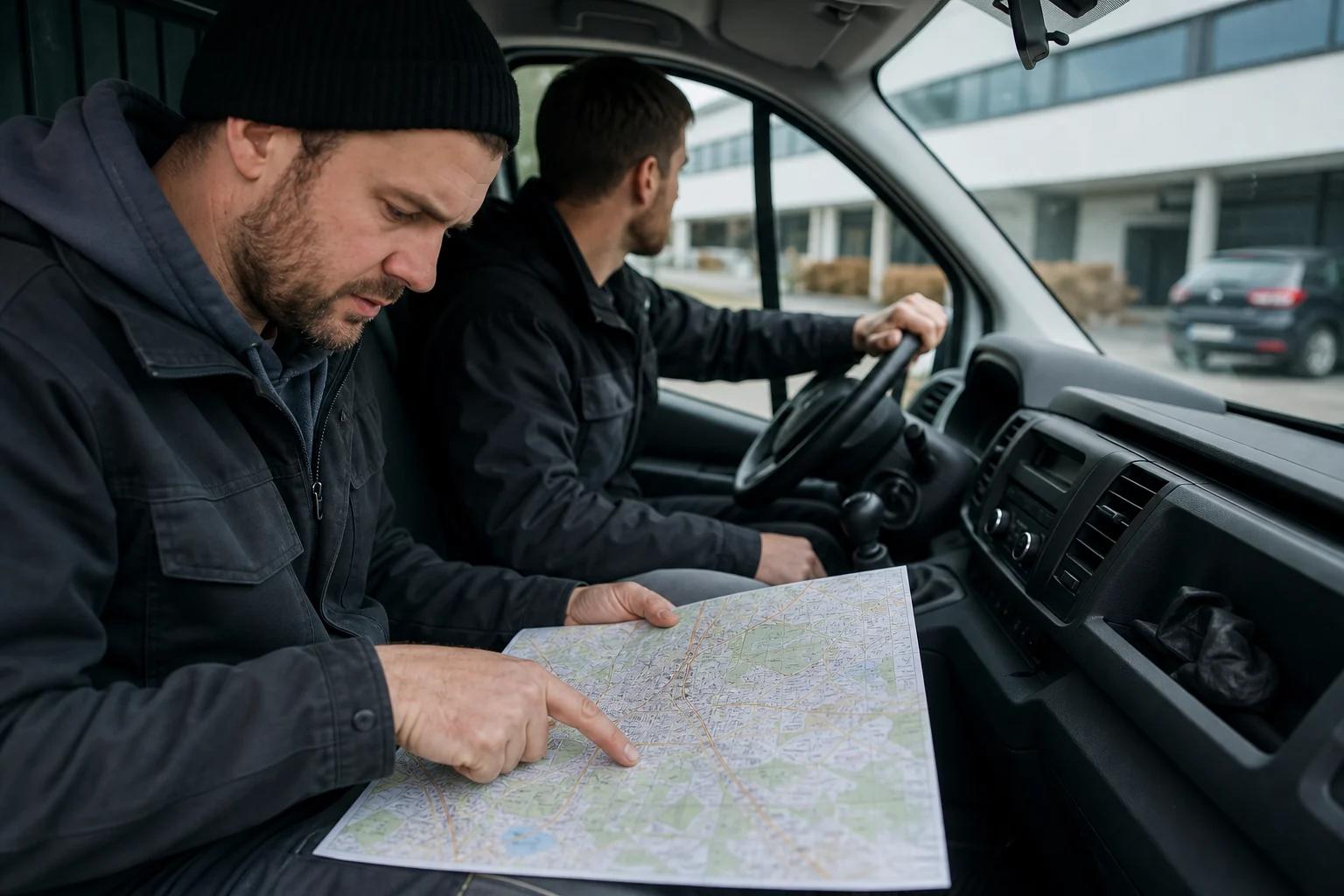
For workers and technicians on assignment, long travel distances influence the whole day: commuting, shift changes, material transport, and the return journey all have to fit together organizationally. That is why location should never be viewed in isolation, but always in relation to the actual job site.
For selection, this means not only checking the address, but also thinking through the work process. Is the accommodation located so that the daily commute remains realistic? Can parking and access be handled practically? Do the routes still work with early starts or late returns?
Anyone organizing a worker accommodation in Germany for longer assignments should ask these questions early. An accommodation that looks suitable on paper can create unnecessary effort in practice if the location does not match the shift or assignment logic.
How to set billing path and responsibilities cleanly before booking
For companies, accommodation is not only a question of availability, but also of internal processing. Before booking, it should be clear who approves the inquiry, which billing details are used, and who receives the booking documents.
This is especially important when several employees are traveling at the same time or several projects are running in parallel. Then clear assignment is needed so that invoices, booking data, and project documents match later on.
A simple pre-check can include these points:
- Who is responsible for the booking internally?
- Which company or cost center should appear on the invoice?
- Who receives the confirmation and further documents?
- How are changes documented?
These questions sound formal, but they save a lot of coordination time, especially in longer projects. Anyone who defines the billing logic in advance prevents accounting and project management from later working with different versions.
Which type of accommodation fits which long-term project
Not every company accommodation is suitable for the same purpose. What matters is whether the type of accommodation fits the project and the team structure. myroom24 arranges accommodations from commercial providers in different forms, including rooms, apartments, and houses in hotels, hostels, serviced apartments, and holiday apartments.
This range is especially relevant when projects are organized differently. A small team with fixed working hours often needs a different structure than a group with several shifts or changing job sites. That is why the type of accommodation should always be checked against the actual need: How many people are staying together, how are rest periods organized, and which routes are created in everyday life?
Checklist for dispatchers and site managers before the inquiry

An example of a usable request for requirements
An inquiry becomes more precise when necessary conditions are separated from mere wishes. The following example is fictional and does not describe any specific accommodation offer:
"Accommodation is needed for four employees for 42 nights at the project site. Two people work early, two start later. Separate sleeping areas for the two daily rhythms are required. Usable cooking facilities are a must. A parking space for the van would be desirable; its suitability must be confirmed based on the vehicle dimensions."
This makes it possible to ask targeted questions: How are the sleeping areas separated? What cooking facilities are actually available? Is there suitable access and parking space? If a requirement is missing, the offer is not suitable at first. If only a desired feature is missing, a confirmed alternative can be checked. This distinction prevents an unimportant extra from masking a missing basic requirement.
Keep confirmed details and open questions separate
For each decisive point, note whether it is shown in the offer, confirmed by the provider, or still open. A mere assumption from a photo should not be counted as a confirmed feature in the comparison. This applies especially to parking spaces, accessibility, and separate sleeping areas.
If several people are evaluating offers, a brief shared record of the decision helps. Not only the selected accommodation should be documented, but also confirmed alternatives and the reasons for excluding other options. If a change is needed later, the comparison does not have to be started from scratch.
How myroom24 can structure the search for long-term accommodation
myroom24 is an online booking platform where commercial accommodation providers offer accommodation for private and business users. For project teams, it is especially relevant that the long-term stays offered cover 28 to 179 nights.
For the search, this means companies can specify the destination and length of stay and filter available long-term accommodations by criteria such as price, location, and equipment. This is especially helpful when several assignments are being prepared in parallel or when different team sizes have to be considered for one location.
An accommodation marked as instant booking can be booked without prior approval from the host, if available. For planning, this is especially relevant when a clearly defined need has to be implemented quickly. myroom24 does not replace internal approval or project planning, but it can clearly organize the selection of suitable options.
Which workflow has proven effective for recurring projects
After an assignment, concrete feedback can be used to learn. Ask the team for factual observations: Was the commute practical at the actual shift times? Did the accommodation match the confirmed details? Was there an organizational problem with access or departure? Record the answers in relation to the respective assignment instead of collecting only a general rating.
A good experience is not a permanent commitment for the next stay. Availability, occupancy, prices, and special requirements must be confirmed again for each new booking. A different van or a changed shift pattern can also make a previously suitable location less appropriate.
For handover between dispatchers, open items are also important: Is there still an unanswered question about the invoice? Was a deviation reported at move-in? Is there feedback pending regarding a deposit that may have been lodged? This keeps it traceable after the project ends what has been completed and who is taking care of the rest.
Conclusion: what makes the biggest difference in long projects
Anyone who wants to organize worker accommodation for long projects should first collect the requirement cleanly and then look at location, room layout, equipment, and billing path together. The best solution is not automatically the one that requires the least effort in the inquiry, but the one that actually works in practice.
If you are preparing the next long-term assignment, start with a clear overview of requirements and check suitable accommodations in a structured way. A suitable entry point is the overview at myroom24 accommodation.
Frequently asked questions
What information should a company record before requesting worker accommodation?
Important details are the number of people, length of stay, job site, desired room layout, and required equipment. For internal processing, billing details and responsibilities should also be clear.
Why should the room layout be decided before comparing options?
Because it directly affects the project routine. Depending on team structure, shift model, and rest periods, a different layout may make more sense.
Which equipment questions are especially important for long-term projects?
Above all, a kitchen or cooking facilities, Wi-Fi, a washing machine, and parking options. These points directly affect the process at the job site.
What role does the location of the accommodation play in longer assignments?
Location affects commuting, the return journey, shift changes, and planning reliability. It should therefore always be assessed together with the job site.
What should a worker accommodation offer when work clothing and materials are brought along?
Clarify in advance where work clothing can be washed or dried and which items may be stored in the accommodation. Ask if tools or bulky materials are to be brought along. Photos or room size alone do not provide a reliable indication of storage options.