Private room for a while: When a room, apartment, or hotel fits
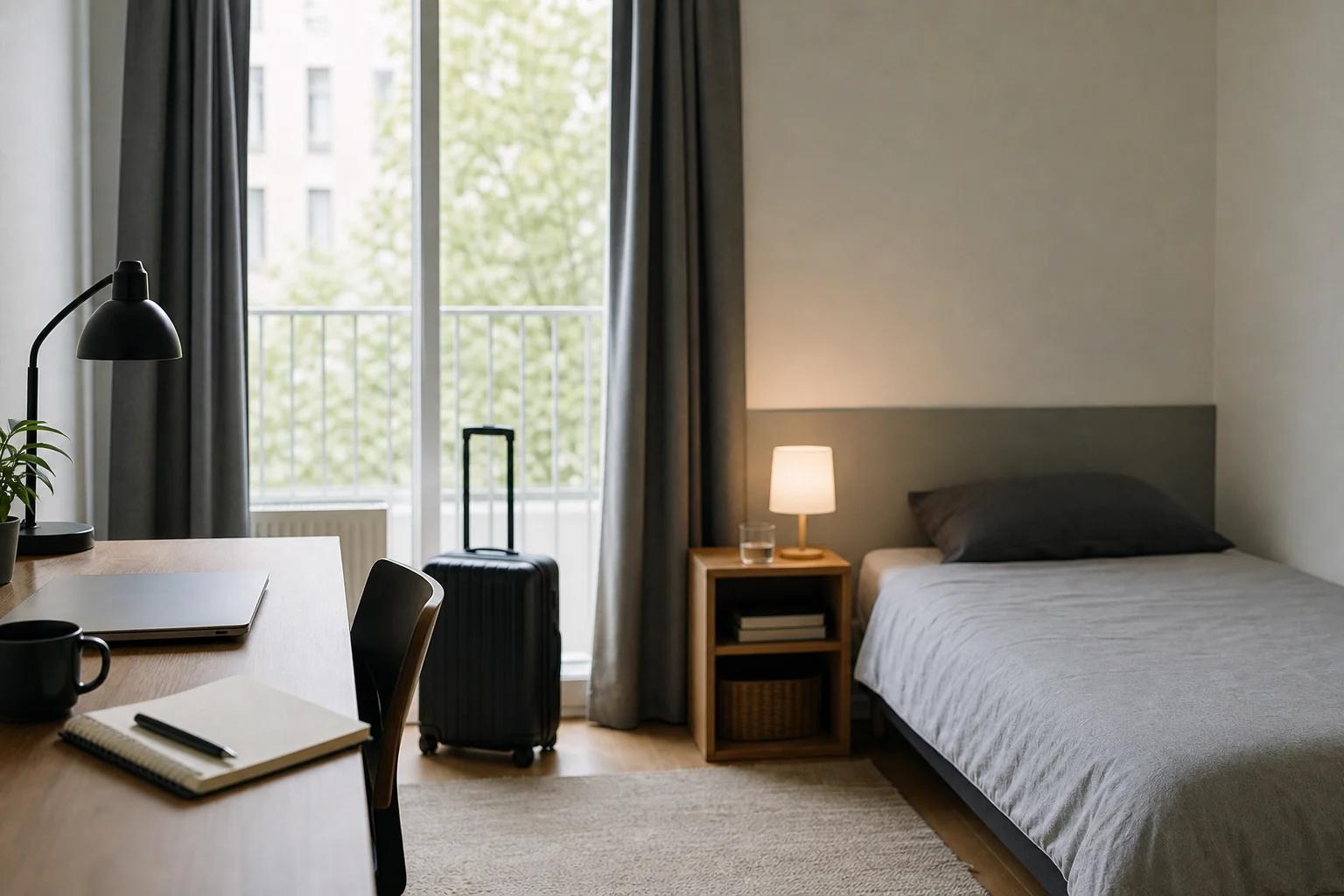
What is the choice between a room, apartment, and hotel about?
A private room for a while is not simply the smaller version of accommodation. The key question is: What tasks should the space serve over several weeks? Is it enough as a place to sleep and a private retreat, or must it also make work, sorting, phone calls, and longer periods of rest possible?
This is exactly where the decision often splits between a room for a while, a furnished room, an apartment, and a hotel. These options differ less by name than by their purpose of use. A room is especially suitable when you only need part of your daily routine to take place in the accommodation. An apartment or apartment hotel is more interesting when you want to combine several functions in one place.
For the choice, the helpful question is therefore not the general one, “What is better?”, but the more specific one: Which activities must work there without constant rearranging?
Which criteria separate a room and an apartment in practice?
Most wrong decisions are not caused by too little comfort, but by weighting individual features incorrectly. Anyone who looks only at size often overlooks that everyday practicality consists of several parts.
1. How much must the space switch between sleeping and working?
If you regularly work in the accommodation, do not just check whether there is a surface for a laptop or documents. More important is whether you can divide the room mentally and practically into two uses. As soon as the bed is at the same time a place of rest, a storage surface, and an occasional workspace, the organizational effort increases.
2. How much quiet do you really need?
Quiet is more than “not loud.” It also means whether you can read, make phone calls, or switch off after a long day in a focused way. Anyone who often switches between outside and inside activities often needs a clearer separation than someone who only comes back to sleep.
3. How much service do you want to handle yourself?
An apartment, a hotel, or a serviced apartment can make sense when certain routines should not have to be organized in addition. This can become especially relevant when you have little time for everyday small tasks during your stay. Conversely, a room is suitable when you can manage with a few well-planned routines.
4. How important is a stable work surface?
For some stays, a compact table or a small shelf is enough. For others, it is crucial that documents, technology, and notes can remain in place for days without having to be cleared away all the time. The question is therefore not only whether there is space, but whether you can pick up where you left off there in peace without reorganizing every morning.
When is a private room for a while enough?

A long-stay room is usually enough when the accommodation covers only a clearly defined part of your day. This is typical when you spend most of the day away and use the space mainly for sleeping, changing, and briefly sorting things out.
A room is especially suitable if these points apply to you:
- You spend many hours away from the accommodation.
- You do not need a permanently set-up workspace.
- You only want to keep a few personal items within easy reach.
- You want a private area without the room having to cover several usage zones.
- You cope well with a simple, recurring daily routine.
A furnished room is therefore not a “fallback solution,” but the right form for a clear usage framework. Anyone who spends little time in the accommodation often does not need an additional living zone. Then what matters most is that sleeping, changing, and short breaks work without friction.
Example: A room is enough when the day happens elsewhere
Take a project stay with fixed appointments outside: leave in the morning, meetings during the day, back in the evening, work a little more, and then sleep. If you hardly leave things out and do not plan longer periods of rest in the room, a room is usually the logical choice. The added value of a larger living form only arises in this scenario when you truly have to spend hours there.
When does an apartment or apartment hotel make more sense?
More space is not automatically the better choice. It becomes sensible when the space has to carry several demands at once. This mainly affects stays in which you do not only sleep, but also work, plan, make calls, or simply spend longer periods in the accommodation.
An apartment or apartment hotel often makes more sense when:
- You regularly work at a table or desk during your stay.
- You do not want to rearrange the room every evening.
- You need a clearer separation between rest and activity.
- You spend longer periods in the accommodation, for example between appointments, workdays, or courses.
- You need a baseline condition that still stays tidy after several days.
Serviced apartments and apartment hotels can also be just as suitable for long stays as an apartment, if the room layout, location, and services fit your everyday life. This is especially interesting when you do not only want more space, but a different kind of usability: less daily switching, clearer storage, and an environment where work and relaxation do not constantly blend into each other.
A hotel can also be suitable if you place higher value on specific services or a particular location than on your own living zone. The useful comparison is therefore not “hotel versus apartment,” but: Which structure best supports your daily routines?
What role does the location play?
For longer stays, location quickly becomes an everyday factor. Good transport connections help not only once, but again every day. If you regularly travel to the office, construction site, campus, or appointments, a shorter route can be more valuable than additional space.
Conversely, a room loses its advantage if you spend a lot of time commuting or rescheduling every day because of it. That is why location should always be considered together with the usage profile: How often are you really on site, and how often do you need the space as a work or rest point?
What cost logic makes sense for 28 to 179 nights?

For 28 to 179 nights, it is not only the room you can book that matters, but the entire use over weeks. That is why the most important cost question is not which category seems cheaper at first glance, but which solution maps your everyday life with as little additional effort as possible.
To compare this, look at three levels:
1. What do you have to organize yourself every day?
If you have to rearrange clothes, technology, and documents often, the effort in everyday life increases. In that case, the pure square meter count is not decisive, but rather whether the space stays organized in a lasting way. An apartment can therefore make more sense if you need a stable work and retreat mode there for weeks.
2. Which services do you actually use?
For hotel or apartment-hotel solutions, a closer look at the services is only worthwhile if you really use them in everyday life. More relevant than a long list of features is the question of whether the services actually support your routine. What you do not need regularly also does not change your daily use.
3. How transparent is the overall use for your stay?
When choosing, think not only about the room, but about the entire stay logic: routes, working time, need for rest, and the effort you have to take on yourself. An accommodation is often suitable when its structure fits your daily routine and you do not constantly have to work against its layout.
How myroom24 helps with the selection in practice
myroom24 is an online booking platform where commercial accommodation providers offer accommodations for private and business users. For deciding between a room and an apartment, this is practical because you can compare different types of accommodation side by side in one search.
On myroom24, you can specify your destination and length of stay and filter available long-stay accommodations by criteria such as price, location, and amenities. This is especially helpful when you are not only looking for a room, but want to compare specifically whether an apartment, a hotel, or another furnished offer fits your stay pattern better.
The offer includes rooms, apartments, and houses in commercial accommodation properties such as hotels, hostels, serviced apartments, and holiday apartments. The long-stay options offered via myroom24 cover 28 to 179 nights. If an accommodation is marked as instant booking, it can be booked subject to availability without prior approval from the host.
Which final check routine prevents the wrong choice?
Before booking, a short reality check with three questions is worthwhile:
- Can I work, sleep, or get ready there for several weeks without daily rearranging?
- Does the location fit the routes I will really have several times a week during the stay?
- Do I actually use the possible services or the additional space, or does the solution only look better on paper?
If you answer these questions honestly, the choice usually becomes clearer. A room for a while is suitable when the space mainly covers retreat and sleep. An apartment or apartment hotel is more suitable when you want to organize several uses side by side there.
If you would like to compare the options now, take a look at the myroom24 accommodation and narrow your search by duration, location, and amenities.
Frequently asked questions
When is a private room for a while enough despite a stay of several weeks?
When you spend most of the day away and mainly need the space for sleeping, changing, and briefly sorting things out.
How do I tell whether an apartment hotel makes more sense for my stay?
When you need to clearly separate work and rest in the space and do not want to rearrange everything every evening.
Which location question is most important for 28 to 179 nights?
How often you repeat the same route: the more trips per week, the more a good connection matters.
How do I check whether services really support my stay?
Only the services you would use regularly are relevant. Everything else usually does not noticeably improve your everyday life.