Temporary Accommodation for Auditors, Experts, and Plant Inspectors: The Right Solution for Time-Limited Assignments

Which accommodation is suitable for an assignment with a fixed duration?
For audits, technical inspections, or assessments, there is rarely an open-ended stay without a fixed framework. In most cases, the assignment location, period, and objective are clearly defined. That is exactly why accommodation should not be considered only at the end of planning, but in parallel with assignment organization. Anyone planning temporary accommodation for auditors, experts, and plant inspectors should first understand the workflow: Are there several appointments at one location? Does travel between the plant, office, and meeting room need to happen? Is there still time after the appointment for documentation or coordination?
Depending on the assignment profile, different types of accommodation may be suitable. A room can be enough for very compact appointments if the focus is on functional overnight stays. An apartment or self-contained unit offers more structure when documents, a laptop, quiet working phases, and several days in one place come together. Serviced apartments and apartment hotels are just as suitable for longer stays as a flat, provided that location, amenities, and duration match the actual need.
Which questions should companies clarify first before booking?
A good decision depends less on the hotel category than on the practical requirements of the assignment. For inspection teams, the most helpful questions are concrete ones that reflect day-to-day work on site.
What does the day look like after the appointment?
Anyone who still writes reports, compares notes, or answers internal follow-up questions after the site visit needs more than just a place to sleep. In such cases, quiet, a suitable place for documents, and a clear separation between work and relaxation areas are important. This is especially true for assignments lasting several days and not consisting of just a single on-site appointment.
How far is the accommodation really from the assignment location?
It is not the address alone that matters, but the actual accessibility with the means of transport used for the assignment. For auditors and plant inspectors, a short route can be important when the day starts early, several locations are scheduled on one day, or a quick move between inspection sites is planned. Evening travel should also be realistically manageable if the schedule is tight.
Which amenities specifically support the inspection work?
A business apartment for inspectors makes sense when it supports the working rhythm. Depending on the assignment, this includes not only furniture, but above all suitable conditions: quiet, a practical workspace, and enough structure for documents and equipment. Anyone who is only on site for a few hours needs different conditions than someone reviewing data or preparing evidence over several days.
How should internal billing work?
For companies, not only the accommodation itself matters, but also the organizational process behind it. Billing details should be complete so the booking can be assigned clearly. Equally important is a clear division of roles: Who obtains approvals, who books, who checks the invoice, and who documents the stay internally? If these points are clarified in advance, fewer follow-up questions arise during the assignment.
What happens if the appointment is postponed?
Schedules can change, especially for inspections and audits. That is why it should be clear before booking who approves additional nights or changes to the stay and how such changes are passed on internally. This is especially helpful when several departments are involved and not every short-term adjustment is meant to be coordinated again.
When is temporary accommodation especially useful for auditors and experts?
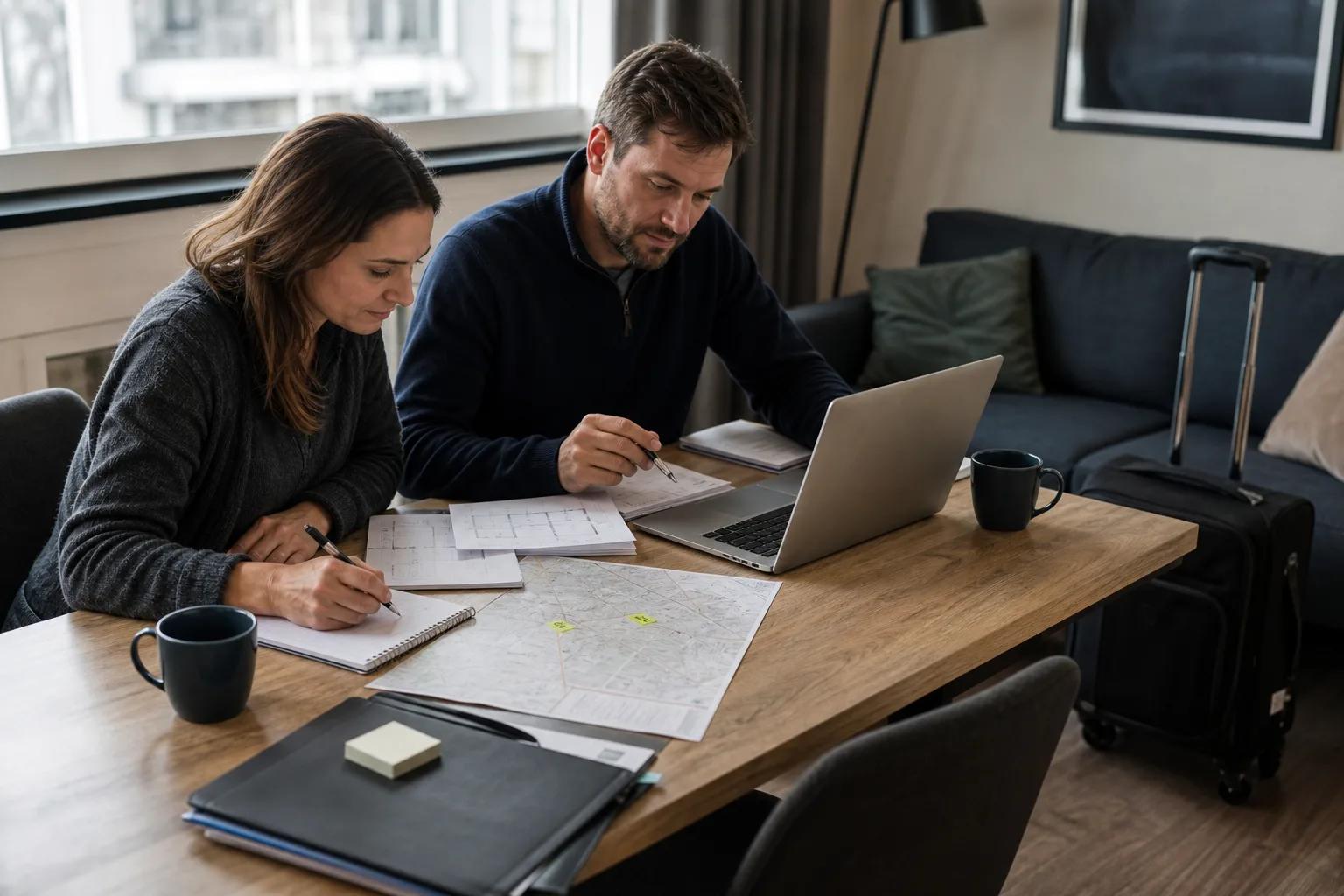
Temporary accommodation is especially useful when an assignment lasts several days or weeks and the overnight stay is closely linked to the workplace. This applies, for example, to plant inspections, site audits, or technical assessments with several appointments at one location. In such cases, accommodation can be aligned more closely with the assignment workflow than a purely spontaneous day-by-day decision.
For companies, planning reliability is particularly important here. Instead of organizing individual nights separately, the entire period is treated as one continuous assignment block. This makes coordination between assignment management, specialist department, purchasing, travel management, and accounting easier. At the same time, recurring standards can be defined: Which location is suitable for which sites? Which amenities are regularly needed? Who decides if the schedule changes?
For recurring assignments with several inspectors or experts, clarifying roles within the team is also helpful. An accommodation for experts does not have to meet the same requirements as accommodation for a larger project team. Sometimes a quiet retreat close to the assignment location is enough; sometimes a somewhat larger unit is sensible if documents, coordination, or several work phases need to be accommodated.
How myroom24 can support such assignments in practice
myroom24 is an online booking platform where commercial accommodation providers offer accommodation to private and business users. The range includes rooms, apartments, and houses in commercial accommodation facilities such as hotels, hostels, serviced apartments, and vacation apartments. For inspection assignments, what matters most is that users specify the destination and length of stay and can filter available long-term accommodation by criteria such as price, location, and amenities.
For auditors, experts, and plant inspectors, this is useful when the location and period are already fixed and the accommodation should be aligned with the actual assignment. The long-term stays offered via myroom24 cover 28 to 179 nights. This makes it possible to structure temporary accommodation for multi-week assignments without having to plan each night individually.
How companies can organize accommodation, travel, and extensions efficiently
For a clean organization, not only the booking itself matters, but also the interface with travel planning and internal approvals. A practical process starts with a few clear decisions:
- Assignment department defines location, duration, and minimum requirements.
- Travel booking or purchasing checks who books the stay and which internal guidelines apply.
- Administration or accounting ensures that billing details are transmitted completely and correctly.
- Assignment management records who should be contacted in the event of changes.
A simple escalation path for short-notice changes is also helpful. If the appointment is postponed, it should be clear whether assignment management, the specialist department, or the booking office is informed first. This helps companies avoid unnecessary follow-up questions between multiple departments.
A practical example: an inspector arrives for three days, but the final on-site coordination is postponed by half a day. If it has already been clarified which department approves extensions and how the information is passed on to the booking office, the stay can be adjusted in an orderly way. That is much more efficient than clarifying changes only at the end of the day.
Travel should also not be considered in isolation. If an assignment starts early, the accommodation must be selected so that arrival, check-in, and the first appointment fit together. This is exactly where it makes sense to connect travel booking with accommodation planning: anyone who checks arrival times, location, and appointment windows together avoids unnecessary routes and idle waiting times.
Which type of accommodation fits which inspection scenario?
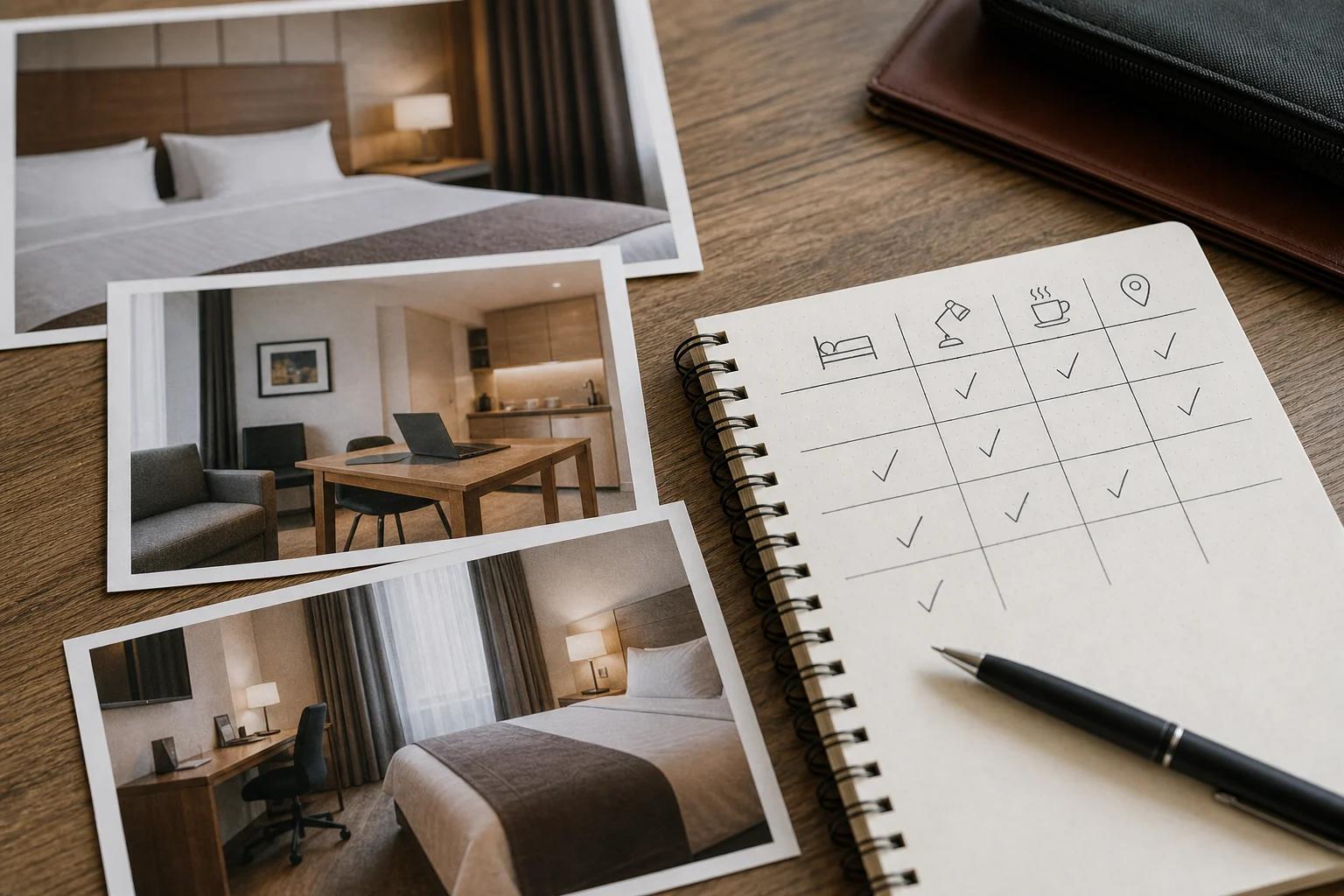
For very short on-site appointments, a room may be sufficient if the focus is clearly on sleeping and leaving early. For multi-day audits or technical inspections with follow-up work, however, more structure is often needed. In that case, an apartment may be suitable if working materials, quiet, and a clearer separation of usage areas are important.
Hotels should not be ruled out across the board in this context. Depending on location, services, and transparent total costs, a hotel may also be suitable for certain assignments, for example if access to a site is particularly good or if a clear, simply organized stay is needed. What matters is not the label alone, but whether the specific accommodation supports the work assignment.
For companies, comparing amenities, services, location, and understandable total costs is therefore more helpful than making a purely categorical decision. This makes it easier to assess which solution really works for the respective inspection assignment.
How can the decision be verified after arrival?
Even if an offer looks suitable online, a quick check on site is worthwhile. Inspection teams should check immediately whether access is easy to understand, whether the location fits the next appointment, and whether the surroundings allow the required working quiet. It is also important to confirm whether the accommodation actually meets the agreed framework.
Especially for recurring assignments, this step provides a practical reference point for future bookings. Companies can use it to determine which location, which amenities, and which type of accommodation may be suitable again for similar appointments.
Conclusion: accommodation is part of assignment planning
For auditors, experts, and plant inspectors, accommodation is not a side issue but part of assignment organization. Anyone who considers duration, location, work requirements, and internal processes together is generally making the more robust decision.
If you want to prepare your next assignment in a structured way, start with myroom24 accommodation and check the period, location, and amenities to match the planned appointment.
Frequently asked questions
Which three points should be fixed before booking accommodation for an inspection assignment?
Assignment location, length of stay, and internal responsibility for booking and approval. Only then can the accommodation be selected in a targeted way.
When is an apartment more suitable than a room for auditors or plant inspectors?
When documentation continues after the appointment, documents need space, or work takes place at the same location for several days. Then more quiet and clearer working areas help.
How should a company handle schedule changes for inspection assignments?
Define in advance who approves additional nights and how changes are passed on to booking and accounting. That keeps the stay manageable even when adjustments are needed.
How can you tell whether accommodation is well located for an inspection assignment?
The decisive factor is the actual accessibility of the assignment location with the means of transport used on site. A good address alone is not enough.
What stay duration is the search on myroom24 designed for?
For long-term stays of 28 to 179 nights.