Temporary accommodation for trade fair build and event production teams: how companies organize several weeks efficiently
What requirements arise first in trade fair build, event technology, and production planning?
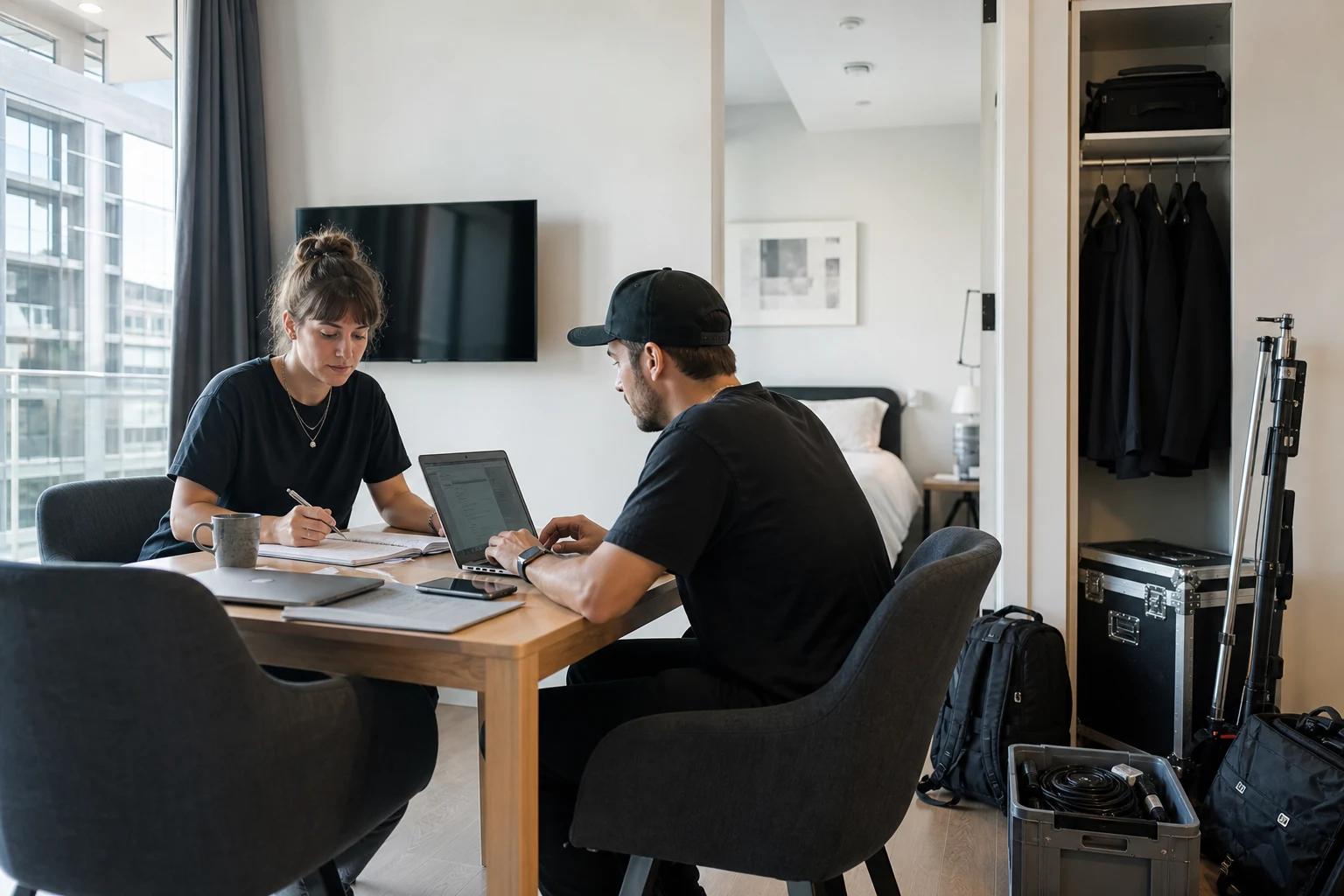
In temporary accommodation for trade fair build and event production teams, the number of beds alone is rarely the deciding factor. What matters more is how the assignment actually runs: pre-build, delivery, setup, live operations, and dismantling often do not follow the same rhythm. On top of that come shifted arrivals, late returns after shifts, and individual people who are only on site for one project phase.
A simple preliminary check therefore helps with selection:
- Which roles are on site throughout, such as project management, technical staff, or logistics?
- Which trades arrive later or only for individual work steps?
- Which times are critical because work starts early in the morning or ends late in the evening?
- Are there phases in the project with a need for rest, for example between setup and live operations?
The clearer these questions are answered, the easier it becomes to organize suitable accommodation later. This is especially important when working hours and occupancy do not match and not all team members have the same priorities.
Which type of accommodation really suits multi-week assignments?
The most suitable accommodation is not determined by the label alone, but by the team structure. Serviced apartments and apartment hotels are just as suitable for long-term stays as an apartment, if they provide the desired space, the necessary quiet, and the organizational structure. A hotel can also work for longer assignments if room layout, services, and location fit the project routine.
It is therefore helpful to look at actual use rather than the category:
For fixed core teams
If the same people work together for several weeks, clear retreat areas and a stable daily routine are often crucial. In that case, the accommodation should not only be comfortable, but also support recurring routines such as sleeping, changing, short breaks, and luggage organization.
For changing deployment groups
If specialists arrive in waves, the more important question is whether occupancy remains flexible and handovers can be organized easily. In such cases, separate rooms, clear arrival times, and a straightforward key or access process matter more than the formal description.
For night work and early starts
With shift work, the team often needs different rest windows. Accommodation with separated units or rooms can then fit better than an open shared structure, because rest and work times can be organized side by side more easily.
How do individual booking, team booking, and consolidated invoicing differ?

Many coordination problems do not arise with the accommodation itself, but with the booking logic. It is therefore worth considering booking and deployment planning separately.
Individual booking
An individual booking is suitable when people arrive at different times or are only needed in specific project phases. This is often the case with lighting, sound, rigging, decoration, or post-production. The advantage is clear allocation per person; the disadvantage is the greater administrative effort when many stays are running in parallel.
Team booking
A team booking makes sense when a defined group is deployed in the same period. It simplifies planning for closed setup or production teams because arrival, occupancy, and departure can be managed together.
Consolidated invoicing
Consolidated invoicing does not concern occupancy, but the later internal allocation. It is especially helpful when project management, procurement, and accounting have different roles or when several stays belong to one order. Then not every booking has to be checked individually internally.
A typical scenario: two people arrive earlier to accompany delivery and preparatory work. The rest of the team only comes for the main setup, and during live operations individual people switch to other shifts. In such a case, it makes sense to plan accommodation organization according to the project phases rather than a rigid overall picture.
Which checklist belongs before the inquiry for a trade fair build accommodation?
To avoid the inquiry getting stuck in many follow-up questions later, the checklist should reflect the team’s day-to-day reality. These points are particularly important:
- Arrival: Do everyone arrive at the same time or in several waves?
- Shift work: Are there early starts, late shifts, or night work?
- Laundry facilities: Does work clothing need to be cleaned regularly during the assignment?
- Accessibility: Does the route to the site fit the working hours?
- Parking and loading zones: Do vehicles, equipment, or material need to be parked or unloaded briefly?
- Room requirements: Do individual people need quiet, or is a shared structure sufficient for the team?
- Extension options: Can the project period shift?
- Cancellation rules: What happens if the arrival date or team size changes again?
- Billing: Who checks the invoice internally and who approves it?
Especially for laundry facilities and shift work, it is worth asking early. If work clothing needs to be changed regularly or only a few people work at night, that affects the entire stay organization.
How can similar offers be compared objectively?

If several accommodations are fundamentally suitable, a comparison based on the same project assumptions helps. The decisive factor is not only the category, but how much organizational effort the offer creates over the course of the weeks.
Useful comparison criteria include, for example:
- How well does the room structure fit the actual team roles?
- Are arrival windows and handovers compatible with the deployment plan?
- How much effort is involved if individual people arrive earlier or later?
- Is there enough quiet for people on early or night shifts?
- How clearly are location, amenities, and any required services described?
- What total costs arise not only financially, but also organizationally through coordination, travel, and changes?
A sober view is important here: hotels, serviced apartments, and apartment hotels can all be suitable solutions if location, amenities, and processes fit the project. Anyone who looks only at the label will easily overlook differences that matter more in everyday life than the name of the accommodation.
How myroom24 structures the project search for teams
On myroom24, commercial accommodation providers offer accommodations for private and business users. For project teams, it is particularly relevant that destination and stay duration can be specified and available long-term accommodations can be filtered by criteria such as price, location, and amenities.
For trade fair, event, and production teams, the occupied stay duration is also important: the long-term stays offered through myroom24 cover 28 to 179 nights. This allows the search to be narrowed to a multi-week project period.
The offer includes rooms, apartments, and houses in commercial accommodation facilities such as hotels, hostels, serviced apartments, and vacation apartments. If an accommodation is marked as instant booking, it can be booked without prior approval from the host if available.
Which process saves the most coordination in practice?
The most efficient process is one that starts with the assignment, not with the type of accommodation. First clarify the project period and team roles, then choose the booking format, and only then compare the offers by location, amenities, and billing. That turns a long search into a clean project process.
In practical terms, this means:
- Split project phases and on-site presence.
- Define responsible roles within the team.
- Define the booking format and invoice route.
- Check arrival, shift work, laundry needs, and handovers together.
- Only then select the suitable offer.
Anyone who follows this sequence has less need to improvise later when arrivals are staggered or the schedule shifts.
Conclusion: Which documents should companies prepare now?
For trade fair build and event production teams, the search becomes much easier if it is already clear before the inquiry how arrival, shift work, laundry facilities, accessibility, and billing are to be organized. Then offers can be compared better and the booking is more likely to match the real project flow.
If the next assignment is already scheduled, it is worth taking a look at myroom24 accommodation to check the project parameters directly against the planned period.
Frequently asked questions
How do I plan accommodation when individual trades arrive earlier than the rest of the team?
Secure the earliest arrivals first and add the remaining people afterward. This way, the booking matches the actual project phases.
When is a consolidated invoice really useful for trade fair and event teams?
When project management, procurement, and accounting have different responsibilities or when several stays belong to one order.
How can I tell whether an offer is suitable for shift work?
Important factors are separate rest areas, suitable arrival times, and a handover process so early and late shifts do not interfere with each other.
What should be clarified before a possible project extension?
Whether the period can be extended flexibly, how changes are reported internally, and whether the same occupancy structure can be maintained.
How do I sensibly compare two similar accommodations for a trade fair project?
Compare the same project assumptions: arrival, team roles, rest needs, laundry facilities, location, and the internal coordination effort.