Temporary Accommodation for Truck Drivers and Mobile Commuters: When an Apartment Fits Better Than a Hotel
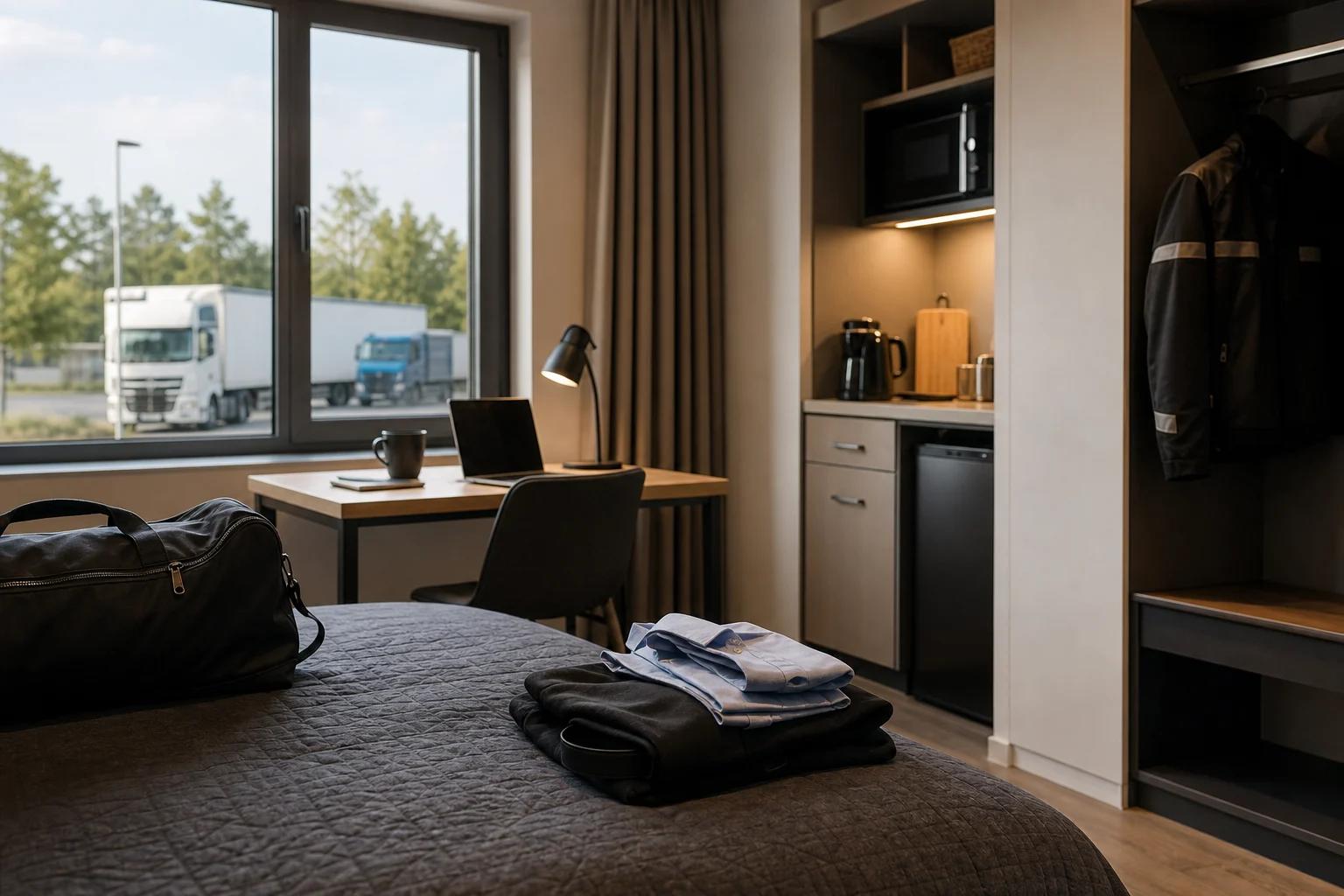
Which requirements matter first in mobile professions?
Temporary accommodation for truck drivers and mobile commuters works reliably only when the accommodation matches the actual workday. What matters is not the widest possible range of extras, but whether sleeping, arriving, eating, and setting off again fit together without unnecessary detours.
Five key questions help with this assessment:
- Can I arrive at the planned time? Anyone arriving late after a tour, a flight, or an outside appointment needs a realistic check-in process.
- Is the sleeping area really quiet enough? After long drives or changing shifts, what matters most is whether rest is possible when the time window for it is short.
- Is there a practical kitchen? Anyone who is not dependent on fixed meal times while on the road benefits from a clear option for self-catering.
- Can I organize laundry and luggage sensibly? With several nights or recurring assignments, order quickly becomes more important than a particularly compact room layout.
- Is the route to the place of work short and easy to understand? For truck drivers, flight attendants, or field service teams, the location must fit the actual process, not just the postal address.
In everyday life, these questions are more helpful than simply searching for a specific room category. They clarify whether accommodation is only suitable for one night or whether it can also support several days of work properly.
Which type of accommodation suits which assignment?
The more important question is not “hotel or apartment?”, but: How much independence, quiet, and organization does the stay really require?
A hotel can make sense if the assignment is short, arrival remains easy to plan, and little self-organization is needed. An apartment or serviced apartment often fits better when cooking, laundry, and a bit more space play a real role in the daily routine. Serviced apartments and apartment hotels are just as suitable for long stays as a flat if room layout, location, and the desired routine match.
These points are especially important when making the decision:
- Self-catering: Anyone working irregularly often needs more flexibility around meals than someone with fixed break times.
- Quiet and privacy: Mobile professions benefit from a sleeping area that is not at the same time storage room, workplace, and passageway.
- Daily organization: If work clothes, documents, or small luggage travel with you, a clear structure becomes more important.
- Scope of service: Depending on how much support is desired on site, a compact hotel stay or an apartment with more independence may be the better fit.
- Overall process: What matters is whether arrival, stay, and departure fit the work schedule without friction.
Important: Hotels are not generally unsuitable for longer stays. If location, scope of service, and total costs match the assignment, a hotel can also be the right choice. The advantage of an apartment or serviced apartment is more that self-catering and daily routine are often easier to manage over several nights.
Which everyday situations on the road change the choice most strongly?

Mobile professions are rarely uniform. That is exactly why it is worth describing the specific situation before choosing accommodation.
When arrival times vary
Truck drivers, flight attendants, and field service employees often experience arrivals that cannot be fixed to the minute. Then it matters whether the accommodation remains practical even with a later arrival and whether access is organized in an easy-to-understand way.
When the next assignment starts early
Anyone who has to continue directly in the morning does not need complicated routes the next day. In such cases, what matters most is whether the location has been chosen so that the start of work is not made more difficult by extra travel.
When luggage and work materials travel with you
Uniforms, documents, personal items, and sometimes extra equipment need more organization than a pure overnight room offers. Then the question becomes whether a compact hotel room is enough or whether an apartment with more structure makes more sense.
When the same place is visited regularly
With recurring assignments, mere availability is rarely enough. Kitchen access, laundry options, and storage space should then be considered over several nights so that each stay works equally well.
When the stay lasts more than one night
As soon as a single stopover becomes several nights, the focus shifts. Then the priority is less pure overnight accommodation and more routines such as storing items, eating, washing, and starting the next day calmly.
How myroom24 can help with the search in concrete terms
myroom24 is an online booking platform on which commercial accommodation providers offer accommodation for private and business users. For mobile professions, this is helpful when a stay is not open-ended but already roughly plannable.
Through myroom24, users can specify their destination and length of stay and filter available long-stay accommodation by criteria such as price, location, and amenities. Stays from 28 to 179 nights are covered. This makes it possible to search for a longer assignment much more specifically than for a spontaneous single overnight stay.
The offer includes rooms, apartments, and houses in commercial accommodation facilities such as hotels, hostels, serviced apartments, and holiday apartments. Accommodation marked as instant booking can be booked, subject to availability, without prior approval from the host. Anyone working with fixed assignment dates can therefore structure the search process more clearly.
Which search steps help most before booking?
A good search does not start with the prettiest photo, but with your own assignment pattern. If you clarify the process first, you reduce later compromises.
1. Define destination and length of stay clearly
For mobile professions, it is important whether the stay is a single block of work or several consecutive nights. Only then does it become clear how much independence the accommodation should really offer.
2. Use work rhythm as a filter
Late arrivals, early starts, or shifted shifts significantly change the requirements for the accommodation. That is why the search should always start from the real calendar, not an ideal daily routine.
3. Arrange amenities according to actual use
Kitchen, laundry options, sleep quality, and storage space are often more important for mobile professions than purely visual features. Anyone who sorts these points in their own order compares more clearly.
4. Check the location for several days of work
A location is only practical if it also remains sensible on recurring days or with changing appointments. This is especially relevant for assignments involving repeated travel to the same place.
5. Keep overall cost transparency in mind
It is not only the room category that matters, but also which services are really needed for the specific routine. Anyone who evaluates location, service, and necessary amenities together makes the calmer decision.
Which details are still worth checking before completing the booking?

If the right category is already set, it is worth doing one final check against the practical points of the arrival day. This is often where the differences become visible that do not stand out in the normal search process.
- Check-in and check-out logistics: How exactly does arrival work, and does it fit the end of a shift or the end of a tour?
- Sources of noise in the surrounding area: Is the accommodation located somewhere where traffic, delivery traffic, or other disturbances can be expected at night or early in the morning?
- Parking or charging options: If travel by vehicle or work mobility is planned, this point should be clarified in advance.
- Flexible cancellation terms: With mobile professions, assignments sometimes change even before the trip begins.
- Access to the sleeping area and luggage: The clearer the process on arrival, the less time is lost on the day of arrival.
This final check does not replace the basic search; it makes the difference between “available” and “really suitable in everyday life” visible.
What is the next sensible step?
If the next assignment is already fixed, start with a structured search for myroom24 accommodation. This allows you to align length of stay, location, and amenities directly with your work rhythm.
Frequently asked questions
How do I recognize that a hotel still suits my assignment?
If arrival, sleep, and service needs remain simple and the location fits your route to work.
When is a serviced apartment especially useful for mobile professions?
When you need more independence for meals, laundry, and organization, but do not want to do without clear service.
What should I check first for recurring assignments at the same place?
Whether the daily route to the place of work, sleeping quiet, and organization over several nights really fit together.
Which question is most important when arrival times vary?
Whether check-in is organized in a practical way and you can still arrive without stress even if you are later than planned.