Temporary Housing for Airport and Trade Fair Assignments with Self Check-in
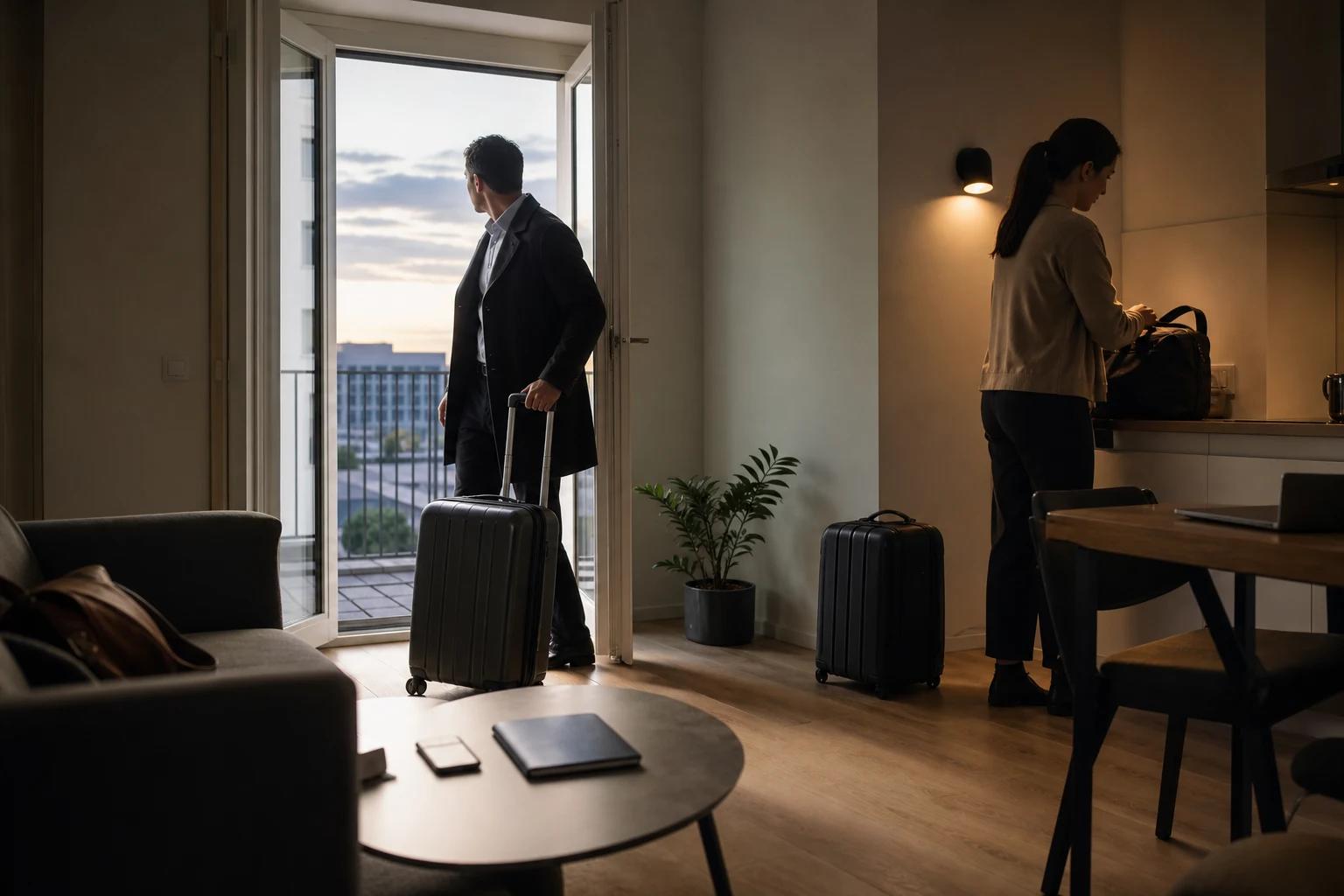
Why is the process on arrival often more important than the actual distance?
Temporary housing for airport and trade fair assignments with self check-in is especially worth considering when the day does not start exactly as planned. A delayed flight, a late trade fair event, or an evening arrival changes the question of what really matters: not just the kilometers, but the path from arrival to the first usable minute in the accommodation.
For project staff, trade fair teams, and business travelers, it is therefore crucial whether the transition from transport to accommodation works without extra coordination. An accommodation can be close to the airport or the trade fair and still be inconvenient if access, orientation, or responsibilities remain unclear. Conversely, a location a little farther away can be suitable if the process is clearly described and arrival works without unnecessary follow-up questions.
Especially with a digital check-in serviced apartment or a comparable furnished offering, what counts is not the label but the concrete process: Who arrives when, how is the building entered, and what happens if the time shifts? These exact questions determine whether the accommodation supports the first evening and the first morning reliably.
Which access information should be confirmed before booking?
Good preparation starts with the information that will actually be needed on the day of arrival. This includes not only the address, but the complete route from arrival to the room or apartment. These points are especially important:
- the planned arrival time or a reliable time window
- the type of access, such as self check-in or a personal key handover
- the exact description of the entrance, key box, code, or reception point
- the route from the parking area, station, or terminal to the accommodation
- a reachable contact option for delays or questions
If a trade fair accommodation is booked with an evening arrival, the access solution should be described so clearly that nobody has to ask on site first. This is especially true when not all team members arrive at the same time. A self check-in does not remove coordination, but it makes the process less dependent on a fixed handover time.
Responsibility should also be clear in advance: Who informs others in case of delays? Who receives the access details? Who confirms that all instructions have been received? The clearer these points are, the less friction there will be on the first day.
What role does parking play when luggage or work equipment is traveling with you?
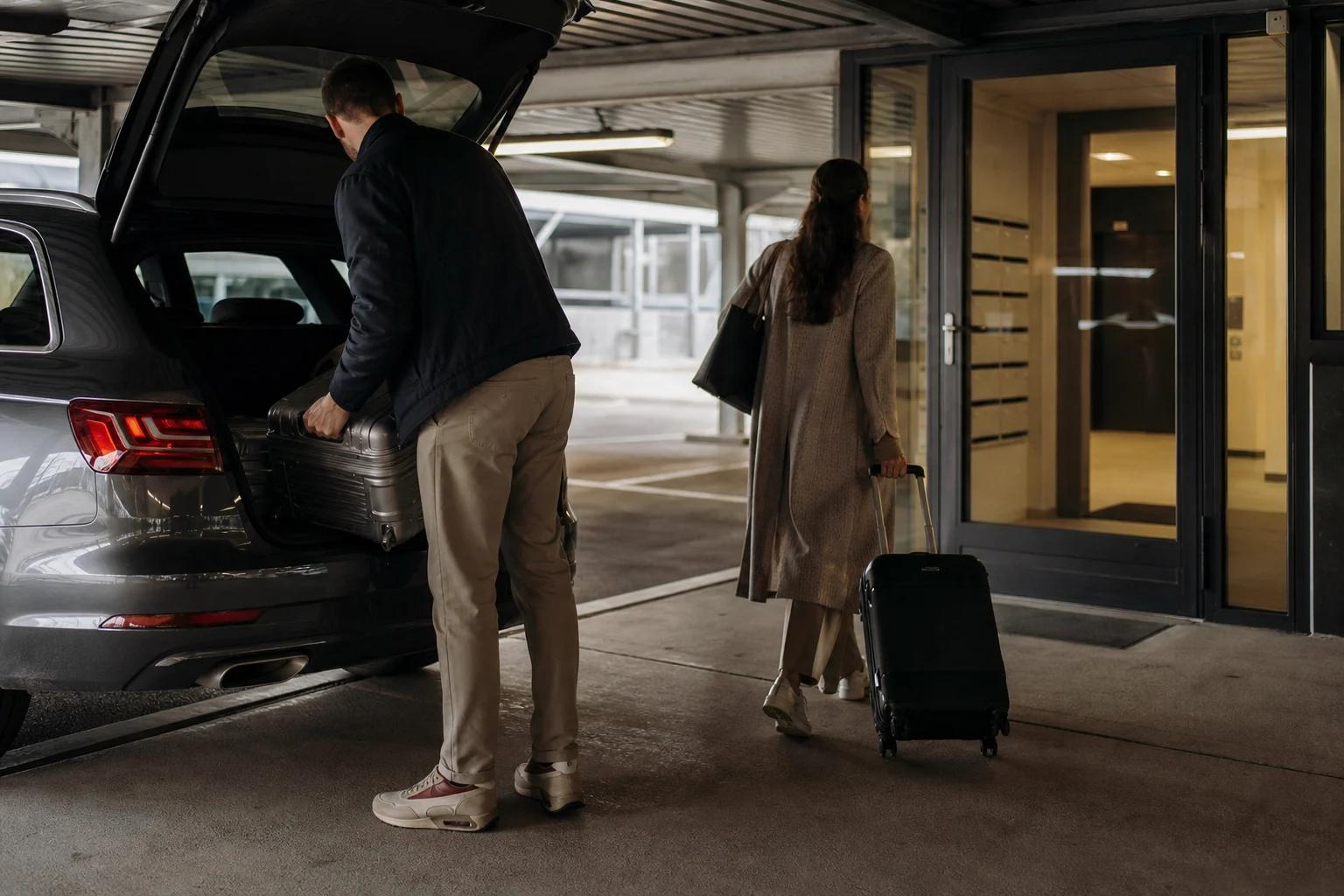
Parking is often underestimated for airport and trade fair assignments, even though it can noticeably influence the process. What matters is not only whether a parking space exists, but how well it fits the assignment. Anyone arriving with a suitcase, documents, equipment, or trade fair material needs a setup that takes unloading, the path to the entrance, and later departures into account.
For an airport-adjacent temporary accommodation, it is therefore relevant whether you can easily find the vehicle again, how far the walk from the parking space to the door is, and whether arrival remains easy to navigate even in the dark or when tired. The same applies to trade fair assignments with deliveries or material transport: if the route from the parking area is complicated, it ultimately costs more time than a slightly shorter distance on the map.
So the practical question is not just: “Is there parking?” but also: “How easy is the entire process from the car to the room?” If that remains unclear, the location has not yet been assessed well enough.
Which amenities support a long stay over several days or weeks?
For longer stays, amenities should not be viewed as an extra, but as part of the working day. The tighter the schedule, the more important functions become that stabilize recurring routines. This mainly includes:
- a kitchen or kitchenette for predictable meals
- a table or workspace for a laptop, documents, and phone calls
- stable Wi-Fi for emails, documents, and coordination
- storage space for luggage, clothing, and work materials
- a practical laundry option when the stay is longer
Someone staying only one night can do without many things. Over several days or weeks, however, a different need emerges quickly: documents must be organized, clothes changed, and appointments prepared. It is therefore sensible to check amenities against the real daily routine. Do I mainly need sleep and short distances? Or do I also need space to work, eat, and organize?
The type of accommodation alone does not answer that question. Whether hotel, serviced apartment, or apartment hotel — what matters is whether the specific amenities fit the planned assignment. A good choice comes from matching needs with actual features, not from broad assumptions.
How do you coordinate team routines when not everyone arrives at the same time?

For projects, trade fairs, or assignments with several people, the accommodation itself is often not the problem, but rather the coordination around arrival and access. If team members are traveling separately, a clear division of roles is needed in advance. Otherwise, unrest arises exactly when the workday has basically already begun.
A simple assignment helps:
- one person collects the final arrival times
- one person manages access details or the key route
- one person remains reachable in case of delays
- everyone involved knows whether they can check in directly or have to wait for a handover
If material, clothing, or documents arrive first, it should also be clarified who receives them or where they can be stored safely. This is especially relevant when some employees arrive later or when several departments are based in the same accommodation.
A clearly organized process is more important here than whether the accommodation is “modern” or “simple.” What matters is whether the team can start the assignment without extra detours.
How do you assess location, amenities, and accommodation type without broad comparisons?
The best decision comes from checking the criteria in the right order. Instead of deciding on a category first, it is worth looking at the actual task of the accommodation. This matrix helps with classification:
| Check question | What to look at | What it means in practice | |---|---|---| | How secure is access for a late arrival? | Self check-in, key handover, clear instructions | The first evening stays manageable | | Does the location fit the tightest appointment? | Trade fair, airport, first appointment, transfer route | The most critical route becomes shorter or simpler | | Are the amenities sufficient for the daily routine? | Kitchen, workspace, Wi-Fi, storage, laundry | The stay works even over several days | | Can several people understand the process? | Responsibilities, accessibility, access details | Team routines remain understandable | | Is parking practical for your luggage and materials? | Parking space, route to the entrance, unloading | Arrival needs fewer extra steps |
A useful example: for an early flight, proximity to the airport may matter more than extra living space. For a late trade fair end, a clearly documented access solution may matter more than a complex handover. For several team members, the clarity of the arrival information can also be decisive, even if the accommodation is not directly next to the venue.
How myroom24 structures the search for such assignments
myroom24 is an online booking platform where commercial accommodation providers offer accommodations for private and business users. The range includes rooms, apartments, and houses in commercial accommodation facilities such as hotels, hostels, serviced apartments, and vacation rentals.
For airport assignments and trade fair stays, it is especially relevant that myroom24 offers long stays from 28 to 179 nights. The search can be set by destination and length of stay and filtered by criteria such as price, location, and amenities. This is particularly helpful when you are not looking for just any accommodation, but for a solution for a specific assignment with a clear duration and suitable arrival profile.
If the arrival is short notice and the process is already fixed, an accommodation marked as instant booking can also be relevant. Such offers can be booked without prior approval from the host, subject to availability. This can speed up the booking once the decision has already been made.
Which final check should come before booking?
Before you make the final booking, check three things once more: the realistic arrival time, the concrete access solution, and the amenities for the entire planned duration. If these three building blocks fit together, the likelihood of questions on the first day or improvisation later is lower.
For the next step, you can start your search by destination, duration, and suitable criteria via myroom24 accommodation and then align the options with the specific assignment.
Frequently asked questions
How can I tell whether self check-in is really suitable for an evening arrival?
By whether access is fully explained even without a personal handover: entrance, code or key route, contact point, and whom to reach in case of delays.
What should the team record in writing if not everyone is arriving at the same time?
Who arrives first, who receives the access details, who stays reachable, and how keys or codes are passed on. That keeps the process understandable even when arrival times differ.
Which parking question is decisive before booking for trade fair or airport assignments?
Not only whether a parking space is available, but how short and clear the route from the car to the entrance is — especially with luggage, equipment, or materials.
How do I check whether an accommodation is suitable for 28 to 179 nights in everyday use?
By looking at the kitchen or kitchenette, workspace, Wi-Fi, storage space, and a practical laundry solution. These points should fit the actual routine.
When is proximity to the trade fair or airport more important than additional amenities?
When the time buffer is very tight, for example with an early start, a late trade fair end, or a short transfer. Then the critical route comes first.