Temporary Housing in Cologne for Continuing Education and Block Seminars: How to Compare Correctly
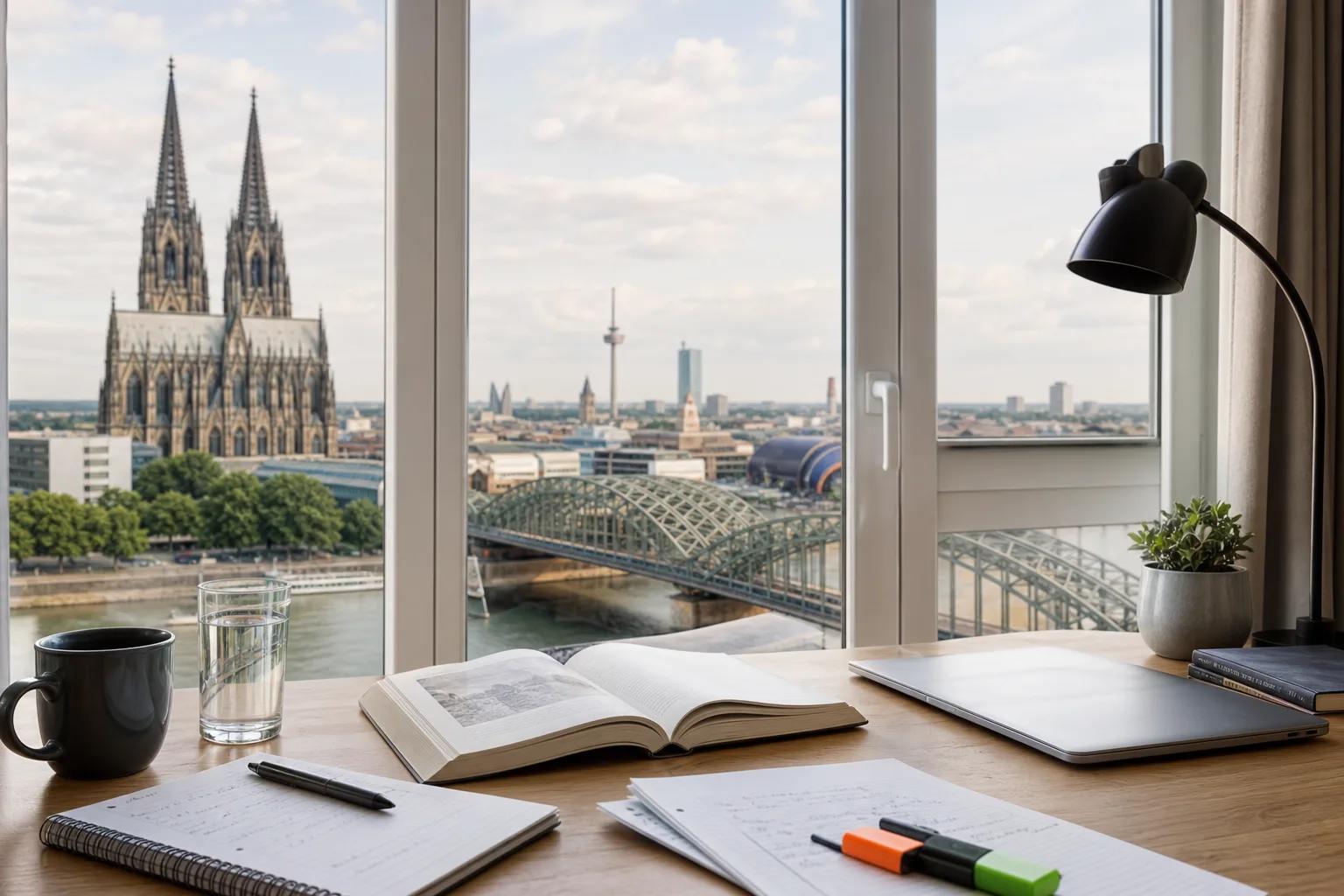
If you are looking for temporary housing in Cologne for continuing education and block seminars, you need more than a room for a few nights. What matters is whether the accommodation supports the entire learning process: from quiet work in the evening to easy self-organization and a reliable route to the course venue. Especially for in-person phases, it is therefore worth looking at the overall setup of the accommodation rather than just individual features.
Which period is actually relevant for your continuing education?
With continuing education, the first thing that matters is the actual course schedule. Some dates are bundled into just a few compact days, while others extend over several weeks or consist of individual modules with breaks in between. For the accommodation decision, this is an important difference because it determines whether you stay continuously, book only individual sections, or want to adapt the stay precisely to the in-person times.
This question is helpful here: Do you need accommodation that accompanies a continuous learning phase, or a solution that can adapt to recurring in-person blocks? For a block seminar in Cologne, what often matters most is the certainty that arrival, overnight stay, and departure will not become rushed. For longer training courses with recurring dates, by contrast, it becomes more important whether the entire period can be planned cleanly and not just the first block.
So make sure the accommodation does not work against the schedule. If the day starts early, the stay needs different priorities than seminars with a later start or longer breaks during the day. This way, you avoid a situation where the accommodation basically fits, but makes the continuing education process unnecessarily complicated.
Which accommodation type fits your learning rhythm?
The better accommodation type depends on how much independence you want and how strongly the stay is integrated into your learning routine. A hotel is not generally unsuitable for longer stays; it can be just as suitable as an apartment if the services, location, and organization match your needs.
| Accommodation type | When it can work well for continuing education and block seminars | What needs to be compared | | --- | --- | --- | | Apartment or flat | If you want to manage things yourself, work undisturbed, and build your own routines. | Check whether work area, storage space, and self-catering work in the learning routine. | | Hotel | If you value fixed routines and clearly structured services. | Compare whether service, quietness, and the route to the course venue match your schedule. | | Serviced apartment | If you want more independence but do not want to handle all organizational tasks yourself. | Pay attention to which services are included and which you need in addition. | | Apartment hotel | If you want to combine living, working, and service in an intermediate form. | The key question is whether the mix of privacy and service supports the entire stay. |
For a seminar apartment in Cologne, this classification is especially useful if you are planning not just one night, but several learning days or an entire course section. Then it is less about the abstract category and more about how the accommodation concretely supports your daily schedule.
Which details make a room suitable for work?

A room is only truly usable if you can work in it concentratively over several days. This concerns not only the size, but also the practical usability of the space during the continuing education period.
Before booking, check these points:
- A work surface with real practical value: Is the table large enough for a laptop, documents, and the material you will actually bring with you?
- Separation between sleeping and working areas: If you review materials in the evening, the room should not have to be rearranged every time.
- Space for materials and equipment: Scripts, printouts, or devices need a fixed place so that nothing has to be reorganized every day.
- Quiet usability over several days: The key question is whether the room remains suitable for everyday use after the first impression.
- The possibility of a clear daily structure: Anyone who reads in the morning, sits in seminars during the day, and works through material in the evening needs a room that can handle those transitions.
This consideration is especially important when you are choosing a Cologne continuing education accommodation. After all, a good workspace is not just an extra; it is often the difference between accommodation that only provides a place to sleep and accommodation that supports the entire learning phase.
Which cost components should you really compare?
For longer stays, it is not enough to look only at the visible base price. For a fair comparison, you should check the components that actually matter in everyday use.
These include, for example:
- the actual overnight or rental component,
- additional services that you will actually use,
- possible costs for self-catering,
- cleaning services, insofar as they are relevant for your stay,
- and everything else you need to plan separately for arrival, stay, or work routine.
What matters is not collecting as many services as possible, but choosing the right ones. If you are often out during the course, a simple setup may be enough. If you work through material almost every day after the seminar, other factors have a stronger impact, such as whether you can organize meals flexibly or whether additional services noticeably structure your day.
This way, you compare not only the price on paper, but the costs in their actual use.
Self-catering or hotel service: What works in everyday learning?

This question is especially important when the course has a lot of in-person time and free hours are limited. Then it quickly becomes clear whether you prefer to plan things yourself or whether fixed routines are helpful.
Self-catering often works well if you want to keep your breaks flexible. That can make sense if you are on the move for several days in a row, study in between, or want to organize meals independently of the property’s schedule. An apartment or a similar accommodation type can make this easier because you do not have to coordinate every step with fixed service times.
Hotel service, on the other hand, can be suitable if you want to have as few organizational tasks on site as possible. In that case, structured routines, clear contacts, and a standardized stay take center stage. This can be especially helpful when your continuing education is tightly scheduled and you do not want to take on additional living tasks outside the course.
So the key question is not which form is generally better, but which form fits your actual daily rhythm. Anyone who wants to work in peace after a long seminar day has different requirements from someone who has to schedule time very tightly between course, city travel, and meals.
How do you coordinate location, arrival, and course times?
The location of an accommodation is well chosen when it fits the specific times of your seminar. It is not the purely geographical proximity that matters, but the question of how reliably the route can be used in everyday life.
Check not only the way there in the morning, but also the return trip in the evening. With early start times, every additional transfer becomes relevant faster than with later appointments. On long seminar days, it is also important whether you can move between the course, accommodation, and possibly a meal without detours.
If your block seminar includes long breaks or a longer midday rhythm, the surroundings of the accommodation can also be important. Then it is not only the distance to the seminar venue that counts, but also whether you can make sensible use of the time in between. With several modules, the overall course structure should also be considered: a short route to the first appointment is of little use if the other days are organized differently.
For a longstay in Cologne for education, it is therefore worth choosing a location decision that is not tied to one address, but to the entire weekly structure.
How myroom24 helps in the search
myroom24 is an online booking platform on which commercial accommodation providers offer accommodation for private and business users. The range includes rooms, apartments, and houses in commercial accommodation facilities such as hotels, hostels, serviced apartments, and holiday apartments.
For the search for a seminar apartment in Cologne or another suitable accommodation, you can enter your destination and length of stay and filter available long-stay accommodations by criteria such as price, location, and amenities. This makes comparisons easier when you want to compare offers for the same course period.
Important for planning: The long-stay accommodations offered via myroom24 cover 28 to 179 nights. This allows a clearly defined continuing education period to be narrowed down much more precisely. Accommodations marked as instant booking can be booked without prior approval from the host, subject to availability.
If you now want to narrow your selection by period, location, and working routine, start with myroom24 accommodations.
Frequently asked questions
Which accommodation is the most practical for a block seminar with several long days?
The most practical form is the one that disturbs your daily routine the least. If you want to organize many things yourself, an apartment or serviced apartment is more suitable; if fixed routines are more important, a hotel can also fit.
What should be clarified for several continuing education modules with breaks in between?
You should check whether a continuous booking matches the entire course schedule or whether separate stays make more sense. The decisive factor is the complete timetable, not just the first date.
When is self-catering particularly useful for continuing education in Cologne?
When your seminar times are tight or you want to continue working in the evening. Then it is helpful to be able to organize meals independently and without fixed times.
Which details should I compare with the organizer before booking?
Above all, you need to clarify the address, the times, and the schedule of the first course day. This makes it easier to assess whether accommodation, arrival, and seminar start fit together.