Temporary Housing in Düsseldorf for Exhibition Builders and Exhibitor Teams: Accommodation Near the Fair and City Center
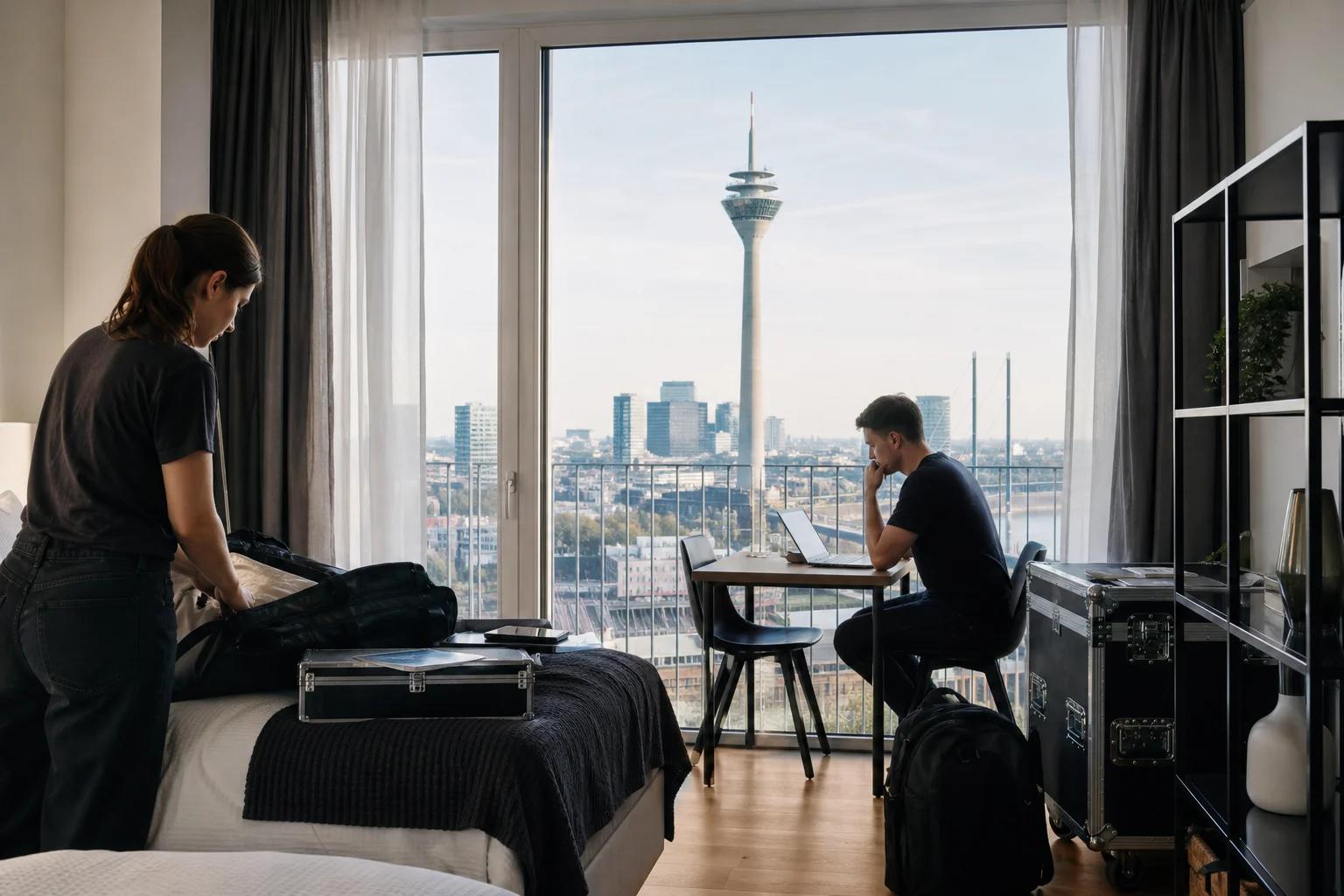
What questions should an exhibition team clarify first before searching for accommodation?
For temporary housing in Düsseldorf for exhibition builders and exhibitor teams, the best starting point is not the search for a property, but a look at the project plan. Anyone who compares accommodations first and only then sorts out the schedule often overlooks details such as separate arrivals, different working hours, or responsibilities when moving in.
Four specific questions help with the initial selection:
- Which nights actually belong to the project period?
- How many people are on site at the same time?
- Does everyone arrive together or in stages?
- Which amenities are really needed in day-to-day work?
This clarification matters because a trade fair accommodation in Düsseldorf should not only provide beds, but also fit into the workflow. In trade fair projects, arrival, materials, downtime, and organization often share the same accommodation. Anyone who structures this in advance can compare more precisely later.
How should the location in Düsseldorf be evaluated sensibly?
A location is well evaluated when it does not just look convenient on a map, but reflects the team’s actual routes. For trade fair and production assignments, several routes matter at the same time.
Close to the fair grounds
If the team travels daily between accommodation and venue, short and predictable routes are a key criterion. This is especially true for early setup times, late returns after stand operations, and short-notice coordination. For a Düsseldorf accommodation for exhibition builders, distance alone should therefore not be the only factor; the route must also remain practical in the project routine.
Close to the city center
Trade fair and event teams in Düsseldorf often also need access to the city center, for example for shopping, printing materials, meetings, or additional errands. Accommodation that sensibly connects the fair grounds and the city center reduces unnecessary extra travel. This is especially helpful when not all tasks are handled directly on site.
Public transport connection
Not every team arrives in the same vehicle, and not every person stays on site continuously for the entire project. A good connection to local public transport is therefore practical when individual team members arrive later, attend appointments in between, or need to move between several work locations. For a team accommodation in Düsseldorf, the public transport connection should therefore be checked explicitly before booking.
Which amenities are really relevant for several nights?

Several nights mean more than just a bed in trade fair work. What matters is whether the accommodation supports work, rest, and organization during the same period.
Kitchen for flexible meal times
A kitchen is especially important when meals need to be organized independently of restaurant hours and changing shifts. This can be relevant for early starts, late returns, or tightly scheduled trade fair days. Before booking, it should therefore be checked whether the cooking option matches the number of people and the schedule.
Wi-Fi for coordination and documents
Many pieces of information in trade fair projects are digital: deployment plans, questions, documents, and short-term changes. Wi-Fi is therefore not just a comfort feature, but part of project organization. Clarifying this question early avoids later follow-up questions about connections or access.
Sleeping areas with different time windows
In teams, not everyone arrives at the same time or sleeps at the same time. It is therefore not enough to check only the number of beds. It is also important whether sleeping areas and retreat options are arranged so that early and late time windows do not constantly disturb each other.
Storage space for luggage, documents, and materials
During a trade fair stay, more than clothing quickly accumulates. Chargers, documents, presentation materials, or tools need a fixed place. Actively checking storage space reduces rearranging after arrival and ensures that work materials and personal belongings do not get mixed up.
How do you organize a team accommodation for setup, exhibition days, and dismantling?
Most coordination problems do not arise on site first, but already during the preparation phase. Clear team organization saves time when several people and several nights come together.
Define responsibilities before booking
It helps to assign simple roles in advance. One person collects travel data, a second checks the sleeping arrangement, and a third bundles the team’s questions. This prevents information from getting lost in individual messages, and the decision remains traceable.
Collect booking data in a fixed order
For inquiries or bookings, the team should record the most important details in a clear order: stay period, number of people, arrival window, desired room or sleeping arrangement, and required amenities. This prevents the same information from having to be gathered repeatedly.
Plan for separate arrivals
Especially for trade fair projects, not everyone arrives at the same time. If individual employees arrive later, there needs to be clear coordination about who arrives first, who takes over access, and who remains reachable as the contact person. This is especially important when setup and exhibition days follow one another directly.
Evaluate setup, exhibition days, and dismantling separately
Each phase has different requirements. During setup, arrival and organizational clarity are crucial. During exhibition days, accessibility and peace and quiet take priority. During dismantling, it matters that the team can return without additional detours after a long working day. This three-part division helps to assess the accommodation not in general terms, but in relation to the project.
Which type of accommodation suits which trade fair assignment?
Not every accommodation serves the same purpose. Anyone working at a trade fair in Düsseldorf should therefore not only check the label, but also the use in the specific project.
Serviced apartment
A serviced apartment Düsseldorf trade fair can make sense when self-catering, a clear living framework, and several nights within the same project are important. This often suits smaller teams or employees who regularly come to Düsseldorf and need a reliable base for their assignment.
Hotel or hotel-like solution
Hotels are not generally unsuitable for longer stays. For some teams, a hotel-like solution may be appropriate when services, clear processes, and location are the main focus. The deciding factors are whether amenities, accessibility, and transparent total costs fit the job.
Larger accommodation for several people
When several team members live together, a larger accommodation with communal areas and sufficient retreat space can be useful. In that case, sleeping areas, storage space, and working quiet should be considered together. This is especially important when meetings, materials, and rest all fall within the same period.
How can myroom24 help with the search in concrete terms?
myroom24 is an online booking platform on which commercial accommodation providers offer accommodations for private and business users. For trade fair projects in Düsseldorf, one thing is important: the long stays offered via myroom24 cover 28 to 179 nights.
The search starts with the destination and length of stay. Available long-stay accommodations can then be filtered according to criteria such as price, location, and amenities. This is useful when a team is not looking for just any accommodation, but one that fits the specific project schedule with setup, exhibition days, and dismantling.
The offer includes rooms, apartments, and houses in commercial accommodation facilities such as hotels, hostels, serviced apartments, and vacation rentals. This allows the team to check, depending on the number of people and the assignment profile, which type of accommodation is suitable for the planned period. For accommodations marked as instant booking, booking is possible subject to availability without prior approval from the host.
The platform then allows suitable options to be narrowed down specifically once location, period, and amenities have already been determined.
Which checkpoints help before the final decision?
Before booking, the team should not only check amenities and location, but also the processes around move-in and stay. Especially with several people, problems often arise at organizational points that are easy to overlook in the initial search.
Important additional checkpoints are:
- How exactly does the check-in work, and who handles it?
- Are access, keys, or codes clearly arranged for later arrivals?
- Are there quiet hours or rules that fit the team’s working rhythm?
- How are cancellation rules and changes to the project plan handled?
- Do the total costs match the number of nights and services actually needed?
These points complement the criteria for location, kitchen, Wi-Fi, and sleeping areas. They are especially helpful when several team members are involved and the project schedule may still shift slightly.
What is the most sensible next step for exhibition builders and exhibitor teams?
If the period, number of people, and requirements are set, a structured comparison by location, amenities, and organization is worthwhile. This makes it quicker to see which accommodation suits the assignment in Düsseldorf. With myroom24 accommodations, teams can narrow the search specifically by travel duration, location, and amenities.
Frequently asked questions
Which details should a trade fair team in Düsseldorf clarify before booking?
Period, number of people, arrival window, responsibilities, and desired sleeping arrangement. These details make comparisons more reliable and reduce follow-up questions.
How can you tell whether an accommodation suits both setup and dismantling?
If arrival, return times, rest needs, and routes work for both phases. The accommodation should not only be designed for a single trade fair day.
Why should a team not evaluate the location only by its proximity to the fair grounds?
Because routes to the city center, errands, and the public transport connection also influence the schedule. Distance alone says little about everyday usability.
What matters when booking if several team members arrive separately?
Agree in advance who arrives first, who takes over access, and who remains reachable. This reduces coordination on site.
What should a team mainly check in the total costs?
The number of nights actually needed, the services included, and possible changes in the project plan. That way, the decision is not determined only by the base rate.