Temporary housing with space for tools, materials, and luggage: how teams check everyday practicality
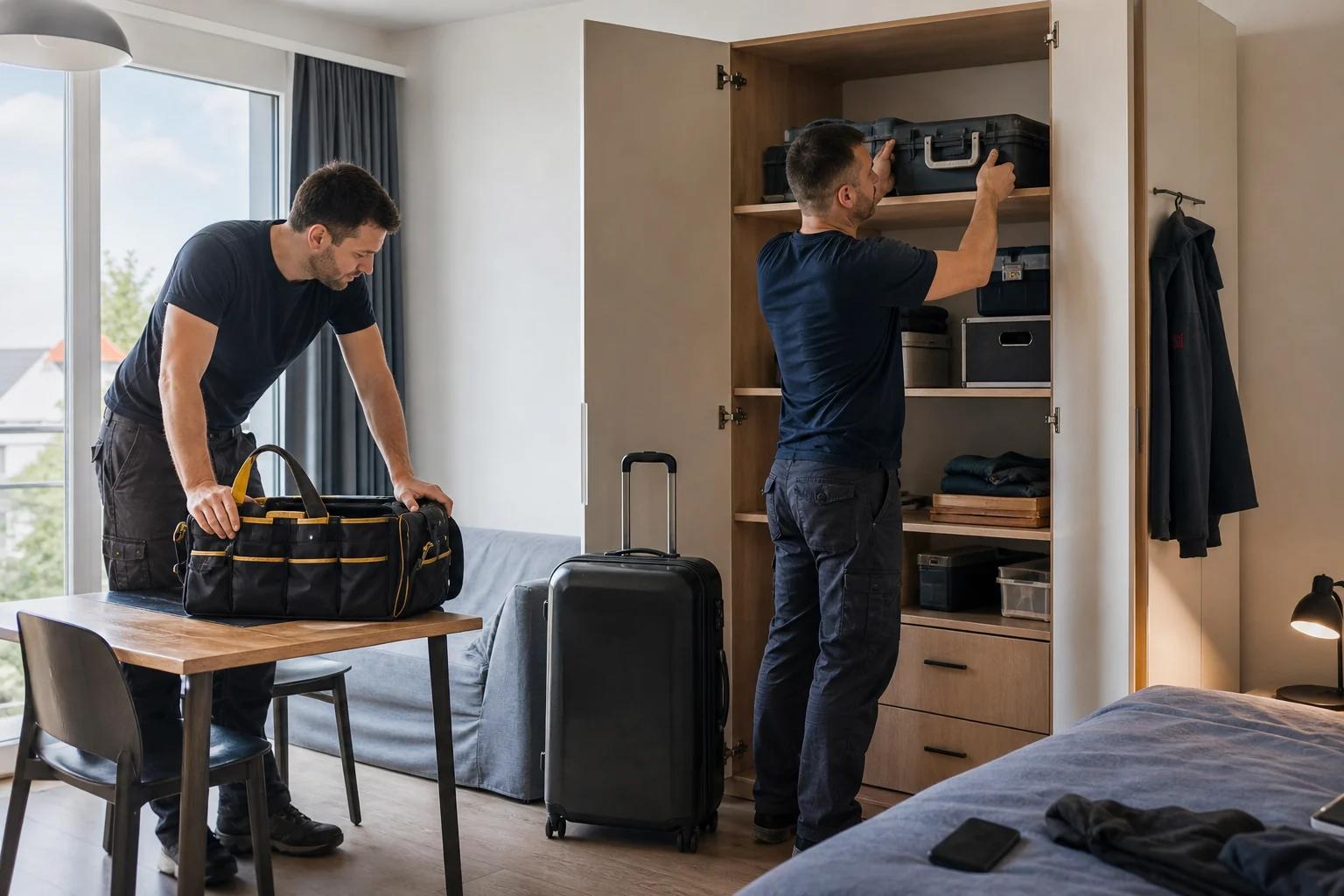
Which storage questions should teams clarify first before booking?
Anyone looking for temporary housing with space for tools, materials, and luggage should not judge the accommodation only by the number of rooms and the furnishings. For project teams, storage often determines whether the stay runs smoothly or whether improvisation is needed every day. This is especially true for longer assignments, changing materials, and several people bringing different equipment.
The first questions should therefore be not general, but very specific:
- Which items really need to be stored?
- How often are tools, boxes, or luggage moved?
- Do certain things need to be kept separate from the living area?
- Who is allowed to use the storage space?
- Are there fixed times or rules for access and handover?
These questions help to think about the need in more than just square meters. A room can seem large and still be impractical if it is difficult to reach or is not clearly assigned to one team. Conversely, a small, clearly defined area can work very well in everyday use if it is directly usable and fits the workflow.
Which assessment criteria make storage truly comparable?
A cellar, a storage room, or a bicycle parking space is only useful if teams check how they can actually be used in everyday life. For a fair comparison, it is not enough to know the name of the area. The decisive factors are the concrete conditions on site.
1. Usable size instead of just a room description
Before booking, measure the most important parts of the equipment as precisely as possible, not just roughly, but with the largest box, the most bulky suitcase, or the longest tool piece in mind. What matters in particular is:
- the length and width of bulky items,
- the height of boxes that are to be stacked,
- the space required for open bags,
- the question of whether everything can be taken out again without rearranging.
This makes it quicker to see whether an area is really suitable for storing materials or only seems like extra storage space.
2. Access, route, and handling
A room is only suitable for everyday use if the team can use it without detours. Check the following:
- Is the storage space close enough to the entrance or the apartment?
- Are there stairs, narrow doors, or tight corridors?
- Is the route practical even with luggage or tool boxes?
- Can the area be used sensibly in the morning, in the evening, and during shift changes?
Especially with changing materials, accessibility is often more important than size alone. If loading and unloading takes a lot of time every time, an existing room quickly becomes an additional burden.
3. Clear assignment and protection
Teams should also clarify whether the area is intended exclusively for them or shared with others. What matters is not only whether something can be locked, but also who decides on it and who may have access in case of doubt. It is useful to ask:
- Does the room belong exclusively to the booked property?
- Who has a key or access code?
- Are there rules for shared areas?
- What happens if the area has to be cleared at short notice?
This helps avoid situations where tools, materials, or luggage are stored but not reliably available.
Which details should the request to the provider include?

The more precise the request is, the better it can be assessed whether the accommodation fits the assignment. Instead of simply asking for “enough space,” teams should describe their situation in a way that allows the provider to realistically assess the need.
The following details are especially helpful:
- How many people are arriving?
- What kind of luggage, tools, or materials are coming with them?
- Are there sensitive, dry, or particularly valuable items?
- Will supplies be delivered or collected during the stay?
- Who should be allowed to accept or leave deliveries?
- Are there fixed time windows for handovers, returns, or material changes?
- Does an area need to remain accessible for emergencies?
This refers not only to storage space, but also to the practical organization around the area. If several team members arrive at different times, the request should also include who needs access when and how the handover should work. This prevents misunderstandings about keys, access, or responsibilities.
How do you separate work and personal materials in the apartment in a sensible way?
When work equipment, clean luggage, and personal belongings are all in the same apartment, a clear division into zones helps. This is especially important when wet, dusty, or delicate items come together.
A simple structure can look like this:
Work zone
This is where tools, consumables, boxes, and items used daily are kept. The zone should be easy to reach so that nothing has to be searched for constantly in the living area.
Private zone
Clothing, documents, toiletries, and personal items should be kept separate from work materials. This keeps the living area tidy, and important things do not get lost in the project routine.
Transition zone
A separate area near the door or in a side room is suitable for shoes, jackets, empty packaging, or items that need to be taken along again the next day. This reduces dirt in the living area and makes packing easier.
A practical example: a two-person team with tool bags, work clothing, and personal luggage benefits when each person has their own luggage zone and the shared material stays in one fixed place. That way, personal items do not disappear among work boxes, and sensitive equipment is not accidentally moved.
How do apartment, serviced apartment, apartment hotel, and hotel differ in terms of storage?

For longer stays, different types of accommodation are possible. What matters is not the category itself, but how well the specific accommodation fits the storage needs, services, location, and the transparent total costs of the assignment. Hotels can also be suitable for longer stays if the space and organization are right.
Apartment
An apartment can be especially useful when the team needs a lot of self-organization and the available space is meant to be used flexibly. What matters here is how side areas, cupboards, and routes are arranged.
Serviced apartment and apartment hotel
Serviced apartments and apartment hotels are just as suitable for long-stay use as an apartment if they provide the necessary space and suitable workflows. For teams, it can be interesting whether there are structured services, clear responsibilities, and uncomplicated use of the available areas.
Hotel
A hotel is not automatically unsuitable for longer stays. What matters is whether luggage, work clothing, and materials can be stored sensibly and how the location and overall organization fit the project. Therefore, concrete points such as storage space, service, accessibility, and the transparent costs of the entire stay should be compared.
How myroom24 supports preselection for long-stay teams
myroom24 is an online booking platform where commercial accommodation providers offer accommodations for private and business users. The range includes rooms, apartments, and houses in commercial accommodation facilities such as hotels, hostels, serviced apartments, and holiday apartments.
This can be helpful for the search because the destination and length of stay can be specified, and available long-stay accommodations can be filtered by criteria such as price, location, and facilities. The long-stay stays offered via myroom24 range from 28 to 179 nights. Accommodations marked as instant booking can be booked without prior approval from the host if available.
This is especially practical for teams when the period is fixed first and then it is checked specifically whether the storage space fits the assignment. This allows the search to be narrowed and the follow-up questions to focus on the points that really matter for tools, materials, and luggage.
How do teams plan arrival and departure without later bottlenecks?
Many problems do not arise during the actual stay, but on the first and last day. That is why the use of the storage space should be planned as a process from the beginning.
A sensible sequence is:
- Store daily items so they are immediately within reach
- Separate work materials clearly from reserves and replenishments
- Place sensitive items in a fixed location early on
- Collect packaging, empties, and return transport materials separately
- Do not organize departure at the very last moment
This keeps the area usable until the end. A fixed place for returns is especially helpful when materials are exchanged or added during the stay. Then everything does not have to be sorted at once on departure day.
Which on-site check prevents later surprises?
If a viewing is possible, the team should use a short checklist on site to check whether the accommodation details also work in practice. This is not about general living quality, but about everyday life with luggage and equipment.
Pay attention to the following points:
- Does the largest item actually fit through the door, corridor, and access route?
- Is the floor dry, clean, and free of obstacles?
- Is there a clear place for wet or dirty equipment?
- Is the area clearly assignable and, if necessary, secureable?
- Does the route to the storage space still work when several people are packing or unpacking at the same time?
Anyone who clarifies these questions early saves later rearrangements and can adapt the accommodation realistically to the assignment.
If you want to compare suitable options for the planned stay, start with myroom24 accommodations.
Frequently asked questions
How can I tell whether a storage room is really sufficient for changing materials?
The decisive factors are usable dimensions, practical access, and whether the area is clearly assigned to the team.
What should be clarified in advance for deliveries during the stay?
Important points are the time of acceptance, responsibility, the drop-off location, and who has access to the area if someone is absent.
What is the best way to separate work materials and personal luggage in the same apartment?
Set up fixed zones: one for work, one for personal items, and a transition area for shoes, packaging, or returns.
Which information is most helpful when several team members arrive at different times?
Provide arrival times, access needs, and the desired handover so that access and responsibilities can be clarified in advance.