Temporary Housing in Frankfurt for Project Teams at the Airport: Location, Accommodation, Process

Which location is really suitable for project teams at Frankfurt Airport?
Anyone planning temporary housing in Frankfurt for project teams at the airport should not see location only as a question of distance. What matters is how the assignment is actually organized: Are there shifts with early starts, several work locations in the Rhine-Main area, or a team arriving at different times each day? In that case, accommodation directly at the airport is not automatically the best option; instead, the right location is the one that interferes least with the workflow of the assignment.
A simple order of steps is helpful in practice: first define the work location, then look at the daily routes, and only then narrow down the accommodation. For a team with a fixed work location, proximity to the airport can make sense because the journey there and back remains easy to plan. If the project moves between the airport, the city center and other places, a location with good connections between several assignment points becomes more important. In this way, the accommodation is chosen not just by address, but by the actual work pattern.
Another point is the need for rest. Anyone who has to sleep after a late shift or has little buffer before an early shift needs accommodation that does not unnecessarily extend the commute. It is therefore worth checking not only the map, but also asking: does the accommodation mainly need to shorten routes, or mainly absorb different daily rhythms?
Which type of accommodation suits a team, an individual guest and a corporate booking?

For longer assignments, there is no single right form. An apartment, hotel, serviced apartment and apartment hotel can all be equally suitable depending on team size, coordination and work rhythm. What matters is that the choice fits the project’s organization and not just the label of the accommodation.
Apartment: more independence when the team is clearly organized
An apartment can be suitable for project teams if a fixed living setup and a high degree of self-organization are desired. In that case, what matters most is how well the stay can be integrated into the daily schedule. For companies, it is important whether occupancy, room layout and the organizational process fit the project.
Hotel: sensible when standardized processes matter
A hotel is not automatically unsuitable for longer stays. It can be a particularly good fit when structured services, clear responsibilities and a standardized process are helpful for the team. For corporate bookings, this can be practical if several people are to be accommodated according to a similar pattern and the coordination effort should remain manageable.
Serviced apartment: between living and services
Depending on the offering, a serviced apartment combines living with selected service elements. This is interesting when a project needs more than just a place to sleep, but not a classic relocation setup either. For teams, this form can be suitable if it expects a little more independence than a hotel and less organizational self-management than a classic apartment.
Apartment hotel: look at the specific facilities
Apartment hotels also belong in the comparison when teams are weighing up independence versus services. What matters is not the name, but the actual facilities: how are sleeping, working and everyday life organized? How much service is included, and how much coordination remains with the team? Anyone who checks these questions can compare different types of accommodation objectively without favoring one form across the board.
How do shift work, arrival windows and team division affect the decision?
With changing shifts, it is not only about proximity to the work location, but about whether the accommodation can support the team’s schedule. If some employees start early, others arrive late and still others work at night, the requirements are different from those of a uniform workday.
It is worth looking at three points:
- Arrival window: Do everyone arrive at the same time or spread out over the day?
- Team division: Do several people share one unit, or are separate rooms and clearer retreat areas needed?
- Handovers: Are there times when part of the team is resting while another part is working?
This is exactly where accommodation types differ in everyday life more than in theory. A shared living area can work for a well-coordinated team if the times are similar. With staggered shifts, however, the same solution can become impractical because rest and use of the space clash. Then the key question is less the distance itself and more how disruption-free handovers and sleeping times can be arranged.
This is also relevant for individual guests in a project context: anyone who is only on site for part of the time does not necessarily need the same solution as colleagues with a longer stay. That is why booking should be planned not only by headcount, but by assignment profile.
Which length of stay should the planning reflect?
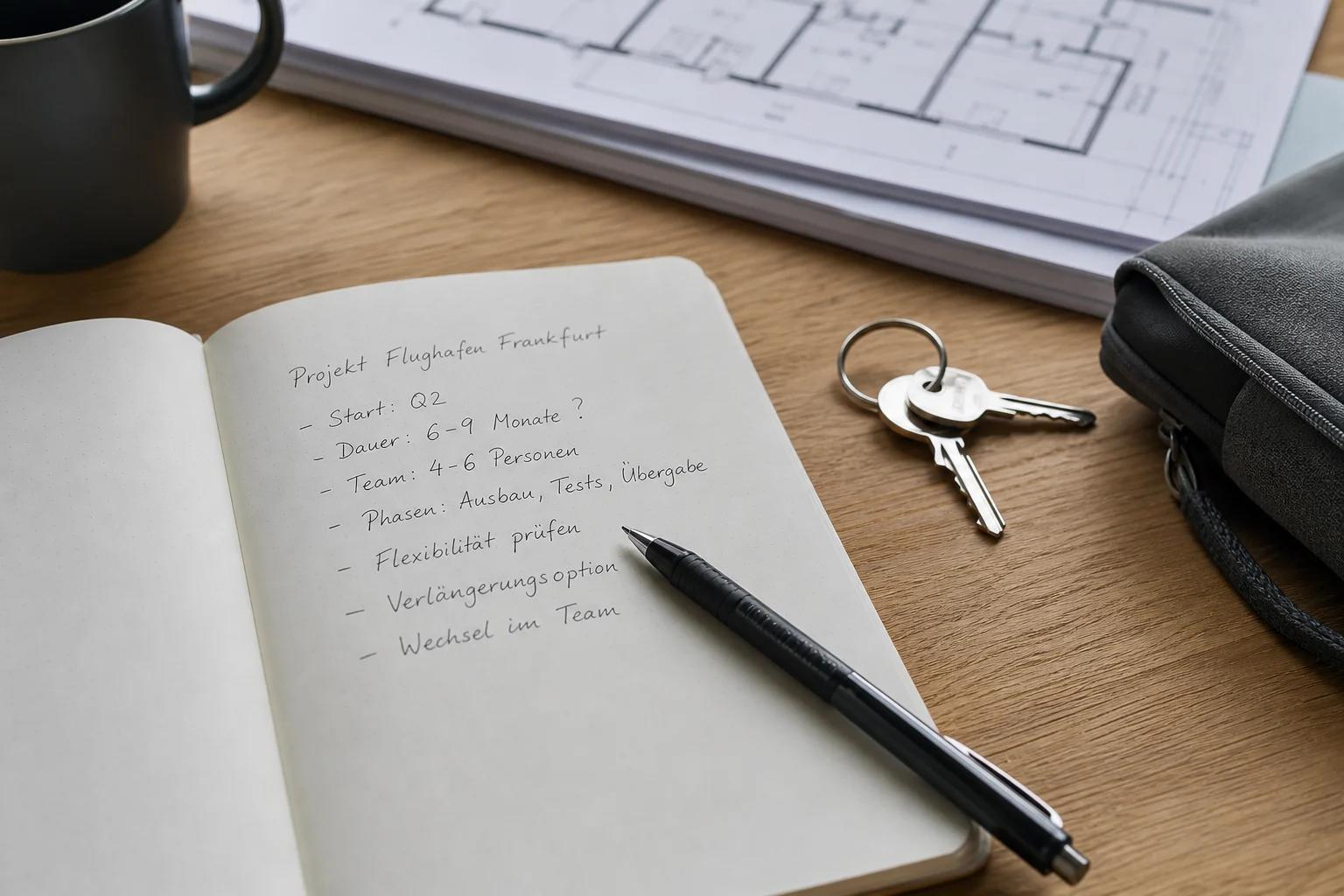
For projects at Frankfurt Airport, the length of stay is rarely just a number. It determines how much the accommodation has to support everyday life. A short project phase requires different priorities than a longer assignment with changing phases, additional material and possible extensions.
It is therefore helpful to ask: is the stay already fully defined, or could the assignment still shift? If dates are still open, the accommodation should not only fit the start date, but also the likely project duration. The longer the stay is planned to be, the more important practical details become, such as a clear sleeping area, enough storage space and a structure that does not have to be reorganized every time a small change occurs.
For companies, it is also important whether the team remains together or whether individual people join later or leave earlier. Clarifying this in advance avoids later friction between the project plan and the accommodation logic. This means the choice is not based on the destination alone, but on the actual length of the assignment and the roles within the team.
How myroom24 structures the search for project teams in Frankfurt
myroom24 is an online booking platform on which commercial accommodation providers offer accommodation for private and business users. For project teams, this is helpful when the destination, length of stay and the most important selection criteria are already defined.
The long stays offered via myroom24 range from 28 to 179 nights. The offering includes rooms, apartments and houses in commercial accommodation facilities such as hotels, hostels, serviced apartments and holiday apartments. Users can specify the travel destination and length of stay and filter available long-stay accommodation by criteria such as price, location and facilities. Accommodation marked as instant booking can be booked without prior approval from the host, subject to availability.
For a project team at Frankfurt Airport, this means the search can be narrowed down to the specific work location, the planned duration and the team’s organizational requirements, rather than comparing random offers.
What information should a corporate inquiry include in advance?
To give the search a reliable direction quickly, the corporate inquiry should be as specific as possible. The key points are above all these:
- How many people are traveling?
- Which work locations are planned for the project?
- Are there different arrival or departure dates?
- Should team members stay together or be accommodated separately?
- Which times need special consideration because of shift starts, rest or handovers?
The clearer this information is, the easier it is to assess whether a location close to the airport, a better connection to multiple places or another type of accommodation makes more sense. For business accommodation in the Rhine-Main area, the address is therefore not the only important factor; the combination of location, process and team structure also matters.
If you now want to narrow the search by location and period, start with myroom24 accommodation.
Frequently asked questions
How can a project team tell whether a location close to the airport or one with better transport connections is the better choice?
If the assignment takes place almost entirely at the airport, proximity to the airport makes more sense. If there are several work locations in the Rhine-Main area, good connections between the work sites are often more important than the airport address alone.
What matters more than the distance to the airport for early, late and night shifts?
What matters are rest periods, separate retreat areas and an arrival window that does not conflict with the shifts. The accommodation must support the team’s daily rhythm, not just be close to the work location.
When is a hotel a sensible choice for longer project stays in Frankfurt?
When standardized processes, fixed services and little coordination effort are important, a hotel can also be suitable for longer stays. The deciding factor is whether the services fit the team’s organization.
How do you proceed if not all team members arrive at the same time or stay for the same length of time?
Then occupancy should be planned in advance according to arrival and departure dates as well as project roles. It makes sense to choose accommodation that can reflect this staggered structure organizationally.