Temporary Housing for Medical Companions and Longer Hospital Stays: What Matters in Everyday Life

When a hospital stay lasts several weeks, the accommodation becomes part of everyday life. For companions, it is then not only about an address near the hospital, but about reliable routes, dependable quiet periods and processes that also work on demanding days. Temporary housing for medical companions and longer hospital stays therefore means above all checking the accommodation so that it genuinely supports everyday life between appointments, waiting times and the journey back.
The most important point to check is not whether an accommodation looks close on the map, but whether it works in real life. A property may be geographically favorable and still be impractical if the route is cumbersome with luggage, the building has many stairs, or rest periods in the room are hardly possible. Conversely, accommodation that is a little farther away can be a good fit if the route is clear, repeatable and manageable without unnecessary extra detours.
Which routes really matter in everyday hospital life?
Proximity to the hospital helps, but it does not replace checking the actual route. For companions, what matters is whether the route works multiple times a day without stress. This applies not only to the first appointment in the morning, but also to the way back after ward rounds, examinations or discussions that take longer than planned.
The practical perspective is important here: How long does the route really take on foot, by public transport or by car? Are there obstacles such as stairs, unclear entrances or confusing transfers? And is the way back still manageable when you are tired or carrying documents, change of clothes or shopping?
A simple guide can look like this:
- Early appointments: The route should be manageable calmly even with little buffer time.
- Between two treatments: A short return to the accommodation must not become a logistical task.
- Late journeys back: The route should remain easy to follow even after a long day.
- Several trips on the same day: The route must be repeatable, not just work well once.
This is exactly where it becomes clear why proximity to the hospital alone is not enough. What matters is the combination of location, easier routes and the question of whether the daily routine does not create new obstacles every time.
Which equipment makes a stay of several weeks more manageable?
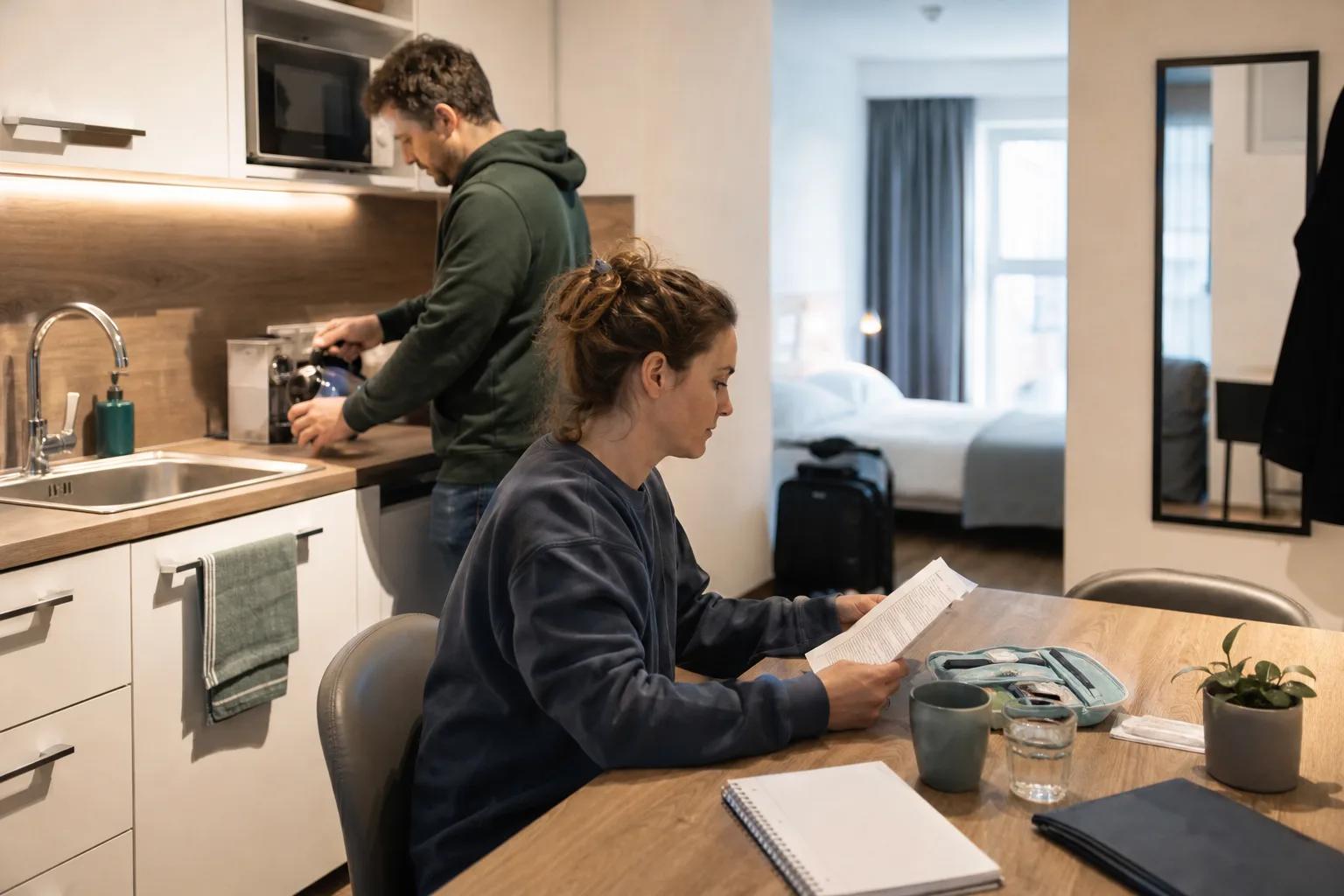
For longer stays, the equipment determines whether the accommodation is just a place to sleep or whether it really supports everyday life. For companions, the points that keep the daily rhythm stable are especially important when hospital appointments are moved or breaks are shorter than expected.
It is worth looking at these details:
- Kitchen or kitchenette: It makes meals easier when treatment times are irregular.
- Private bathroom or a sanitary area that is easy to use: This makes the start of the day more predictable and reduces coordination.
- Quiet accommodation: Anyone who needs to rest or make phone calls after conversations or waiting times needs as little disturbance as possible.
- Elevator or few stairs: This helps when luggage, documents or shopping must be carried regularly.
- Clear access to the room: Long routes inside the building or a complicated entrance cost extra energy every day.
- Enough space for personal items: During stays of several weeks, documents, medication and change of clothes quickly become a fixed part of everyday life.
Important here: serviced apartments and apartment hotels can be just as suitable for longer stays as a classic apartment if the equipment and location match the need. Hotels are also not ruled out across the board. What matters is what the specific accommodation offers and whether these points fit the daily routine with hospital, rehab or aftercare.
How should accommodation and daily routine fit together?
Accommodation is well chosen when it fits the fixed and unpredictable parts of the day. Hospital phases are rarely completely predictable: there are ward rounds, waiting times, delays and conversations that can take longer. That is why the accommodation should not create additional pressure.
It makes sense to go through a typical day before booking. When does the first appointment start? How much buffer time is left for the outward and return journey? Is it possible to go back to the accommodation in between without losing half the morning? And what happens if an appointment ends later than announced?
Four concrete questions help with planning:
-
Does the arrival time fit the first treatment?
If move-in and the first appointment are too close together, unnecessary time pressure is created. -
Is there enough rest between two appointments?
An accommodation should allow short recovery periods too, not just the night. -
Are small errands possible without detours?
Especially during longer stays, quick everyday routes become more important than extra services. -
Is access still uncomplicated on a long day?
An easy return route is more important than a good description on paper.
This makes the accommodation a fixed part of the day rather than another organizational task.
What is additionally important in rehab and aftercare?

In rehab and aftercare, many routines repeat over weeks. That is why it is not enough to look only at the first day. What matters more is whether the accommodation still works when appointments recur regularly or routines change slightly from week to week.
For this phase, it is particularly relevant whether the companion can really use the accommodation between treatments. That means: rest, sort documents, make phone calls, eat or simply take a break without having to travel new routes every time. If every interruption triggers additional journeys or complicated coordination, the stay becomes unnecessarily cumbersome.
It is therefore helpful to look at the repetition of everyday life:
- Does the route to the hospital remain reliable across several appointments in the week?
- Can the accommodation also be used sensibly on days with longer breaks?
- Are rest, meals and return organized so that constant improvisation is not necessary?
- Does the surroundings fit when appointments take place regularly over a longer period?
Especially in aftercare, it is not the single good day that counts, but reliability over the entire period.
How myroom24 can structure the search
myroom24 is an online booking platform where commercial accommodation providers offer accommodation for private and business users. For longer hospital phases, it is particularly helpful that the destination and length of stay can be entered and available long-term accommodation can be filtered by criteria such as price, location and equipment.
myroom24 offers, among other things, rooms, apartments and houses in commercial accommodation facilities such as hotels, hostels, serviced apartments and holiday apartments. The long-term stays offered via myroom24 cover 28 to 179 nights.
This is practical when the accommodation should not only be near the hospital, but also fit the intended period and daily organization. Anyone searching in a targeted way can consider location and equipment together and thus compare offers that really come into question for the planned stay.
How does the decision between similar offers become easier?
When several accommodations look similar, a clear order in the evaluation helps. First, the route to the hospital should be right. Then quiet and the question of whether withdrawal and breaks are possible in everyday life become important. Only after that should details such as room layout, building access or additional services make the difference.
A simple decision aid is:
- For changing or early appointments: The most reliable route to the hospital takes priority.
- For long waiting times: Quiet and a well usable retreat become more important.
- For self-catering: Kitchen or kitchenette should be checked clearly.
- For a lot of luggage or limited resilience: Elevator and short routes inside the building carry more weight.
- For a stay of several weeks: The accommodation should also function reliably on ordinary days, not only during the first viewing.
Anyone who goes through these points consistently does not decide based on the first impression, but on the actual benefit in everyday hospital life. For the next step, it is worth taking a look at myroom24 accommodations to compare location, equipment and length of stay with the planned schedule in a targeted way.
Frequently asked questions
When is accommodation with a kitchen particularly useful for companions?
Especially when appointments are irregular and meals cannot be planned at fixed times.
How can I tell before booking whether the location is really practical?
If the route to the hospital can be managed several times a day without detours, stairs or unclear transitions.
Which type of accommodation is more suitable for longer hospital stays: hotel, serviced apartment or apartment?
That depends on whether service, self-catering or the clearest possible daily routine is the priority.
What should be checked differently for rehab or aftercare than for a single hospital appointment?
Whether recurring routes, rest periods and everyday routines work reliably over several weeks.
What is more important for the companion than proximity to the hospital alone?
A route that works in everyday life, a quiet retreat and equipment that does not complicate daily routines.