Temporary Housing for Medical Professionals with a Longer Commute to the Clinic: Live Quietly, Work Closer
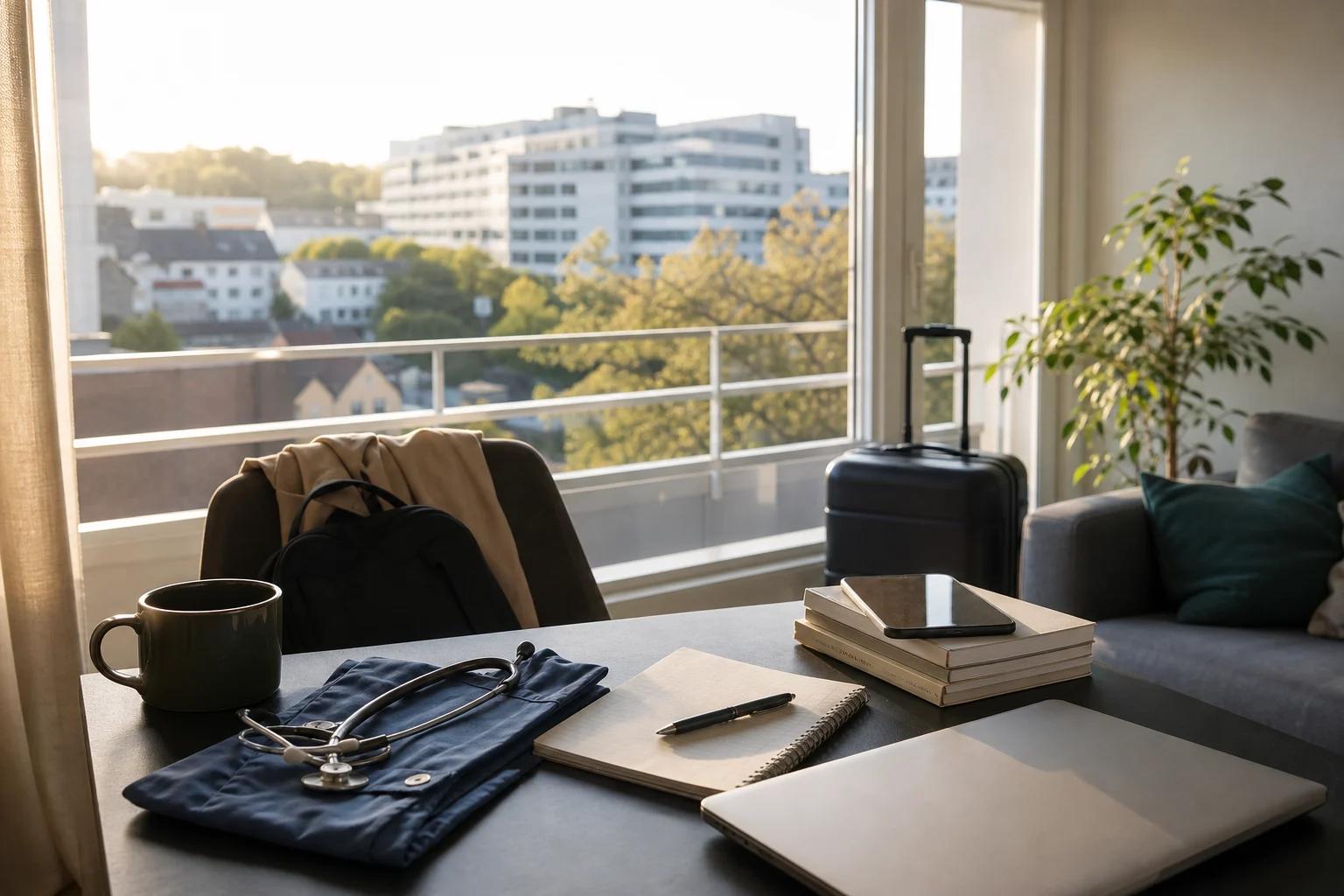
Which questions should medical professionals clarify first?
When it comes to temporary housing for medical professionals with a longer commute to the clinic, it is rarely about the most beautiful accommodation, but about the most reliable one. Anyone with longer journeys to work for early, late, or night shifts needs accommodation that takes the realities of the assignment into account: Is the route to the clinic manageable? Can you really sleep there? Are there enough ways to handle meals, laundry, and move-in logistics cleanly?
For individuals and for HR departments, it is worthwhile to check these questions in exactly this order. That makes it faster to see whether a property is suitable for the specific shift schedule or only seems appropriate on paper.
How do I check the route to the clinic in a way that fits the shift?
The map view alone is not enough. What matters is how the route behaves at the times when the shift actually begins or ends. A short journey at midday can be significantly more demanding in the morning before a shift starts or late after a shift.
In practical terms, the route should be checked at the actual shift time, not just as a rough distance. Anyone traveling by public transport should pay attention to transfers and frequency. Anyone arriving by car should take the usual traffic at the time of the assignment into account. Even small differences in the process make a big difference in clinic life, for example when the start is not at a fixed office time, but before sunrise or after a long late shift.
For teams in clinics, this is especially important when staff are traveling from farther away. In that case, what matters less is whether accommodation looks close on the map, and more whether the route works reliably in everyday life.
Which amenities really save trips between two shifts?

For longer assignments, accommodation becomes practical above all when it replaces recurring trips. A kitchen matters when meals should not be tied to fixed restaurant or canteen hours. This is especially relevant for shift work, because arrival and break times are often not conventionally schedulable.
A laundry option should also be considered early. Anyone staying for several weeks needs a solution for clothes and laundry without having to plan around external opening hours all the time. That is not only convenient, but also reduces additional organizational steps after a long shift.
Quiet is just as important. After demanding shifts, it is not enough that a bed is available. The accommodation must be chosen so that recovery remains possible. Anyone reviewing offers should therefore not only look at photos, but also ask: Does the environment make sleep easier or harder?
A good rule is: every amenity should either save time or make recovery easier. If a feature does neither in everyday life, it is probably secondary for the specific assignment.
How do I compare an apartment, serviced apartment, apartment-hotel, and hotel objectively?
For longer clinic stays, the type of accommodation should not be chosen based on prejudice. A temporary apartment can make sense when independence and clear structure are important. Serviced apartments and apartment-hotels are just as suitable for long stays as an apartment if they offer the right location, quiet, and desired level of service. A hotel can also work if the specific property fits the needs of the assignment.
The sensible approach is therefore not a comparison by label, but by function. Someone who wants to organize as little as possible will set different priorities than someone who wants to live as independently as possible. Someone who mainly needs quiet after a long shift will evaluate things differently than someone who must work flexibly during the day. And someone planning with changing shift times will look at total costs, location, and room layout differently than someone with fixed working hours.
It is also important not to compare only the amenities, but the overall situation. That includes the location relative to the clinic, the type of accommodation, on-site service, and the move-in process. This makes the decision property-based rather than categorical.
How does myroom24 help with such a search in practice?
myroom24 is an online booking platform on which commercial accommodation providers offer accommodation for private and business users. For medical professionals and HR departments, this is helpful when a clear period and concrete criteria have already been defined.
On myroom24, the destination and length of stay can be specified. Available long-stay accommodations can be filtered by criteria such as price, location, and amenities. This is useful when accommodation should not be just "somewhere nearby," but must be selected specifically according to the place of assignment and the planned everyday routine.
The long stays offered via myroom24 range from 28 to 179 nights. Depending on the need, different types of accommodation can be reviewed, including rooms, apartments, and houses in commercial accommodation facilities such as hotels, hostels, serviced apartments, and holiday apartments. Accommodations marked as instant booking can be booked without prior approval from the host if available.
For this search purpose, that is practical because the focus is first on the right period and only then on the property. That is exactly how accommodation can be found that fits the assignment and the planned journey, instead of merely being formally available.
What does a good decision look like in practice?

An example: a nurse is to support a clinic with longer shifts for several weeks. The accommodation is not directly at the main entrance, but it is connected in such a way that the route remains reliable at the actual shift times. At the same time, there is a kitchen for flexible meals and a laundry option for the multi-week stay.
In such a case, the decision is not only a question of distance. What matters is whether the accommodation supports the entire routine: arrival, sleep, meals, laundry, and the daily route to the clinic. When these points fit together, a long commute does not become constant extra effort in shift work.
This way of thinking also helps HR departments: instead of confirming accommodation based only on proximity, it becomes possible to check whether it truly supports the shift schedule. That saves follow-up questions and avoidable rescheduling later.
Which points should HR departments document before booking?
For organizational bookings, it is helpful to bundle the requirements clearly in advance. These include above all the exact period, the realistic arrival time, the necessary proximity to the clinic, and the question of which amenities are actually needed in everyday life.
Especially with changing shifts, it should also be clear who coordinates the arrival and who is available in case of questions. That way, the booking does not only become an issue at move-in, but is already properly prepared. This is especially important when employees are not from the region and the assignment starts at short notice.
Anyone who clarifies these points properly avoids duplicate questions and can choose accommodation that matches the shift schedule.
What is the next sensible step?
If you are looking for specific accommodation for a planned assignment, start with myroom24 accommodation and compare the properties by location, amenities, and length of stay.
Frequently asked questions
How do I assess the location when early, late, and night shifts start at different times?
Check the route at the actual shift time, not just at midday. What matters is whether the journey works reliably for all relevant shifts.
Which amenities should be checked first during longer clinic stays?
Kitchen, laundry option, and quiet. These three points have the strongest influence on whether everyday life between two shifts works without additional trips.
When does a hotel still fit despite a longer commute to the clinic?
When the specific property combines location, quiet, service, and process well with the assignment. The category alone does not say anything about that.
What should HR document before booking accommodation for clinic staff?
Period, arrival time, connection to the clinic, required amenities, and the responsible contact person. This makes it possible to choose accommodation that matches the shift schedule.