Temporary Housing for Moving with Children and Home Office Option: How Family Life Stays Manageable During the Transition

What actually has to work during the transition phase?
When it comes to temporary housing for moving with children and a home office option, it is not first about attractive furnishings, but about reliable routines. Between moving out and moving in, after a job change, or during a renovation, the accommodation has to carry several roles at once: sleeping, working, eating, laundry, and the routes to school or daycare. The fewer these routines interfere with one another, the easier it is to keep everyday life manageable.
For this interim phase, apartments, serviced apartments, apartment hotels, or hotels may be suitable. The decisive factor is not the label alone, but whether the accommodation fits the family’s concrete needs: How many people need space to withdraw? How often is home office used? How much cooking and laundry is involved? And how important are short distances in everyday life? Anyone who answers these questions first compares offers by usefulness rather than by label.
Which room layout prevents constant rearranging in everyday life?
Is an additional room enough, or are two bedrooms really needed?
The key question is not only how many rooms are available, but whether sleeping and working can really be separated from each other. Two bedrooms are especially helpful when children have different bedtimes or one parent still needs to work in a concentrated way in the evening. Then there is less friction because not every routine takes place in the same room.
However, a second room only brings real benefit if it is quiet enough and is not used as a permanent passageway. That is why a very practical check is worthwhile before booking: Can one room become the sleeping zone in the evening while the other is used for work or play during the day? If furniture would have to be moved every time, the layout is often less suitable for everyday life than it appears in photos.
Which questions help more during a viewing than a glance at the floor plan?
Families should not only ask whether the accommodation seems large enough, but how often they would have to rearrange things in daily life. Useful check questions include, for example:
- Does a work area have to be cleared before every video call?
- Do you walk directly from the entrance through sleeping or working zones?
- Is the quietest spot really also the spot where work can be done?
- Can one area be closed off in the evening without affecting all the other rooms?
These questions show whether the room layout supports the daily rhythm or constantly demands new compromises. Especially during a family move, that is often more important than a single large room.
Which equipment should be checked specifically before booking?
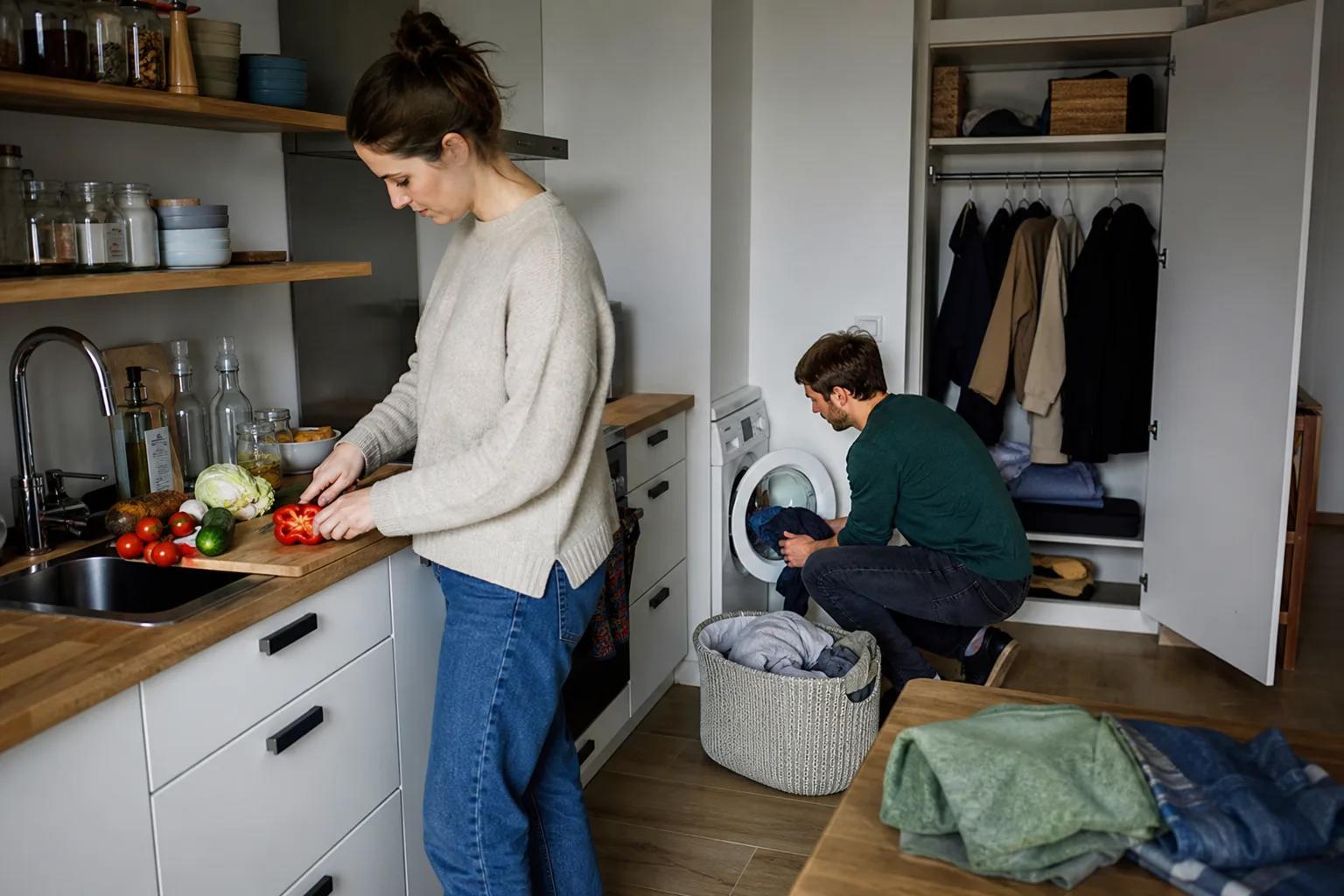
Why the kitchen and laundry option should be considered together
With children, an existing kitchen quickly becomes the practical core of the accommodation. Breakfast, packed lunches, dinner, and small snacks can only be organized without much extra effort if the kitchen is actually usable in everyday life. This is especially relevant during the transition period, because meal times, school appointments, and work blocks are often not freely movable.
A laundry option is just as important. In family life, more laundry usually accumulates than in the case of a single person or a couple. If washing is possible on site or clearly arranged, additional trips are avoided and clothing remains easier to plan. This is not about comfort for comfort’s sake, but about whether the daily routine is constantly interrupted.
How do you recognize storage space that is not only enough on paper?
Storage space in an interim apartment is useful when it really creates order. Families need room for clothes, shoes, school materials, toys, suitcases, and often also documents related to work and the move. If these things are left out in the living area, an actually functional accommodation quickly becomes a restless transitional space.
That is why a close look at cupboards, shelves, and small side areas is worthwhile. The decisive question is: Can the most important things be stored in such a way that sleeping, working, and living do not constantly run into each other? Anyone who checks this point assesses the accommodation by its practical value and not by decorative details.
What does a home office space in a family apartment need besides an internet connection?
Wi-Fi is only a prerequisite, not the whole solution. For home office in a family context, what matters most is whether the workplace has its own logic: enough surface for a laptop and documents, a chair that can be used for several hours, and as little through traffic as possible. As soon as regular phone calls or video meetings are added, quiet becomes more important than an improvised spot at the edge.
A good test is therefore simple: Can you work there while the rest of the family follows its normal daily routine? If school, play, meals, and work are constantly claiming the same area anew, more friction than necessary arises in the long run.
How do you weigh location against space?
For families with children, location is often not just a question of the address, but of the recurring routes. Anyone who has to get to school or daycare every morning while also working from home primarily needs predictable connections. A good public transport connection can help if a car is not always available or if several appointments fall on the same day.
More important than a general location description is the view of everyday life: How quickly is the route to school, daycare, shopping, and work? Is arrival practical with a stroller, luggage, or school bag? Is the route still reliable when everything happens at once in the morning? These questions are more meaningful than a general reference to a pleasant environment.
If the routes are very regular, a well-connected location can be more important than additional space. If, on the other hand, family life is mainly organized within the accommodation, room layout and retreat zones move to the forefront. It is precisely this trade-off that helps avoid optimizing the wrong thing.
How myroom24 structures the search for families
myroom24 is an online booking platform where commercial accommodation providers offer accommodations for private and business users. For families in the transition phase, this is especially useful because the travel destination and length of stay can be specified and available long-term accommodations can be filtered by criteria such as price, location, and equipment. The long-term stays offered via myroom24 cover 28 to 179 nights.
For a family with a fixed moving date, this is helpful because the search can be aligned with a realistic time frame. In addition, accommodations marked as instant booking can be booked, subject to availability, without prior approval from the host. This can make the selection easier when the transition phase is clearly limited in time and several framework conditions must fit together.
Which decision matrix helps before the viewing?

Instead of weighting all criteria equally, a simple order helps. Not every family needs the same priority:
| Situation | First priority | What to check | | --- | --- | --- | | One parent regularly works from home | Separate, quiet work area | Can work be done there without constantly rearranging the sleeping or play area? | | Children have clear bedtimes | Retreat and room separation | Can one area be kept quiet in the evening while the rest of the apartment is used? | | School or daycare determines the daily rhythm | Location and routes | Are the daily distances reliable and compatible with family life? | | Many items from two households must be stored temporarily | Storage space | Is there enough room so that suitcases, clothes, and documents do not interfere with the living area? |
This matrix does not replace a viewing, but it prevents a single detail such as a nice table or a spacious living room from obscuring the real everyday challenges.
Which decision ultimately leads to less rearranging in everyday life?
The best choice is usually the accommodation where the most important routines interfere with each other the least. Anyone who checks sleeping, working, cooking, laundry, storage, and routes separately in advance can more quickly see whether a transitional apartment really fits the family rhythm. An accommodation may be compact, as long as the areas remain clearly usable and do not have to be reorganized all the time.
If you would like to check these criteria now in a targeted way, start with the myroom24 accommodation and filter by length of stay, location, and equipment.
Frequently asked questions
How can I tell whether a separate retreat room is really enough for our family?
If the room can be used without through traffic and sleeping or working there is not constantly interrupted.
What should I check first if home office and early children’s bedtimes are both important?
Whether the work area and sleeping area can be separated so that no daily rearranging is needed.
When is location more important than a larger floor plan?
When school, daycare, or commuting have to work according to the same schedule every day.
Which equipment is especially critical in a transitional apartment for families?
A usable kitchen, a laundry option, sufficient storage space, and a work area that is not right in the middle of family traffic.
How does a clear length of stay help me choose?
It narrows the search to offers that fit the actual transition period between moving out and moving in.