Temporary Housing for Remote Workers with a Quiet Work Environment: Check Workspace, Wi-Fi, and Everyday Living
What question should be at the start of your search?
If you are working and living in one place for several weeks, asking only for a “nice room” is not enough. What matters is how your workday actually works there: with calls, focus phases, breaks, meals, and sleep. The more precisely you describe your everyday routine, the easier it is to see whether a place is only pleasant for short stays or whether it can also support a longer rhythm.
For temporary housing for remote workers with a quiet work environment, it helps to first organize your own working style. Do you work with fixed time slots, do you often switch between deep work and meetings, or do you work at off-peak hours with participants in other time zones? These differences significantly change the requirements for space, quiet, and accessibility.
A simple preliminary check is helpful:
- Do you need a fixed workspace, or is a well-usable table enough for individual work blocks?
- Are video calls a daily part of your routine, or only needed occasionally?
- Does the living space also need to function as a work area during the day?
- Do you want to be able to consciously create distance from the workspace in the evening?
Anyone who clarifies these points in advance compares accommodations not by impression, but by suitability for everyday life.
How should a workspace be arranged in the room?
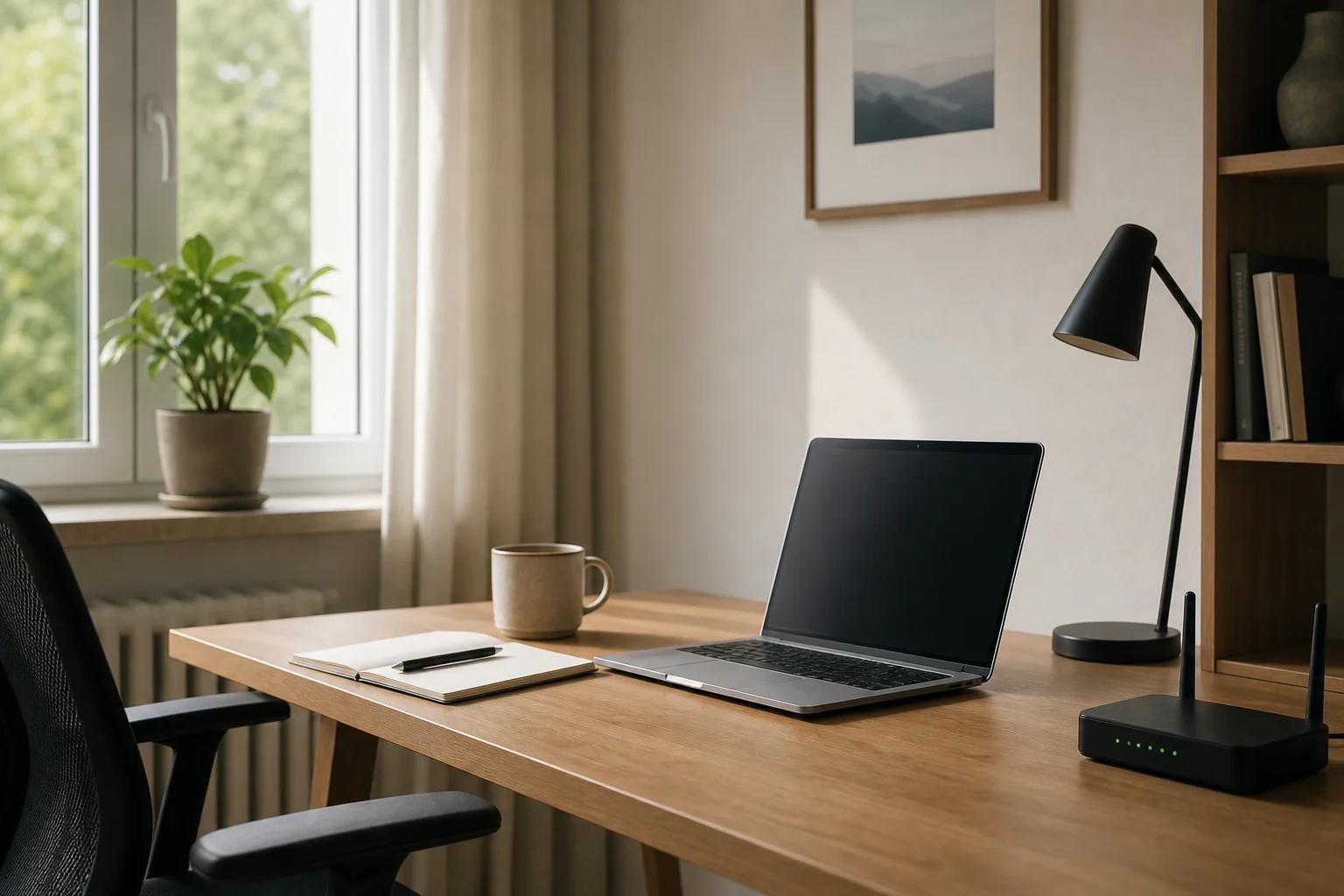
A good workspace is created not only by a table, but by the combination of surface, light, power outlets, and surroundings. For longer remote phases, it is important that you do not have to rearrange everything every day. If your laptop, charger, headset, and documents are constantly being put away and taken out again, that costs time and concentration in the long run.
What matters specifically in the work zone
- Table size and position: Does it fit not only the laptop, but also a second work surface for documents or a notebook?
- Power outlets within reach: Can you charge devices without running cables across the room?
- Lighting: Is there daylight and also lighting that makes screen work possible in the evening?
- Seating position: Can the chair be used in a way that lets you work steadily for longer periods?
- Separation from the sleeping area: Does the workspace remain recognizable as a workspace, or does it become an improvised storage spot in the evening?
The placement of power outlets and the table is often more important than size alone. A smaller room can be more practical than a larger one if everything is within reach and you do not have to organize your equipment over long distances. For a functional home office for a temporary stay, room size is therefore not the only relevant factor; the key question is also whether your workspace can be set up permanently.
How do you check Wi-Fi and technical suitability for everyday use?

With WLAN long-stay, the simple note “internet available” is not enough to make a decision. For remote work, what matters is whether the connection fits your actual usage profile: many video conferences, cloud work, large files, or changing working hours. An offer may seem technically suitable and still cause too many interruptions in everyday life if you have not clarified the most important details in advance.
These questions are useful before booking:
- Is Wi-Fi available in the room itself, or only in shared areas?
- Is the connection designed for several devices at the same time when laptop, phone, and other work equipment are running in parallel?
- Can you work where you also want to sit, or do you have to move around to get a connection?
- Is there a contact person if technical questions arise during the stay?
These points help you assess a remote work accommodation not just by the existence of a network, but by its practical usability in everyday life. It is also important whether your workdays remain manageable if you occasionally rely on longer online sessions. If you communicate a lot, you do not just need “internet,” but a stable routine without constant plugging in and out or changing locations within the room.
How do you recognize whether quiet and service work together for several weeks?
Quiet does not come from a good location alone. It also depends on how the building is organized. If you stay for a longer period, you should not only pay attention to street noise, but also to sounds from the building itself: hallway, entrance area, elevator, common areas, or other rooms. This becomes especially relevant if you work early in the morning, late in the evening, or in unusual time windows.
Which details reveal more than a nice description?
- Is the room located so that you are not living directly next to heavily used areas?
- Are there indications of how much movement there is in the building and when you need quiet?
- Is it clear how cleaning, linen changes, or other service tasks are organized in long-stay mode?
- Can you plan your workdays without the most important work blocks being interrupted by house routines?
Cleaning and service are often underestimated during longer stays. They are not just a comfort issue; they also affect whether the space stays organized over several weeks. If you work frequently, you should know when services take place and whether they fit your schedule. That way, you avoid surprises that only become visible in everyday life.
Which location really helps in everyday life?

For stays of several weeks, the surroundings often determine the practical value of an accommodation. A good location is not automatically just a central one, but the one that reduces your routes and makes your day predictable. If you still want to shop after work, go for a short walk, or get something done between two calls, short and reliable routes are often more important than a particularly striking residential area.
Pay attention to these questions:
- How far are the everyday routes to local shops, public transport, or the place where you start your day?
- Can you spend breaks outside in a sensible way without planning long distances for it?
- Does the surroundings fit your work rhythm if you start focused in the morning or still have appointments in the evening?
- Is the way back still practical if you return late or need to pick something up in between?
This way, you are not just comparing an address, but the environment in which your workweek takes place. That is especially important if you are living in one place for several weeks and do not want to reorganize everything every day.
How myroom24 structures the search for longer remote phases
myroom24 is an online booking platform on which commercial accommodation providers offer accommodations for private and business users. The range includes rooms, apartments, and houses in commercial accommodation facilities such as hotels, hostels, serviced apartments, and vacation rentals.
For your search, you can specify your destination and length of stay on myroom24 and filter available long-stay accommodations by criteria such as price, location, and amenities. This is helpful if, for several weeks, you are looking not only for a place to sleep, but for a place to work with a suitable environment.
The long-stay options offered via myroom24 cover 28 to 179 nights. Accommodations marked as instant booking can be booked without prior approval from the host, subject to availability.
This lets you align the search from the start with the period in which remote work actually takes place. That way, you can specifically check which accommodations fit your work rhythm, the quiet you need, and your desired living comfort.
Which booking details should you check once more before submitting?
Before you book, it is worth taking one last look at the points that often make the biggest difference in everyday life. What matters is not only whether an offer basically fits, but whether it is clearly described for your specific way of working. So check which services are included, which questions remain open, and whether the conditions fit your planned stay.
These questions are especially useful for longer stays
- Is it clear how the workspace in the room can be used without you having to move things around every day?
- Are quiet hours, house organization, and cleaning routines described in a way that fits your working hours?
- Are your main routes short enough so that shopping, breaks, and appointments fit easily into your day?
- Are the amenities and location presented in a way that lets you assess the actual workday?
If you check these points carefully, you are not making a decision based on feeling, but on the course of your workday. That is the most reliable approach, especially during longer remote phases.
If you want to narrow down suitable options, start with the myroom24 accommodation and filter by destination, duration, and amenities.
Frequently asked questions
How can you tell whether the workspace in the room is enough for several weeks?
If the table, power outlets, and light work well together and you do not have to move your equipment around every day, the workspace is usually more suitable for everyday use.
What should you do if your working hours do not match the quiet hours in the house?
Clarify in advance where the typical noises come from and whether your room is physically separated from them.
Which location is especially practical for remote work over several weeks?
The most helpful locations offer short routes to supplies and transport so that breaks, shopping, and appointments work without major detours.
How do you compare an apartment, a serviced apartment, and a hotel without blanket assumptions?
Look at the layout, quiet, service, and everyday effort instead of focusing only on the type of accommodation.