Temporary housing for returnees from abroad: How to restart in Germany without housing stress

What should be clarified before returning to Germany?
The return becomes much easier if you do not start planning only after arrival. For the first weeks after the move, three things are especially important: a reliable place to stay, a realistic timeframe, and a rough plan for registration, work, and everyday life.
Practically, it helps to break the return down into three questions:
- Where will I live in the first few weeks?
- Which appointments have to work immediately after arrival?
- When will I decide on a permanent housing solution?
Especially when returning from abroad, the transition period is often not a side issue but the phase in which the most important decisions are made. A temporary apartment provides structure without requiring you to finalize everything right away.
Which documents and information should you gather in advance?
For the return itself, luggage and transport are not the only important things; organizational basics matter too. A small return folder with all the information you may need quickly in the first few days is useful.
This includes, for example:
- ID card or passport
- rental or booking documents for the temporary accommodation
- employment contract or documents related to starting a job, if available
- important addresses and phone numbers
- proof or documents required for registration or appointments
- a list of open to-dos for the first 7 to 14 days
Anyone who has these documents bundled together saves time after arrival and avoids unnecessary back-and-forth. This is especially helpful if you first need to get used to German procedures again after a long time abroad.
How do you structure the first weeks after returning in a sensible way?
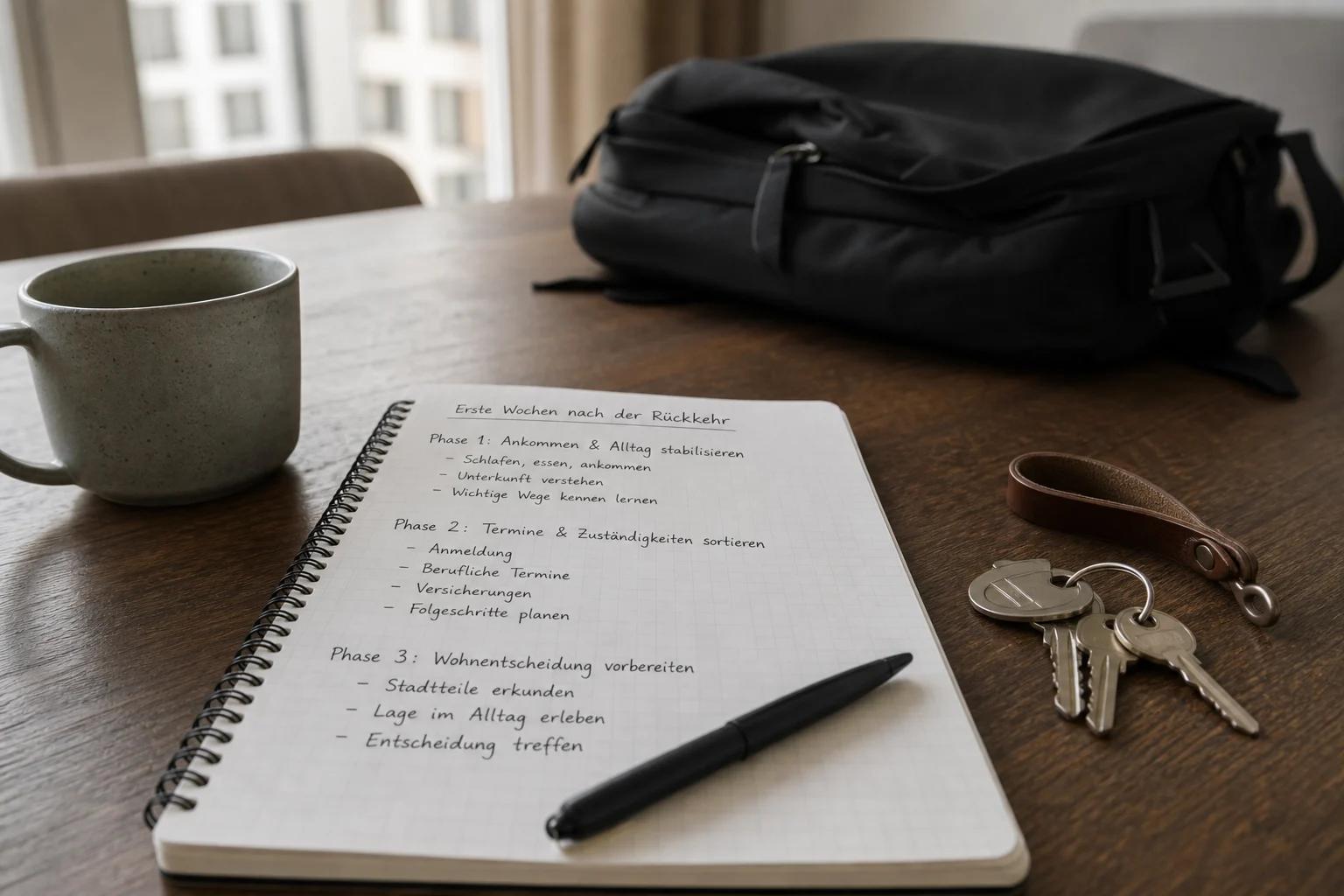
Most returnees benefit from a clear process instead of spontaneous improvisation. It helps to think of the time after arrival in phases.
Phase 1: Arrive and stabilize everyday life
In the first few days, the goal is not to have everything sorted out already. What matters more is that you sleep, eat, understand the accommodation, and know the most important routes. These include, for example, the way to work, the nearest supermarket, or the next appointments.
If you have a lot of organizational pressure immediately after returning, a furnished temporary solution is often useful because you do not also have to organize furniture, a kitchen, or basic equipment.
Phase 2: Sort appointments and responsibilities
Once the first routes are clear, you can structure the next tasks. Typical topics are registration, professional appointments, insurance questions, or clarifying the next steps for your permanent place to live. Especially in this phase, a fixed base is useful from which you can handle tasks one after another.
Phase 3: Prepare the permanent housing decision
Only when you are back into everyday life can you better assess which district, which location, and which type of housing really suits you. Many decisions only become possible once you are no longer just planning but are already experiencing the city in daily life.
How do you recognize a sensible interim solution for the return?
A good interim solution is not simply one that is available at short notice. It fits the actual needs of the first few weeks.
Pay particular attention to these points:
- Duration: Does the accommodation fit the planned period?
- Location: Are work, registration, appointments, and shopping easy to reach?
- Amenities: Can you live there immediately, sleep, and organize the first days?
- Suitability for everyday life: Is the accommodation suitable for sorting documents, doing digital work, or preparing appointments?
- Predictability: Is it clear how the booking, the period, and the terms are structured?
It is important to note that not every return requires the same type of accommodation. Someone who is often on the move and only needs a compact starting point has different requirements from someone who has to coordinate a job start and a search for housing at the same time in the first few weeks.
Which differences matter for apartments, serviced apartments, aparthotels, and hotels?
For returnees, the name alone is not decisive, but rather the specific suitability for the first few weeks. A classic apartment usually offers more independence. Serviced apartments and aparthotels may also include services that are helpful during a transition phase. Hotels can also be suitable for longer stays if the location, amenities, and the transparent overall solution match your own requirements.
Instead of making a blanket comparison, it is worth looking at these criteria:
- Independence: How much of everyday life do you organize yourself?
- Scope of services: Which services are included, and what do you have to handle yourself?
- Wohnen auf Zeit für Rückkehrer nach dem Ausland works best when you adapt the accommodation to your actual start-up needs.
- Transparency: Which services, periods, and conditions are clearly understandable?
This turns the choice into a factual decision based on the situation, timeframe, and work routine rather than a fundamental question of “good” or “bad.”
How can myroom24 specifically help with the return?
myroom24 is an online booking platform where commercial accommodation providers offer accommodations for private and business users. For returnees, this is especially practical when different types of accommodation need to be compared in a short time without being tied to just one solution.
On myroom24 you will find rooms, apartments, and houses in commercial accommodation facilities such as hotels, hostels, serviced apartments, and holiday apartments. Long stays range from 28 to 179 nights. For the search, you can specify your destination and length of stay and filter available accommodations by criteria such as price, location, and amenities.
If your return date is already fixed, instant booking can also be helpful: accommodations marked as instant booking can be booked without prior approval from the host if available. This is especially useful if you want to plan your first weeks in Germany in a binding way.
How do B2C returnees and HR managers think differently about the transition period?

Not every return is organized privately. For companies and HR or mobility managers, the question often is how to organize a secure start for employees returning from abroad. For private individuals, by contrast, the immediate combination of housing, work, and settling in is usually the focus.
For both groups, it helps to check the same core questions:
- Is the period clearly defined?
- Is the accommodation close enough to the first routes?
- Is the booking structured in a way that keeps the start predictable?
- Is there enough flexibility if the next housing step is only decided after a few weeks?
The difference usually lies less in the accommodation itself than in the coordination: private returnees often need a simple, understandable start. Companies, on the other hand, benefit from clear planning for arrival, accommodation, and the start of the assignment.
Which sequence has proven effective for the first 14 days?
A practical process for the first time after returning often looks like this:
Day 1 to 3: Settle in
Arrive, check the accommodation, stabilize your sleep rhythm, and explore the surroundings.
Day 4 to 7: Organization
Sort out important appointments, clarify routes, gather documents, and structure any open registration or work-related questions.
Day 8 to 14: Prepare decisions
Use initial impressions from everyday life to assess the permanent housing solution, the right district, or further steps more realistically.
This sequence is not a rigid rule, but it helps to keep the restart from becoming overwhelming. Especially after a long time abroad, it makes sense to treat the first weeks consciously as a transition phase.
The next sensible step
If you are planning your return to Germany, start with the period, the location, and the amenities. Then compare accommodations that suit your first few weeks specifically, instead of having to make the final housing decision in advance. A good starting point for your search is the myroom24 accommodation if you want to organize the transition period consciously and predictably.
Frequently asked questions
Which documents should I have ready immediately before returning to Germany?
Keep your ID card or passport, booking documents for the accommodation, important addresses, work-related documents, and a short list of your first appointments ready. This helps you avoid unnecessary searching in the first few days.
What is more important for the first weeks after returning: a central location or more space?
Usually the location is more important if you need to organize registration, work, and everyday life at the same time. More space is especially worthwhile if you really need it for work, documents, or longer stays.
How long should temporary accommodation be planned for after staying abroad?
It makes sense to plan the period until the first organizational steps are completed and the next housing decisions can be realistically assessed. The exact duration depends on your job start, the city, and your personal situation.
When is a serviced apartment more suitable for returnees than a classic apartment?
When you mainly need a furnished, clearly structured start in the first few weeks and do not want to immediately take care of permanent furnishings. In that case, services and existing amenities can make the transition easier.
Can I book already if I do not yet know my final place of residence?
Yes. That is exactly what temporary housing is for: you secure the first few weeks and gain time to decide on your permanent place of residence after arrival in peace.