Temporary housing for separated parents and shared custody: a stable transitional solution for families from 28 nights

When does a second home really help in a shared custody arrangement?
A second home is especially useful when not only the place of residence changes, but several everyday components also have to be organized at the same time. In a shared custody arrangement, this involves routes to school or daycare, handovers between parents, leisure appointments, bedtimes, and the question of where clothes, school materials, and personal items stay.
The key difference is this: not every tense family situation needs another apartment right away. Temporary housing for separated parents and shared custody becomes relevant above all when the current solution makes moving between two households unnecessarily complicated in daily life. That can be the case if children would have long detours, handovers regularly fall into hectic times of day, or one parent needs to live closer to school, childcare, or the commute on certain days of the week.
A second home is therefore not just a reaction to the separation itself, but to the concrete logic of family life. Anyone who clearly describes that logic can better decide whether a temporary apartment for parents actually brings order to everyday life or whether other issues should be clarified first.
Which everyday situations speak especially for temporary housing in a shared custody arrangement?
For the decision, it is not only important that an additional place to live is needed, but why. Different situations require different solutions.
When exchange days and handover days create too much friction
Some families only realize in the weekly rhythm that packing, picking up, and sorting again takes more time than expected. Then it is not just about the route, but about the recurring organization around belongings, appointments, and responsibilities. A temporary apartment after separation with children can help in such a phase if important things can stay on site and do not have to move back and forth between two households every time.
When school or childcare routes shape the daily schedule
The more fixed the times for school, daycare, hobbies, or childcare are, the more important the location of a home becomes. Good transport links are then not an extra advantage, but part of practical everyday suitability. If arrival, pickup, and handovers fit the children’s fixed times, there is less pressure in the morning and afternoon.
When two households are not yet neatly separated organizationally
In transitional phases, it is often still unclear which things will stay where permanently and which will be taken along every day. Then a second home becomes especially useful when it creates clear responsibilities. This affects not only furniture or clothes, but also learning materials, toys, sports bags, and personal routines. Families in a transitional phase benefit above all when one place does not have to be “set up” from scratch every time.
What should parents look for in space, storage, and layout?
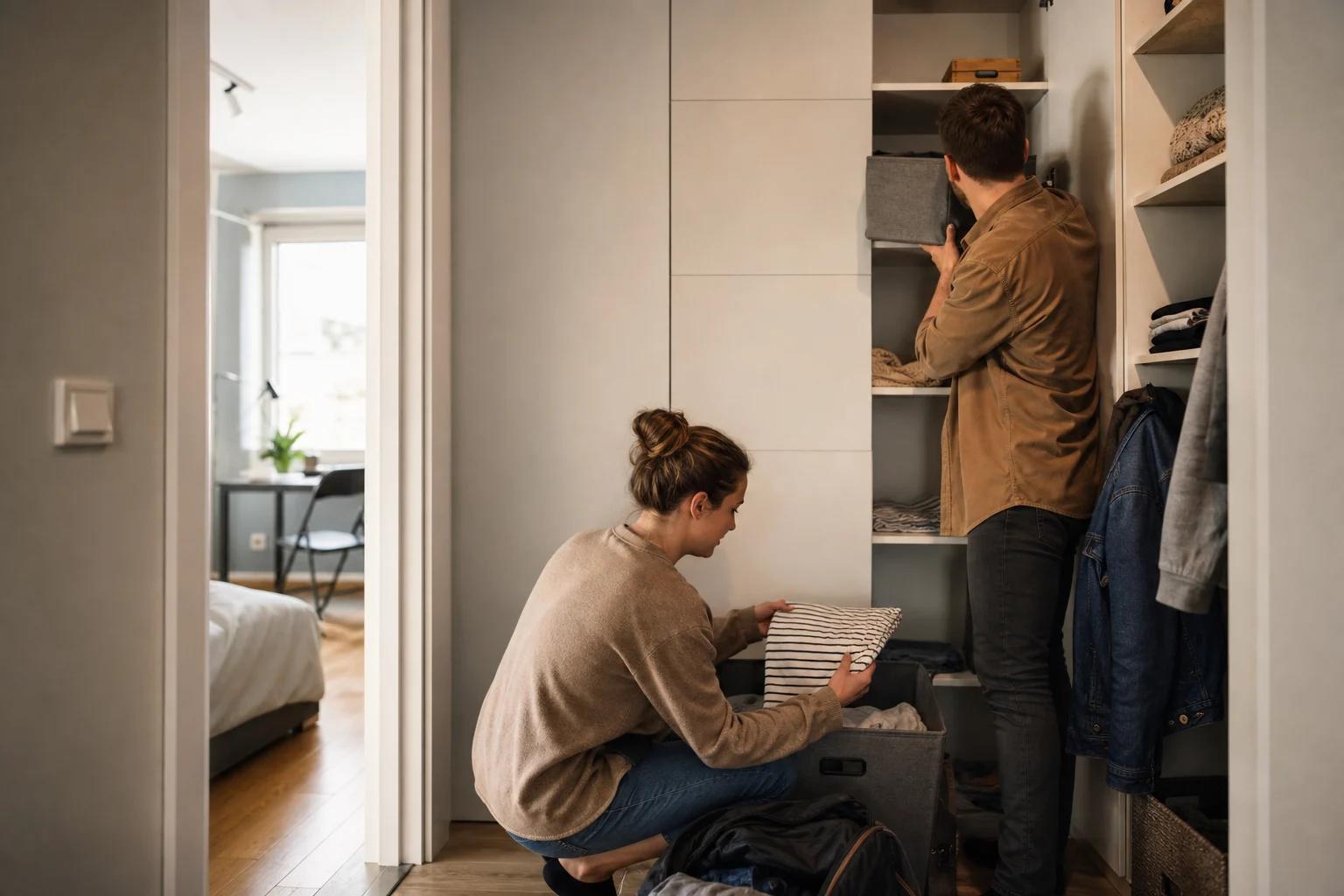
The question is not whether a home looks large, but whether it supports the daily lives of children and parents at the same time. Especially when stays alternate, practical details help more than square meters alone.
Storage that avoids repeated trips
If things like clothes, sports equipment, notebooks, or care items do not have to be gathered anew all the time, moving between two households becomes more manageable. Good storage solutions prevent every arrival and departure from starting with extra searching. This is especially important when children stay in the home for several days and are not just visiting briefly.
A kitchen for real family routines
A kitchen is especially helpful in family life when it can be used regularly. Breakfast, snacks, simple meals, and flexible meal times should be possible without complications. This matters when children arrive hungry after school or childcare, or when meals do not happen at fixed times every day.
Space to retreat and rest for different age groups
When several people live in a transitional apartment, they do not always need the same routines at the same time. Younger children often need quiet and a clear place to sleep, while older children need a place to study or read. A layout that allows for these different needs is usually more valuable in daily life than a purely open or purely compact solution.
Laundry and daily care without extra organization
The more often people switch between two households, the more important it becomes to consider how clothes and other everyday items are cared for. A home becomes much more practical when such routines do not have to be improvised. Especially for longer stays, it is worth checking whether the daily care of belongings is possible without detours.
Which criteria help when choosing a family-friendly temporary apartment?
A family-friendly temporary apartment is not automatically the most modern or the largest home. What matters is whether it supports the recurring tasks of a shared custody arrangement in everyday life.
A simple checklist helps:
- Can the most important things stay on site permanently?
- Are the routes to school, daycare, childcare, or work realistic?
- Is there a clear place for eating, sleeping, and studying?
- Can the home be used sensibly over the planned period?
- Is the location chosen so that handovers are not unnecessarily complicated?
These questions help assess the home based on practical suitability rather than instinct. Especially when family organization is still in flux, that is often more helpful than choosing based only on visual impressions.
How can myroom24 help in this living situation?
myroom24 is an online booking platform on which commercial accommodation providers offer accommodation for private and business users. For parents in a transitional phase, this can be helpful because different types of accommodation can be compared in one place: rooms, apartments, and houses in commercial accommodation properties such as hotels, hostels, serviced apartments, and vacation rentals.
For this search, one thing is especially important: the long stays offered through myroom24 cover 28 to 179 nights. This means the platform is geared toward temporary stays that are longer than a short-term stopgap but do not necessarily need to be permanent.
In addition, users can specify the destination and length of stay and filter available long-stay accommodation by criteria such as price, location, and amenities. This is practical when the choice depends primarily on whether school routes, handovers, and family rhythms fit together. Accommodation marked as instant booking can be booked without prior approval from the host, subject to availability.
How do you compare hotels, serviced apartments, and apartment hotels for longer family stays?
For longer stays, the type of accommodation should not be the only deciding factor, but rather its specific suitability for everyday life. Serviced apartments and apartment hotels are just as suitable for long stays as an apartment if they fit the need for space, kitchen use, storage, and location.
Hotels should also not be excluded across the board. Depending on the amenities and services, a hotel can make sense for certain family situations, for example when organizational tasks need to be bundled or when the location fits school, childcare, or handovers particularly well. The important thing is therefore a factual comparison: what amenities are available? Which services are included? How transparent is the overall situation for the planned period? And how well does the location fit the daily routes?
The right comparison therefore does not look at prejudices, but at concrete requirements. This is especially important when a family needs a second home for a limited period and decisions therefore have to be made with everyday life in mind.
What typical mistakes can be avoided during the transition phase?
A common mistake is to check only one feature. A good kitchen is of little use if the routes to school or childcare are too long. Conversely, a good location helps little if sleeping, studying, and storing belongings do not work in everyday life.
So pay attention to whether the home meets several requirements at the same time:
- enough space for people and their belongings,
- a kitchen for regular meals,
- storage for changing everyday items,
- quiet areas for different daily rhythms,
- and a location that makes handovers and routes realistic.
Anyone who considers these points together avoids later detours. Especially for a family solution lasting several weeks or months, that is more important than spontaneous individual decisions.
What next step makes sense now?
The most helpful thing is to first define your fixed points: Which routes need to be short, which things should stay on site, and roughly how long should the transitional solution be used? After that, the search can be narrowed down much more precisely.
If you want to review suitable options, take a look at the myroom24 accommodation and compare the offers with regard to location, amenities, and length of stay.
Frequently asked questions
When is temporary housing in a shared custody arrangement more sensible than a spontaneous stopgap solution?
When handovers, school routes, and fixed routines need to work reliably over several weeks or months and a temporary home can be planned more clearly for that purpose.
What role does the location play for a second home for separated parents?
The location should above all fit school, daycare, childcare, and handovers. If these routes are short and predictable, daily life becomes much more structured.
How do I know whether a home is practical for children in a shared custody arrangement?
By whether there is enough space for belongings, quiet for different daily rhythms, and a kitchen for real family routines.
Why is the stay length of 28 to 179 nights important for families in transition?
Because it is geared specifically to temporary living phases in which a second home is needed for several weeks or months.
How does a bring-along and storage concept help with two households in concrete terms?
It defines what stays permanently in the home and what changes between households. That makes it faster to check whether the housing solution is practical.