Temporary Living for Guests with Pets and a Longer Transition Period: Check Rules, Location, and Everyday Practicality

When it comes to temporary living for guests with pets and a longer transition period, it is not only about people having a furnished place to sleep. What matters is whether the accommodation also fits everyday life with a dog or cat — that is, routines, retreat, rest, and the daily routes that come up. Especially during a move, renovation, or job change, it helps to check early and in a structured way: Is the animal allowed? What are the rules? What is the surroundings like? And how much shared everyday life does the accommodation actually allow?
Which house rules you should clarify before booking
The first question is always: Are pets explicitly allowed? If that is not clearly stated, the question should be asked before booking and not only upon arrival. For guests with pets, a general “it should be fine” is not enough, because with longer stays, clarity from the start matters.
More important than a simple permission are the specific house rules. Check in writing whether there are requirements regarding the following points:
- may a dog or cat stay alone in the accommodation?
- do rules apply to shared areas?
- are there restrictions for certain animal species or sizes?
- are special cleanliness or consideration rules mentioned?
- is it clearly regulated how noise or smells should be handled?
The more precisely these points are described, the better the stay can be planned. This is especially important when several people move in or when the animal has fixed habits. Unclear rules create more friction in everyday life than any small structural inconvenience.
Which surroundings make everyday life with a pet practical
The location often matters more in daily life than a beautiful photo. Anyone living with a dog needs routes that can reasonably be walked every day. That includes safe walking paths, an environment where walks do not become complicated, and as little hustle and bustle right outside the door as possible. So it is not only about green spaces, but about an environment that allows routine.
Even during a transition phase after renovation or a housing change, accessibility matters. If the workplace, school, construction site, storage facility, or administrative errands must be reached regularly, the accommodation should fit these routes. Otherwise, additional detours arise every day, which quickly become exhausting with a pet, luggage, and organization.
Also pay attention to the immediate surroundings: Is access narrow? Are there strong noise sources? Is the entrance easy to manage with a leash, carrier, or luggage? Such details barely stand out on paper, but on site they determine how stress-free arrival and departure are.
Which furnishings really matter during the transition phase
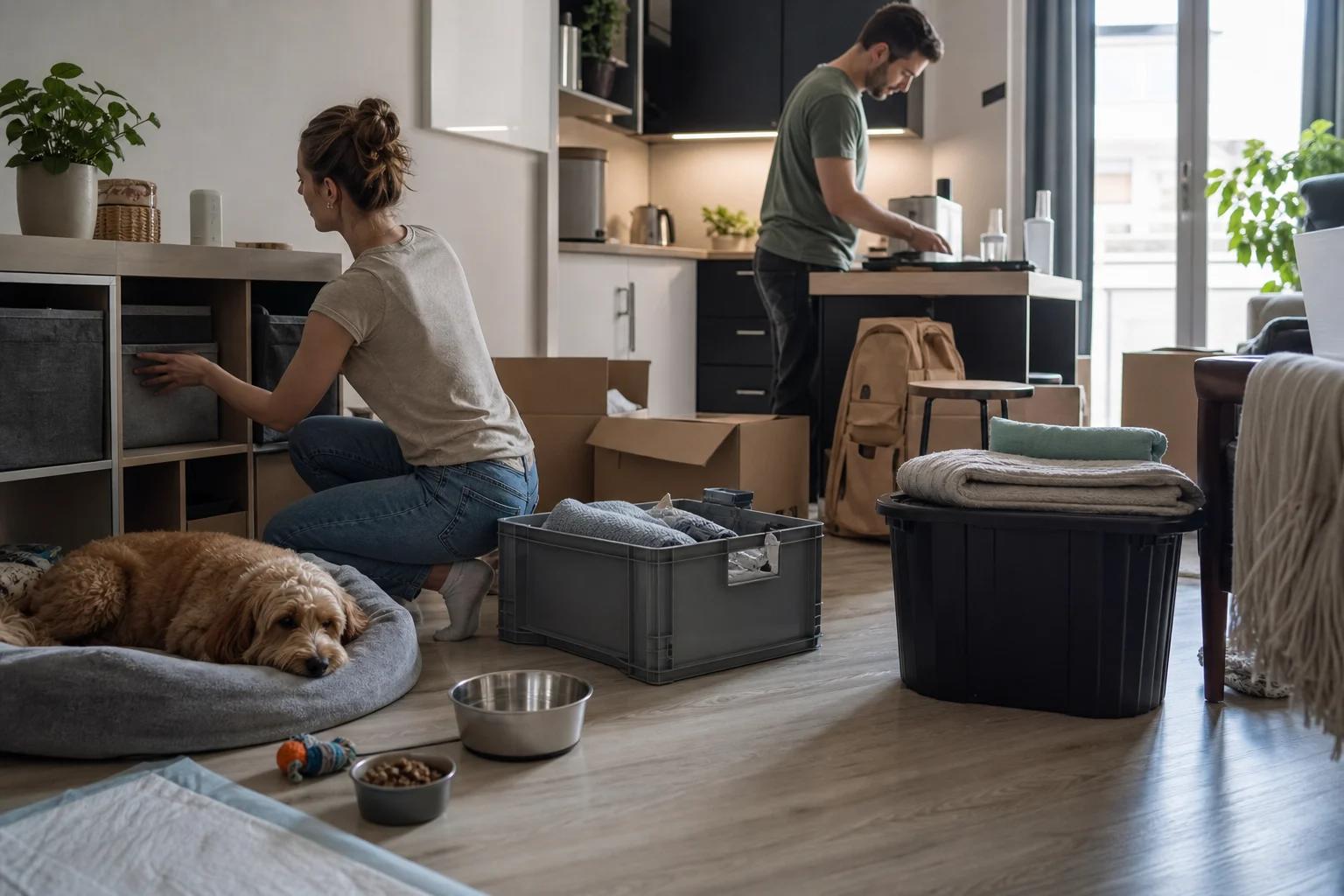
For a longer stay, furnishings are not just a matter of comfort, but of organization. A clear retreat area for both animal and human helps when luggage, work materials, or children’s things are also in the room. Even more important is that the floor plan does not constantly force the same area to be rearranged.
Also practical are easy-care surfaces, sufficient storage space, and a kitchen or kitchenette that makes daily life manageable without constant improvisation. Anyone moving in with a pet needs space for a sleeping area, food, accessories, and cleaning, without everything permanently getting in the way.
Cleaning service is more than an extra in this context as well. When the pet moves in too, the accommodation should be organized so that cleanliness remains realistic in everyday life. This is especially true when a move, renovation, or other transition issues are running in parallel. An accommodation is suitable for everyday life when it does not make every task more complicated.
How to compare apartment, serviced apartment, apartment hotel, and hotel fairly
For longer stays, it is not the category alone that matters, but the combination of space, service, rules, and location. Serviced apartments and apartment hotels can be just as suitable as an apartment if they offer the necessary retreat space, suitable furnishings, and clear usage rules. A hotel can also work for a longer stay if the conditions are right.
So compare not by name alone, but by concrete criteria:
- Layout: Is there an area where the animal, luggage, and everyday life do not constantly overlap?
- Furnishings: Is there a kitchen, or is use organized differently?
- Service: How is cleaning handled, and how much self-organization remains?
- Location: Does the surroundings suit walks, daily routes, and the need for quiet?
- Total costs: Are all transparently listed costs understandable, rather than only a single benchmark?
This makes the comparison objective. What matters is not whether an accommodation looks like an apartment, an apartment hotel, or a hotel on paper, but whether it supports the concrete everyday life with a pet and a transition phase.
How myroom24 structures the search for 28 to 179 nights
myroom24 can help with this decision because the search can be tailored to a longer transition phase. Users enter their destination and length of stay and can filter available long-stay accommodations by criteria such as price, location, and furnishings. This allows the selection to be narrowed more specifically to situations with pets, where not only the room but also the surroundings and usage conditions must fit.
The time frame is also important: the long-stay options offered via myroom24 cover 28 to 179 nights. That fits moves, renovations, or other phases in which a temporary solution is needed for several weeks or months.
Depending on the offer, rooms, apartments, and houses in commercial accommodation facilities such as hotels, hostels, serviced apartments, and holiday apartments may appear there. This makes it possible to compare different forms of living objectively, without prematurely ruling out one option. Especially with pets, this comparison is worthwhile because it is not the label that counts, but the practical suitability.
A sensible checking scenario before booking
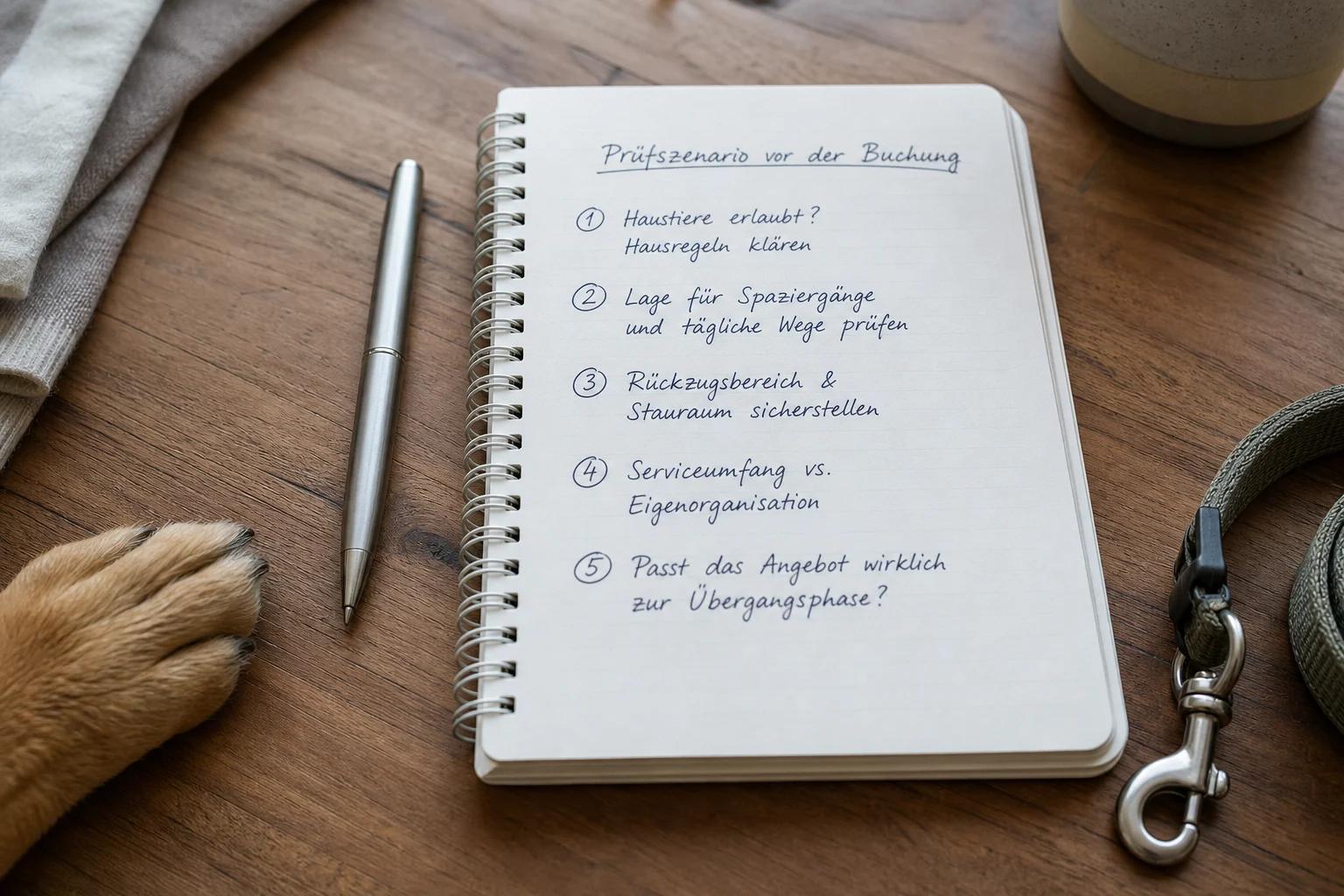
Imagine a family with a dog moving out for a few weeks after a renovation. In such a case, the wrong question would be: “Is the accommodation nice?” The more important question is: “Can our everyday life function there without constant improvisation?”
The right sequence would then be:
- Clarify in writing whether pets are allowed and which house rules apply.
- Check whether the location is suitable for walks and daily routes.
- Make sure there is a usable retreat area and enough storage space.
- Compare how much service and how much self-organization is included in the accommodation.
- Only then decide whether the offer really supports the transition phase.
This approach helps because it shifts the decision away from gut feeling and toward concrete criteria. That makes temporary solutions with a pet more manageable, especially when a move, renovation, or job change is already underway in the background.
When you should ask again
If an accommodation allows pets but leaves key points open, it is worth asking again. This is especially true for unclear rules on leaving the animal alone, shared areas, cleanliness, or quiet hours. Even if location and everyday life do not fit, you should not book on a whim. Clear answers in advance are more helpful than later compromises on site.
In the end, one thing matters most in this topic: the accommodation must fit the animal, the length of stay, and the routes that really come up during the transition phase. Anyone who checks rules, surroundings, and furnishings in this order will make the more robust decision.
If you want to compare suitable options, take a look at the myroom24 accommodations and filter specifically by duration, location, and furnishings.
Frequently asked questions
Which house rules should I always have confirmed in writing for accommodation with a pet?
Important rules concern allowed animal species, shared areas, leaving the animal alone, cleanliness, and any quiet hours. Without a clear written statement, you should not book firmly.
How can I tell whether the accommodation has enough retreat space for both the animal and luggage?
There should be a clearly usable area where sleeping space, food, accessories, and luggage are not constantly in the way. What matters is the practical layout, not just the size.
How do I assess the location if I am regularly out and about with a dog?
Look for safe routes, an environment that works for everyday life, and connections that fit your regular appointments. That keeps walks and routes more predictable.
How do I compare an apartment, apartment hotel, serviced apartment, and hotel fairly for a longer transition phase?
Compare layout, service, location, usage rules, and transparently listed total costs. None of these living forms is automatically better or worse; what matters is the fit with everyday life.