Temporary Living with Storage and Space for Luggage: How to Check Everyday Usability
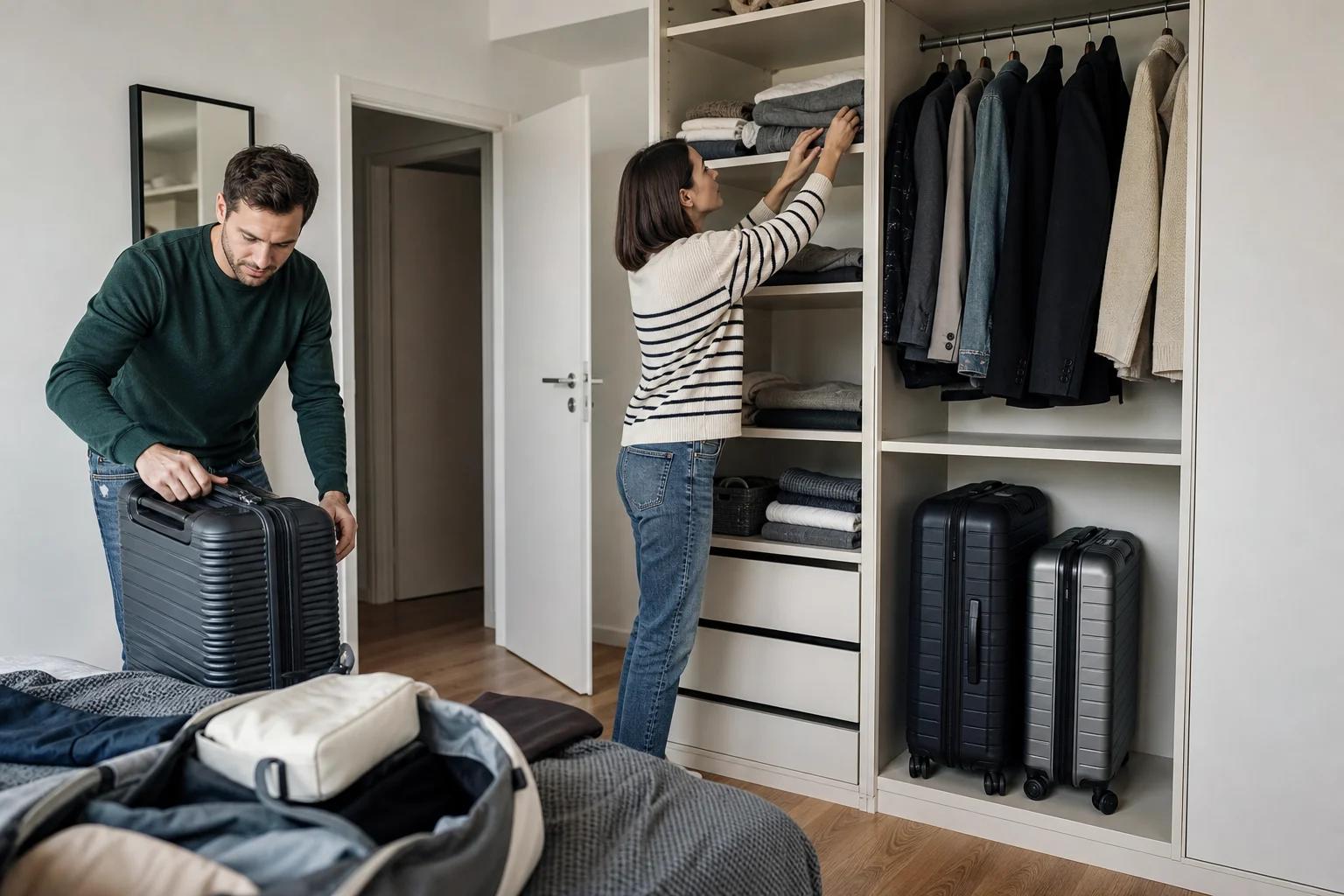
Why storage becomes the key issue on longer stays
If you are looking for temporary living with storage and space for luggage, you are not deciding on a single overnight stay, but on everyday life over weeks or months. Then the question is not only whether an accommodation looks well kept or modern. What matters is whether clothing, work materials, shoes, documents, and personal items can be stored in a way that keeps the space usable every day.
Especially during longer stays, it quickly becomes clear whether a room is meant only for arrival and departure or whether it is a real transitional solution for everyday life. A suitcase that permanently sits in the walkway does not only take up space. It also makes unpacking, cleaning, and finding the things needed in the morning or evening more difficult. That is why it is worth treating storage not as a side issue, but as part of living quality.
Which storage zones you should plan for before moving in
When you assess accommodation from afar, it helps to separate the space by function. Not every area in the room serves the same purpose. So the question is not only whether there is “enough space,” but what that space is actually suitable for.
Closed storage for clothing and personal items
A closed wardrobe, drawers, or compartments with doors are especially important if you want to store clothing neatly and protected. Such areas also help when you do not want personal items left out in the room. A shelf or console can be an addition, but it does not replace a usable wardrobe.
Open surfaces for items that need to be within reach every day
A bedside table, shelf board, sideboard, or a free corner on the table is useful for items you use every day: chargers, glasses, a notebook, work documents, or keys. For these surfaces to really help, they should not be confused with clothing storage. An open surface is practical, but it does not create order for larger pieces of luggage.
A dedicated place for suitcases and bags
Luggage needs a fixed zone. This can be a niche, an area next to the wardrobe, the space under the bed, or a free area in the entrance. What matters is that the suitcase does not have to be moved every day in order to use the room normally. Anyone staying longer should therefore always check whether suitcases and bags can be stored in a meaningful way rather than merely set down.
Additional surfaces for work items or special luggage
Many long-stay guests travel with more than clothes. A laptop, documents, camera equipment, sports bags, or children’s items often need their own places. If these things do not have a fixed location, disorder quickly develops because everything has to be reorganized constantly. Good long-stay equipment is therefore often shown by the fact that not everything has to disappear into one single wardrobe.
How to read photos and the floor plan correctly from afar

Photos give a first impression, but they do not automatically answer the question of whether the room works in everyday life. That is why you should always look at pictures together with the room layout.
Pay attention to walkways and opening clearances
A room often looks larger than it is in everyday use when the photo focuses only on the furnishings. So check whether doors, wardrobe doors, drawers, and the bed are positioned so they can open without conflict. A room is only truly usable if luggage is not constantly in the way and movement areas remain open.
Read proportions, not just furniture
A single attractive piece of furniture says little about how usable the area is. The relationship between bed, table, wardrobe, and free wall space is more important. If a photo shows many large pieces of furniture in a small space, there is often little reserve for suitcases or additional items. A floor plan or a photo taken from the doorway is therefore more useful than a tight detail shot.
Ask for measurements of the critical points
Especially with remote bookings, exact measurements are often more helpful than general descriptions. Useful details include, for example:
- internal width, height, and depth of the wardrobe
- height under the bed
- width of a niche for luggage
- free space next to the bed or at the entrance
- room height for shelves, hooks, or storage surfaces
This lets you check whether your largest piece of luggage will really fit instead of just hoping it will “somehow work.”
Which follow-up questions provide reliable answers when booking remotely
If a description does not make it clear how much storage is actually available, precise questions help. It is important that the follow-up question is aimed at your specific use and not just at a general assessment.
Questions such as these are helpful:
- How many closed compartments or wardrobe sections are there?
- Can a large suitcase be stored upright, flat, or open?
- Are there separate places for clothing, work materials, and other personal items?
- Do the wardrobe system and its storage include drawers, shelves, or compartments?
- Is the storage intended only for the booked person, or is it shared with others?
These questions provide useful answers because they ask about the actual practical value. If you are traveling with several pieces of luggage, it is also worth making a short list of the most important items. Then the other side can answer specifically instead of just generally assuring you that there is “enough space.”
Which priorities movers, project guests, and families should set

Storage needs are not the same for all travelers. If you know your own situation, you can judge better which equipment really matters.
Movers need a clear separation between everyday life and moving items
Anyone living through a move often brings clothing, documents, and items that have not yet been put away. In this case, stable wardrobe space and a clear separation between immediately usable items and reserve luggage are important. It is especially helpful if not everything has to be spread loosely throughout one room.
Project guests need order for work and luggage at the same time
In project-based stays, work documents, technology, and personal items often come together. Then it is crucial that the work area and luggage do not block each other. A good sign is when the room shows fixed zones: space for working, space for clothing, and a separate area for suitcases.
Families need assigned places for several people
With families, disorder usually arises not because of one suitcase, but because of many small things: jackets, shoes, bags, toys, or children’s clothes. That is why it is important whether storage is not only available but also sensibly divisible. If several people use the same area, more structure is needed than just one large wardrobe.
How apartment, serviced apartment, apartment-hotel, and hotel differ in storage
For longer stays, the category alone is not decisive. An apartment can offer a lot of independence and its own storage. A serviced apartment or an apartment-hotel can also be a good fit if the room layout, furniture, and daily organization are right. A hotel can also be suitable for longer stays if the equipment, services, and location fit the planned everyday routine.
The most useful comparison is therefore always concrete: Where are clothing, suitcases, and work materials stored? Is there closed storage? Do the routes remain clear when everything is put away? And does the room layout fit the kind of stay you are actually planning? Only when these questions are answered is it worth looking at the type of accommodation.
How myroom24 makes preselection more structured
On myroom24, you can specify your destination and length of stay and filter available long-stay accommodations by criteria such as price, location, and amenities. This is especially helpful when you are deciding from afar and first want to compare the offers that basically fit your timeframe and your needs.
The long-stay options offered via myroom24 cover 28 to 179 nights. This lets you narrow the search to the planned stay before you examine details such as storage, room layout, and luggage space more closely. Accommodations marked as instant book can be booked without prior approval from the host, subject to availability. This is especially helpful if you already know exactly what equipment you need and do not want to plan additional coordination.
Which order helps most when making a decision
When comparing several offers, it is best to proceed in this order: First, check whether your largest piece of luggage can realistically fit. Then see whether clothing, work materials, and personal items can be stored separately. Only in the third step should you assess whether the room remains freely usable even after everything is stored.
This order matters because it prevents you from being guided only by attractive photos or a good location. A room that is easy to use is not automatically the largest room. What matters is whether the available surfaces are sensibly divided for your everyday life.
If you want to compare suitable options now, start with the matching myroom24 accommodations and check each selection against your own storage checklist.
Frequently asked questions
What dimensions should I ask for before booking for my largest suitcase?
Ask for the internal width, depth, and height of the intended space, as well as the height under the bed or in a niche.
How can I tell from afar whether the room is suitable for everyday use despite limited space?
If suitcases, clothing, and work materials each have separate space and doors, drawers, and walkways remain usable without obstruction.
Which follow-up question is most important for families with several pieces of luggage?
Ask whether there are separate places for suitcases, children’s clothes, and everyday items, or whether everything has to be stored in one area.
What should I compare first in a hotel, serviced apartment, or apartment-hotel?
Not the category first, but closed storage, luggage space, the room layout, and the services that suit the stay.