Temporary Living for Weekly Commuters with Baggage Storage: How to Keep Moving Between Two Homes Stress-Free
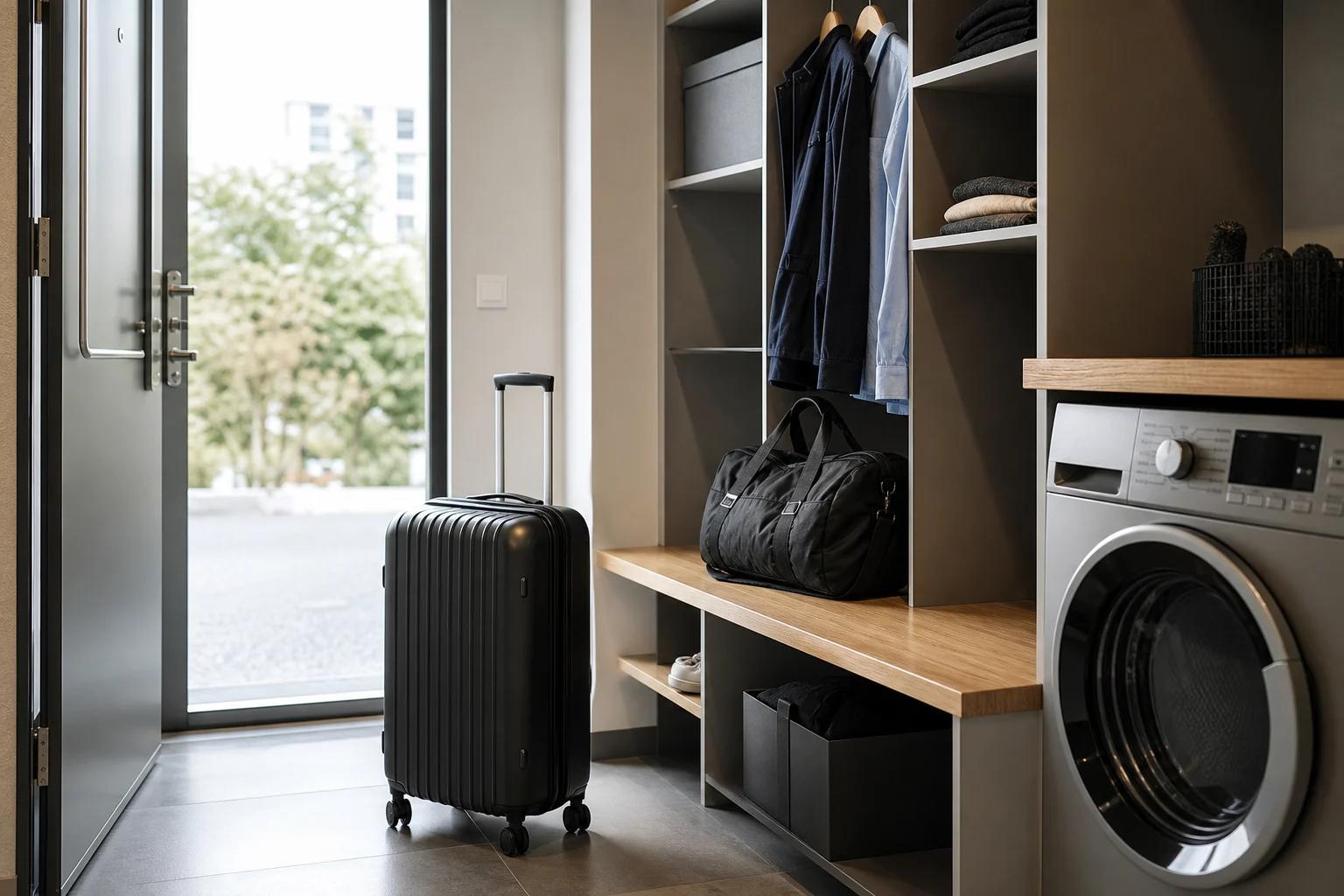
Why is baggage storage more than just a place to put things for weekly commuters?
With temporary living for weekly commuters with baggage storage, it is not just about leaving a suitcase somewhere. Anyone who switches every week between their home location and their work location is really organizing two small living systems: one for workdays and one for returning home. That is exactly why baggage storage is part of everyday life and not a side issue.
The difference becomes especially clear when you arrive in a hurry on Monday morning. Everything you need for the week should have a fixed place: work documents, technology, clothes, chargers, and personal items. If you have to redistribute these things every time, it does not just cost time. It also makes it harder to keep track of which items stay in the accommodation and which need to go home again at the weekend.
A simple split into two groups is therefore helpful:
- Things that stay on site permanently: for example documents you need regularly in your working life, or clothes for the week.
- Things that travel with you: for example private documents or items you need at home at the weekend.
This separation may seem minor, but it saves search time again with every arrival and departure. With a commuting rhythm in particular, that quickly becomes a noticeable difference, because you do not have to decide anew every time what belongs in which bag.
Which features make the weekly rhythm easier in practical terms?

Storage space: how much order does your baggage really need?
For weekly commuters, size alone is not the deciding factor, but rather how usable the storage space is. A wardrobe can be large and still impractical if you cannot separate clothes and documents there in a sensible way. So pay attention to more than just the word “furnished” in the description.
These points are especially worth checking:
- Is there closed storage so not everything is left out in the room?
- Is there a fixed surface for technology and documents?
- Can a suitcase be stored so it is not in the way every day?
- Is there enough space to separate work clothes from leisure clothes?
Especially if you are on site only for certain weekdays, clearly structured storage space is often more helpful than extra living space without an organization system. So you are not simply looking for space, but for a place where your weekly baggage is easy to find again.
Location: why the map alone still says nothing about everyday life
Good public transport connections are important, but the distance shown on the map is not enough. What matters is how the route feels with baggage. A short walk may be acceptable, while a location that seems close but involves transfers, stairs, or a long walk from the station becomes unnecessarily more demanding in everyday life.
So do not just check the location, but also the actual route:
- How far is it really from the station, stop, or workplace to the accommodation?
- Is the route easy to walk with a suitcase or bag?
- Does the connection fit your arrival and departure times?
- Is the route still practical if you arrive late or have to leave early?
This makes it easier to assess whether the accommodation fits your weekly pattern or whether every change creates extra stress. For weekly commuters, this is especially relevant because the route between transport and room counts several times every week.
Access: which routines really matter in the evening and in the morning?
With changing working hours, the accommodation itself is not the only important thing; access matters too. If check-in is unclear or you have to ask every time you arrive, the start of the week becomes unnecessarily complicated. A clear process helps especially when you do not always arrive at the same time.
What you should check before booking:
- Is it explained how you get to the accommodation?
- Are the next steps on arrival clearly described?
- Do you know in advance how access is organized?
- Is the process understandable even if you arrive late in the evening?
The more specific these points are, the easier it is to plan the switch between two homes. This is not about luxury, but about predictability.
Laundry: why washing options influence how much baggage you need
For weekly commuters, laundry is often the point at which accommodation proves itself in everyday life or does not. If you can keep clothes fresh during the week, you need to bring less spare clothing. That also makes packing at the weekend easier.
So the real question is not only whether a washing option exists, but how it fits into your routine. If you are only on site on fixed days, accommodation is especially worthwhile when you can build laundry into the same weekly rhythm. Then an extra task becomes a fixed step in your routine.
How do you tell the difference between an apartment, a hotel, and a boardinghouse in everyday life?

The right type of accommodation depends on how you organize your week. For weekly commuters, the question is not which category is “better,” but which one maps the switch between work and going home most cleanly.
| Type of accommodation | What you should pay attention to from the perspective of weekly commuting | | --- | --- | | Apartment | Useful if you need your own structure, want to leave baggage at the location for longer, and organize the accommodation more independently in everyday life. | | Hotel | Suitable if you value short, clearly regulated routines and uncomplicated arrival, and mainly want to know how access and the process are organized. | | Boardinghouse | A middle form if you want more of a residential character than in a classic hotel, but do not want to organize everything completely on your own. |
More important than the label is the usage situation: How much baggage do you bring? How often do you switch between going home and your work location? Do you want to leave things on site or take them with you every time? Once you answer these questions, it becomes clearer which type of accommodation suits your rhythm.
You should also look at the overall costs from this perspective. Compare not only the accommodation itself, but also the effort that results from your routine: extra trips, repeated packing and unpacking, time lost because of unclear arrival, or frequent reorganizing. A transparent decision therefore always takes the entire use into account, not just the room category.
How does myroom24 help you find a suitable commuter accommodation?
myroom24 is an online booking platform on which commercial accommodation providers offer accommodations for private and business users. The range includes rooms, apartments, and houses in commercial accommodation facilities such as hotels, hostels, serviced apartments, and holiday apartments.
For weekly commuters, it is especially relevant that the long-term stays offered via myroom24 cover 28 to 179 nights. This means you are searching specifically within a period that matches a recurring switch between two homes.
When searching, you can specify your destination and length of stay and filter available long-term accommodation by criteria such as price, location, and features. This allows the selection to be narrowed specifically to the characteristics that really matter in everyday weekly life: good accessibility, suitable storage options, and equipment that fits your baggage and routine.
If an accommodation is marked as instant booking, it can be booked without prior approval from the host if available. This is especially helpful when your assignment or start of work is already fixed and you want to plan your arrival time with certainty.
How do you make a safe decision when two offers seem similar?
If two accommodations seem similar at first glance, a simple order helps with the decision. First check whether arriving with baggage is realistic. Then look at storage space and access. Only in the third step do you compare how well the process fits your weekly rhythm.
This order prevents you from being guided by a nice description when everyday life later turns out to be impractical. Especially with regular trips home, it is often more sensible to choose an offer with clear routines than one that only seems spacious at first glance.
If you want to narrow down your search now, start with the myroom24 accommodation and check specifically which option fits your commuting rhythm, your amount of baggage, and your arrival times.
Frequently asked questions
Which type of accommodation is suitable if I want to leave baggage at my work location during the week?
Then storage space, access, and a clear weekly routine are especially important. Apartments often offer more room for your own organization, hotels more clearly regulated routines, and boardinghouses sit somewhere in between.
What matters if I arrive late after work?
Check in advance how access is organized and whether the route from the stop or station is still easy to manage with baggage. The more clearly the process is described, the less you have to improvise on site.
How do I plan the weekend trip home if work documents are supposed to stay behind?
Decide in advance which items stay in the accommodation and what comes home every time. A fixed sequence helps: secure documents, store technology, separate clothes, then close everything.
When should I look more closely at an offer with a hotel character?
If you need short distances, clearly regulated routines, and easy arrival, that can be a good fit. The key is whether baggage volume, location, and your weekly rhythm work together.