Temporary living for weekly commuters with luggage storage and flexible trips home: What makes the weekly routine easier
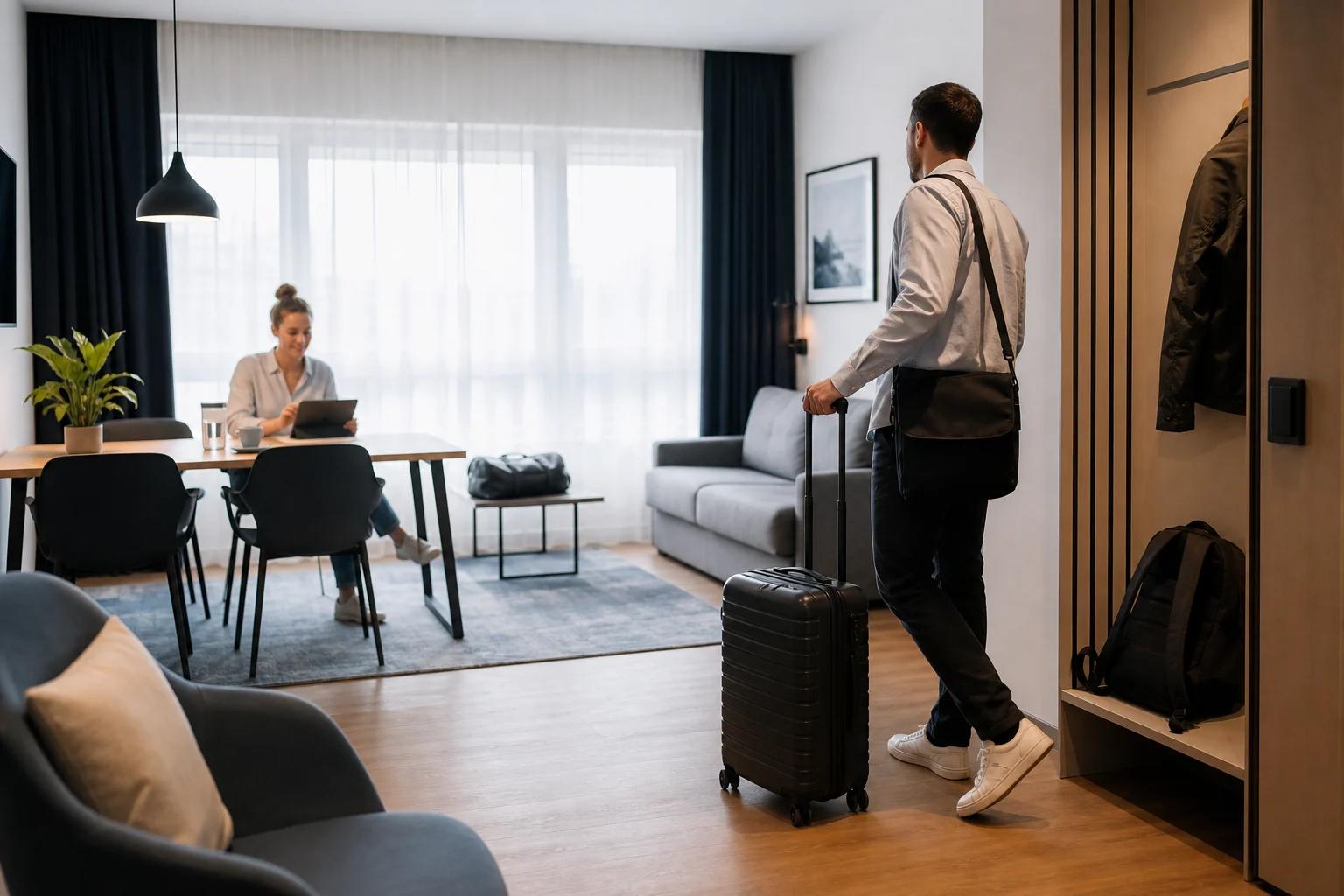
Why is the weekly routine so important in this type of living arrangement?
With temporary living for weekly commuters with luggage storage and flexible trips home, it is not about accommodation for any transition, but about a recurring routine. Anyone arriving at the work location on Monday, living there during the week, and going home again at the weekend needs accommodation that takes this movement between 2 places into account.
The decisive question is therefore not only: Is the accommodation available? But also: Does it fit my actual weekly pattern? That is exactly where most friction arises in practice. If arrival, commute, departure, and return do not fit together, every week creates unnecessary organization.
For weekly commuters, the second home is therefore above all a functional place to work with a sleeping option. The clearer the process on site, the less time is lost searching, rearranging, and improvising spontaneously.
Which type of accommodation suits which commuting routine?
There is no single right solution. An apartment, a serviced apartment, an apartment hotel, or even a hotel can make sense depending on the length of use, the commute, and the personal desire for independence. What matters is not judging the type of accommodation by its label, but by what the weekly routine actually requires.
A simple comparison question can help:
- Do I need a lot of independence and fixed storage space?
- Do I want to keep processes as simple as possible?
- Is a clear separation between work, retreat, and luggage important to me?
- Is the location above all about the work location or a transport hub?
An apartment can be suitable if a lot of independence is needed. A serviced apartment or apartment hotel can make sense if services and a clear start to the week are more important than maximum self-organization. A hotel is also not ruled out across the board: what matters is whether location, services, room layout, and transparent total costs fit the planned stay.
Anyone comparing options should therefore not ask which type of accommodation is generally best. A better question is which form makes the weekly routine least complicated.
Which equipment really helps when you move between 2 places every week?

The most useful equipment is often not the most noticeable. For weekly commuters, the main things are elements that simplify recurring tasks and keep the second home tidy.
Storage space with clear organization
If work clothing, leisure clothing, and luggage do not have to be redistributed every time, the start of the week stays calmer. Practical is accommodation where things can be stored separately: what is needed daily, what comes only for the work week, and what can remain there until the return trip.
A fixed place for items needed immediately
A place for items that must be at hand directly on Monday is especially important. Depending on the job, this includes ID documents, chargers, paperwork, technical devices, or change of clothes. Anyone always storing these items in the same place avoids time loss in the morning.
A quiet structure for evening and morning
Weekly commuting becomes exhausting when even small routines become complicated. It is therefore worth paying attention to a room layout in which sleeping, changing, and working do not constantly overlap. A clear retreat helps use the accommodation not as interim storage, but as a functional place to work.
How can arrival, luggage, and the return trip be organized in practice?
The weekly change usually becomes difficult when you have to decide again each time what needs to be taken along. A fixed routine is often more helpful than a particularly large bag or a spontaneous packing style.
A simple arrival checklist
Before traveling, it should be clear what is really needed for the first 24 hours. A separation into 3 groups is useful:
- Work luggage: clothing, documents, technology, and charging accessories.
- Start luggage: hygiene items, medication, and things for the first evening.
- Reserve or stored items: objects that are not needed daily and can stay on site.
Especially when luggage storage plays a role, it should be clarified in advance what may remain on site at all and where it can be stored safely and neatly. This prevents luggage from ending up distributed randomly around the room.
A clear departure sequence
The trip home can also be standardized. A fixed routine at the end of the week is helpful:
- Check work materials and personal items
- Pack clothes for the return trip separately
- Leave things that will stay on site until the next week in the same place
- Note open tasks for the next work start
This means the weekend trip home does not become a new planning task every time. For many weekly commuters, this reliability is more important than a particularly flexible but confusing routine.
How do fixed assignments, shift work, and changing projects differ?

Not every weekly commuter has the same rhythm. The accommodation should therefore fit not only the place, but also the work model.
Fixed assignment with recurring working hours
If the work location stays the same, location is often the most important factor. Then what matters above all is that the route in the morning is short and straightforward. The accommodation must make the start of the week as simple as possible because the routine remains similar from week to week.
Shift work with changing times of day
In shift work, not only the distance matters, but also suitability for everyday life at unusual times. Then the accommodation should be organized so that arrival and departure are not connected with long detours and the retreat before or after the shift remains uncomplicated.
Projects with changing work locations
If work locations change, the flexibility of the accommodation gains importance. Then it is not only location and equipment that matter, but also how easily the next booking can be adapted to a new place. Anyone who changes places frequently therefore needs a solution that does not make the change more difficult in organizational terms.
How myroom24 can help with this search in concrete terms
myroom24 is an online booking platform where commercial accommodation providers offer accommodation for private and business users. For weekly commuters, it is especially helpful that the search is not aimed at just any accommodation, but at a clear period and specific criteria.
Users can specify destination and length of stay and filter available long-stay accommodation by criteria such as price, location, and equipment. This is useful when the second home should not just happen to fit, but match arrival, return trip, and commute.
Important for planning: Long-stay bookings offered through myroom24 cover 28 to 179 nights. This means the search is aimed at a period relevant for regular weekly commuters and longer projects. The accommodation types brokered include rooms, apartments, and houses in commercial accommodation facilities such as hotels, hostels, serviced apartments, and holiday apartments.
What should be checked before extending the stay?
If an assignment is extended, you should not simply rebook without checking the routine again. A longer stay often changes luggage needs, the logic of the trip home, and how the accommodation is used.
These questions help before extending:
- Does the work location remain the same, or does the commute change?
- Is the current storage space still sufficient?
- Do more things need to remain on site than originally planned?
- Does the booked period still match the actual project progress?
Especially for weekly commuters, it is useful to think about extension and returning to the work week together. The earlier it is clear whether the current accommodation still fits the new period, the easier the organization remains.
Conclusion: What matters is a routine that can be repeated
For weekly commuters, a good second home is not a matter of chance, but of a suitable weekly rhythm. Location, storage space, clear routines, the right type of accommodation, and a realistic length of stay matter more than general housing promises.
If you want to compare options, start with the myroom24 accommodation and check whether length of stay, location, and equipment fit your commuting routine.
Frequently asked questions
How do I organize luggage storage if I arrive with only light luggage?
Separate work luggage, start luggage, and items that can stay on site. It should be clear in advance where the luggage can be stored safely and neatly.
How can I tell whether the location really fits my weekend trip home?
The location fits if the route to the work location is short and straightforward and the return trip can be organized without unnecessary detours.
What matters more for shift work than for a fixed office job?
In shift work, in addition to location, easy routes at unusual times and a routine that does not complicate arrival and departure are especially important.
When should I extend my stay instead of searching again?
If the work location, weekly rhythm, and storage needs remain the same, extending is often the most obvious next step. If the assignment location changes, it should be checked again.