Temporary Accommodation for Medical Professionals and Relatives from 28 Nights

Which question should come first?
For temporary accommodation for medical professionals and relatives from 28 nights, the most important starting question is not how attractive a property looks, but what a typical day there actually feels like. Anyone in a medical environment rarely plans only for a quiet evening. More often, it is about changing schedules, short errands, unclear end times at the clinic and the question of whether there is enough privacy in between.
It therefore helps to mentally walk through the stay once: When does the day begin? When does it end? Does someone need to leave very early or arrive late? Will meals be needed on the go or prepared on site? Is there time to do laundry, rest and change clothes? The more precisely these questions are answered, the better a property can be assessed.
For medical professionals and relatives, the priorities are often different. Professionals pay more attention to reliable routines around shifts, routes and accessibility. Relatives often need above all a place that does not add extra strain between visits, waiting times and organisational tasks. Both perspectives can be combined if the search is based on the actual clinic routine rather than general ideas of housing.
How does the accommodation fit the clinic routine during the day and at night?
Proximity to the clinic is helpful when it works at the times when the route is really needed. A property may seem close on the map and still be impractical in everyday life if access is complicated, the route passes through confusing areas or arrival after a long day becomes unnecessarily tiring.
That is why it is worth looking at the actual route. Anyone moving between accommodation and clinic at different times of day should check before booking whether the route remains workable under realistic conditions. This includes early mornings, late returns and situations where luggage or exhaustion make the journey feel longer.
It is practical to test the route from the perspective of the stay, not just from the perspective of distance. Questions that help here are:
- What does the route look like at the times when it will actually be used?
- Can it be managed without detours, transfers or hard-to-understand access points?
- Does the arrival situation still work when the day at the clinic has lasted longer than planned?
Especially in medical transition periods, it is therefore not abstract proximity alone that counts, but the sum of travel time, orientation and access. That is often more meaningful than any rough distance.
When are peace and privacy real decision criteria?
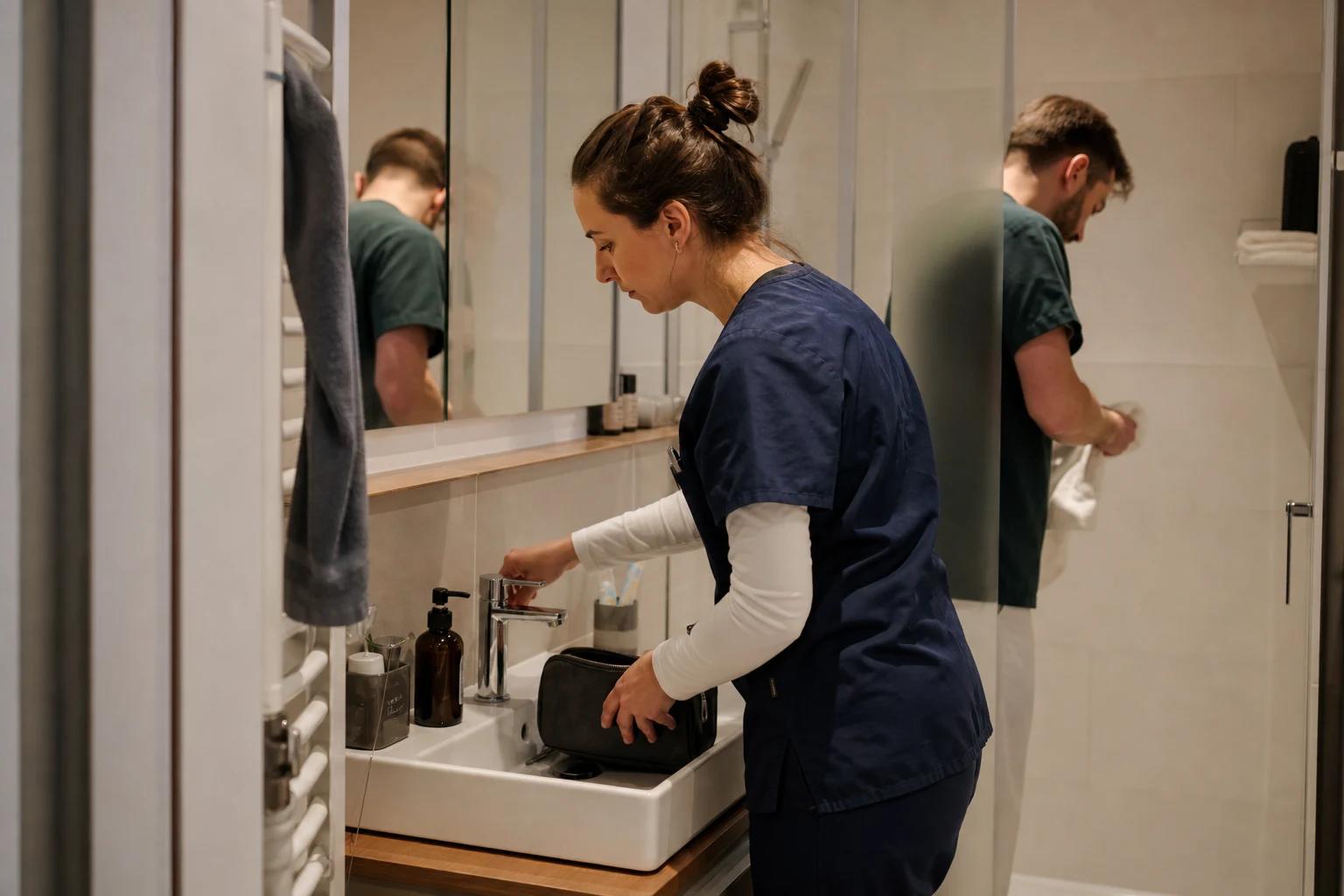
In a medical transition period, quiet is not just a comfort feature. Anyone returning after a shift, a clinic visit or several organisational appointments needs a place where sleeping, showering, changing clothes and short periods of rest are possible without additional noise. The surroundings of the accommodation should therefore be considered just as carefully as the room itself.
What happens outside the building is not the only important factor. Inside as well, corridors, shared areas or frequent movement by other guests can be noticeable. Anyone sensitive to noise or needing to switch off quickly after stressful days is more likely to benefit from a quiet structure than from a purely functional place to sleep.
The same applies to a private bathroom. It is not just about convenience, but often about a smoother routine in the morning and evening. When several people are planning at the same time, when appointments change at short notice or when the stay is strongly shaped by the clinic schedule, a private bathroom creates a simpler routine. That is not an end in itself, but it can help avoid unnecessary coordination.
Barrier-free access should also not only matter once a limitation is already obvious. Even without a specific health history, steps, long indoor routes, heavy doors or confusing entrances can become exhausting. Anyone arriving tired or carrying luggage notices such obstacles particularly clearly.
Which equipment helps with meals, laundry and irregular appointments?
For longer stays, the equipment often determines how independent daily life remains. A kitchen, a washing machine and enough space for personal belongings are therefore more than practical extras. They help above all when clinic times make meals and laundry routines hard to plan.
A simple example: Anyone returning late from the clinic does not necessarily need an elaborate offer, but a reliable way to eat something and keep clothes ready for the next day. Anyone moving back and forth for several days between visits, waiting times and errands may not want to organise every task outside the accommodation. This is exactly where self-catering becomes relevant.
The question is therefore not only whether a kitchen is available, but how it can be used in everyday life. Is it enough for simple meals? Can something be prepared there with little effort? Is the routine for breakfast, dinner or short snacks practical? The same applies to laundry facilities: if clothes need to be changed more often in a medical or family setting, this quickly becomes a fixed part of planning.
When assessing equipment, it is therefore important not to look only at individual features, but at how they work together. A washing machine is of little use if getting to it is impractical. A kitchen helps little if the daily rhythm does not allow fixed meal times. What matters is whether the equipment supports the specific form of stay.
How do I compare a flat, serviced apartment, apartment hotel and hotel objectively?

For medical transition periods, there is not only one correct type of accommodation. Serviced apartments and apartment hotels are just as suitable for long stays as a flat, if location, routine and equipment match the need. A hotel can also be a suitable option if clear services, structured routines or good integration into the daily schedule are more important than maximum self-organisation.
A fair comparison therefore does not start with prejudice against a category, but with the question of which form best reflects everyday life. Anyone needing more self-catering will look more closely at kitchen, bathroom and laundry facilities. Anyone wanting to be relieved of organisational tasks may pay more attention to services and a clear routine. Anyone travelling with relatives or frequently moving between the clinic and accommodation will in turn rate peace, route guidance and ease of arrival particularly highly.
It makes sense to compare types of accommodation using the same criteria:
- How much self-organisation is realistic in everyday life?
- Which services or routines are actually needed?
- How direct is the route to the clinic or other places needed every day?
- How well can the overall situation be assessed in terms of location, equipment and organisational effort?
This turns the comparison into no fundamental question between accommodation types, but into an objective decision based on actual use. In a medical environment, that is usually more helpful than a rigid preference for a particular category.
How myroom24 helps with this search in concrete terms
myroom24 can structure the search when you need accommodation for a clearly defined medical period. The platform is an online booking platform on which commercial accommodation providers offer accommodation for private and business users. For the search, this means that the destination and length of stay can be narrowed down in advance instead of having to work through unsuitable offers.
On myroom24, available long-term accommodation can be filtered by criteria such as price, location and equipment. This is especially helpful when proximity to the clinic, a quiet location or a suitable self-catering option are all relevant at the same time. The long stays offered via myroom24 cover 28 to 179 nights. This makes the search suitable for planned medium-term periods in which the stay has to be organised over several weeks rather than just short-term.
The offer includes rooms, apartments and houses in commercial accommodation facilities such as hotels, hostels, serviced apartments and holiday apartments. This is particularly practical if you want to compare different types of accommodation objectively and are not already committed to a single solution. Accommodation marked as instant book can be booked without prior approval from the host, subject to availability.
Which final check should come before booking?
Shortly before booking, it is worth carrying out a check that is no longer general, but very close to the later everyday situation. The central question is: Will the accommodation still work when the day at the clinic is longer, shorter or less predictable than expected?
A short reality check helps with this. Anyone travelling with relatives or working in a medical environment should pay particular attention to the following points:
- Is access on the day of arrival understandable and usable without additional questions?
- Does the route from the entrance to the room still work when arriving tired or with luggage?
- Is it clear how kitchen, bathroom and laundry facilities are integrated into everyday life?
- Can the accommodation be used over the entire planned period in the way the clinic routine requires?
This final check is important because the first impression of an accommodation does not always show how it feels after several days. Especially in medical transition periods, it is therefore not only equipment and location that matter, but also the process between arrival, privacy and the next appointment.
Once you have sorted these points, start the structured comparison via myroom24 accommodation.
Frequently asked questions
How do I check whether accommodation is still easy to reach after a late shift?
Look not only at the distance, but at the route at the time you would actually use it. What matters is a clear entrance, easy orientation and no unnecessary detours.
Which facilities should I not leave to sort out only on site if I am travelling as a relative?
A kitchen, a private bathroom and a reliable way to do laundry are the three points that quickly affect everyday life. If one of them is missing, the stay often becomes much more cumbersome.
When can a hotel still make sense for a medical stay?
When clear routines, service and uncomplicated organisation are more important than maximum self-catering. What matters is whether location, quiet and access fit the personal routine.
How do I recognise that quiet and barrier-free access were considered together?
Pay attention to whether the route from the entrance to the room is short and easy to understand and whether noise sources in the building could play a role. Both have to be considered together.