Temporary Room in a Shared Apartment: When a Furnished Room Is Better Than an Entire Flat

How does a temporary room in a shared apartment differ from a furnished room and temporary accommodation?
Anyone looking for a temporary room in a shared apartment often means three different housing types that differ clearly in everyday life. To make a good decision, the name alone is not important; what matters is how much independence, privacy, and organizational effort you actually need.
A room in a shared apartment is located in a shared flat. This means: you have your own room, but you typically share the kitchen, bathroom, and other common areas with other residents. This housing type is especially suitable if living together does not feel burdensome and you consciously want to avoid renting an entire apartment.
A furnished room for a limited time is more clearly designed for a defined stay. It is usually already equipped with the most important furniture, so you do not have to set it up yourself. That is exactly what makes it interesting for transitional phases in which housing needs should be functional rather than permanent.
A complete temporary apartment is a self-contained unit with more spatial independence. It usually offers more privacy, but it also requires a larger budget, more space, and often more organizational decisions. If you are only in one place temporarily, that extra independence can be useful — but it is not automatically necessary.
The crucial question is therefore: do you really need an entire apartment, or is a room enough for you to use reliably for the planned period?
For whom is a temporary room often the better choice than an apartment?
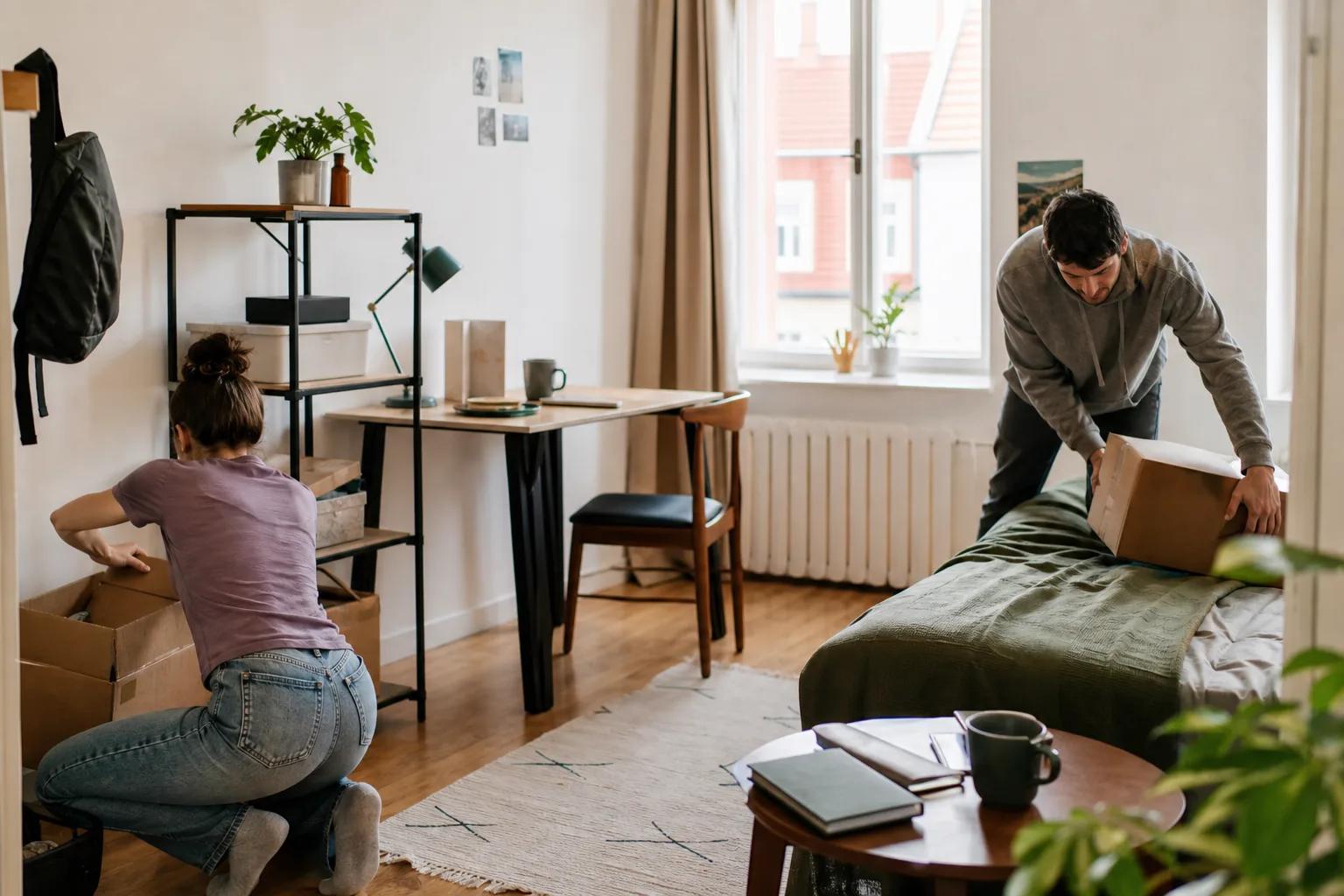
A temporary room is especially suitable when your stay is limited and you mainly need the space to sleep, study, work, or settle in. This often applies to students, interns, project staff, and people in the middle of moving.
An apartment may offer more privacy, but it is not always the more sensible solution. What matters in particular is how much of your daily life you will actually spend in the accommodation. Anyone who is away from home a lot during the day often needs less space than someone who works mostly indoors or wants to retreat deliberately.
A simple comparison helps in practice:
- A room is enough if you are bridging a clearly limited period, living independently, and can cope with shared spaces.
- An apartment is more suitable if you want more privacy, more space for work or hobbies, and as little contact with housemates as possible.
Especially with a limited to medium budget, a room can be the far more practical choice. What matters then is not the largest possible area, but whether the location, quiet, and basic furnishings fit your planned daily routine.
Which criteria really matter in everyday life?
Photos and floor plans often say less than the actual usage questions. When comparing a furnished room for a limited time, it is worth looking at the points that are immediately noticeable in everyday life.
1. How much privacy do you really need?
The most important preliminary question is not “How nice is the room?” but “How close do I want to live?” In a shared apartment, flatmates are part of everyday life. For some people that is pleasant, for others exhausting. If you need peace and quiet, you should pay special attention to the living situation and the use of shared spaces.
2. Which amenities make the stay practical?
Typical criteria include Wi-Fi, kitchen, washing machine, and registration capability. These points are not equally important for everyone, but they often determine whether the accommodation works for your purpose:
- Wi-Fi is relevant if you work, study, or need to stay in digital contact with authorities, your university, or your employer.
- Kitchen is essential if you want to take care of yourself and not depend permanently on eating out.
- Washing machine saves trips and time, especially during longer stays.
- Registration capability becomes important if the accommodation is not just a place to sleep, but also your temporary residence.
Whether registration is possible and relevant in your case should always be checked specifically before booking.
3. How noisy and how day-to-day is the accommodation?
Not every accommodation suits the same phase of life. Anyone preparing for exams, working from home, or first needing structure after a move should evaluate the surroundings more carefully. A quieter location can be more important in such phases than additional square meters.
4. How clearly is the stay limited in time?
A temporary room works best when the period is well defined. The more precisely you know when you will arrive and how long you will stay, the easier it is to choose the right housing type. Vague time frames, on the other hand, quickly lead to planning either too large or too small.
When is a room for interim rent the more sensible solution?

A room for interim rent is especially interesting when you do not need a long-term rental contract and do not want to furnish an entire apartment from scratch. Typical situations are an internship, a limited stay between two places to live, or the phase in which you first get to know a new city and then continue searching in peace.
The practical advantage lies in functionality: you use only the space you actually need and avoid the effort of fully equipping a household. At the same time, you should realistically check whether you can cope with shared routines. Anyone who needs a strictly private living situation is usually better off with a more self-contained unit.
A simple decision question is useful here: do you primarily want to arrive and live, or do you want to adjust to a new life situation in peace without organizing a large apartment right away?
How does myroom24 help with finding a temporary room in a shared apartment?
myroom24 is an online booking platform where commercial accommodation providers offer stays for private and business users. For people looking to rent a room in a shared apartment for a limited time or generally a room for a limited stay, the clear focus on longer stays is especially important: the stays offered via myroom24 include 28 to 179 nights.
This is helpful if you do not need a short-term solution for one or two nights, but are looking for a planable period of several weeks or months. You can specify your destination and length of stay and filter available long-term accommodation by criteria such as price, location, and amenities. That makes comparison easier when you need to decide between a room, an apartment, or another type of accommodation.
myroom24 also brokers different types of accommodation in commercial lodging properties such as hotels, hostels, serviced apartments, and holiday apartments. In addition, accommodations marked as instant booking can be booked without prior approval from the host, subject to availability. For your search, this means: you can look specifically for accommodation with the right period and the right features instead of checking each provider individually.
Which decision steps lead to the right solution most quickly?
If you are comparing a shared room, a furnished room, and an apartment, a fixed sequence helps. This prevents you from being guided by individual details such as pictures or wording.
Step 1: Define the period
First decide how long you will actually stay. A limited stay requires different criteria than a permanently planned apartment.
Step 2: Choose the housing type
Then decide whether you accept shared living, need more privacy, or prefer a fully self-contained unit.
Step 3: Check everyday practicality
Check whether the accommodation is useful for your daily life: Wi-Fi, kitchen, washing machine, quiet, and, where applicable, registration capability.
Step 4: Match the location and process
Pay attention to travel distances to work, university, or interim stops. An accommodation with the right location can be more important in everyday life than a larger area.
Step 5: Complete the booking only after the functionality check
If the period, amenities, and housing type fit together, the decision is more reliable. This helps you avoid choosing accommodation that fits on paper but becomes unnecessarily complicated in everyday life.
If you want to start comparing directly, use myroom24 accommodations to narrow down the planned period and the right criteria in a targeted way.
Frequently asked questions
How can I tell whether a temporary room in a shared apartment is really enough for my stay?
If you mainly need a place to sleep, study, or work and can accept shared areas, a room is often enough. If you need more privacy or more space on a permanent basis, an apartment is more suitable.
Why is registration capability important in a furnished room for a limited time?
It is especially relevant if the accommodation is not only used temporarily, but also meant to serve as your transitional residence. Before booking, clarify whether registration is possible and necessary in your case.
Which amenities should I check first for a room for interim rent?
Priority is usually Wi-Fi, kitchen, and washing machine. These three points often directly determine whether the stay works in everyday life.
When is a room for interim rent more suitable than a whole apartment?
If your stay is limited, you need little space, and you accept shared areas, a room is often more economical and functional than an apartment.
For which stays is myroom24 intended when it comes to temporary rooms?
For long-term stays of 28 to 179 nights. That means the search is aimed at limited stays over several weeks or months, not very short overnight stays.