Temporary accommodation for stays with digital access and clear service hours: checklist for arrival and everyday life
Which organizational points should be clarified before arrival?
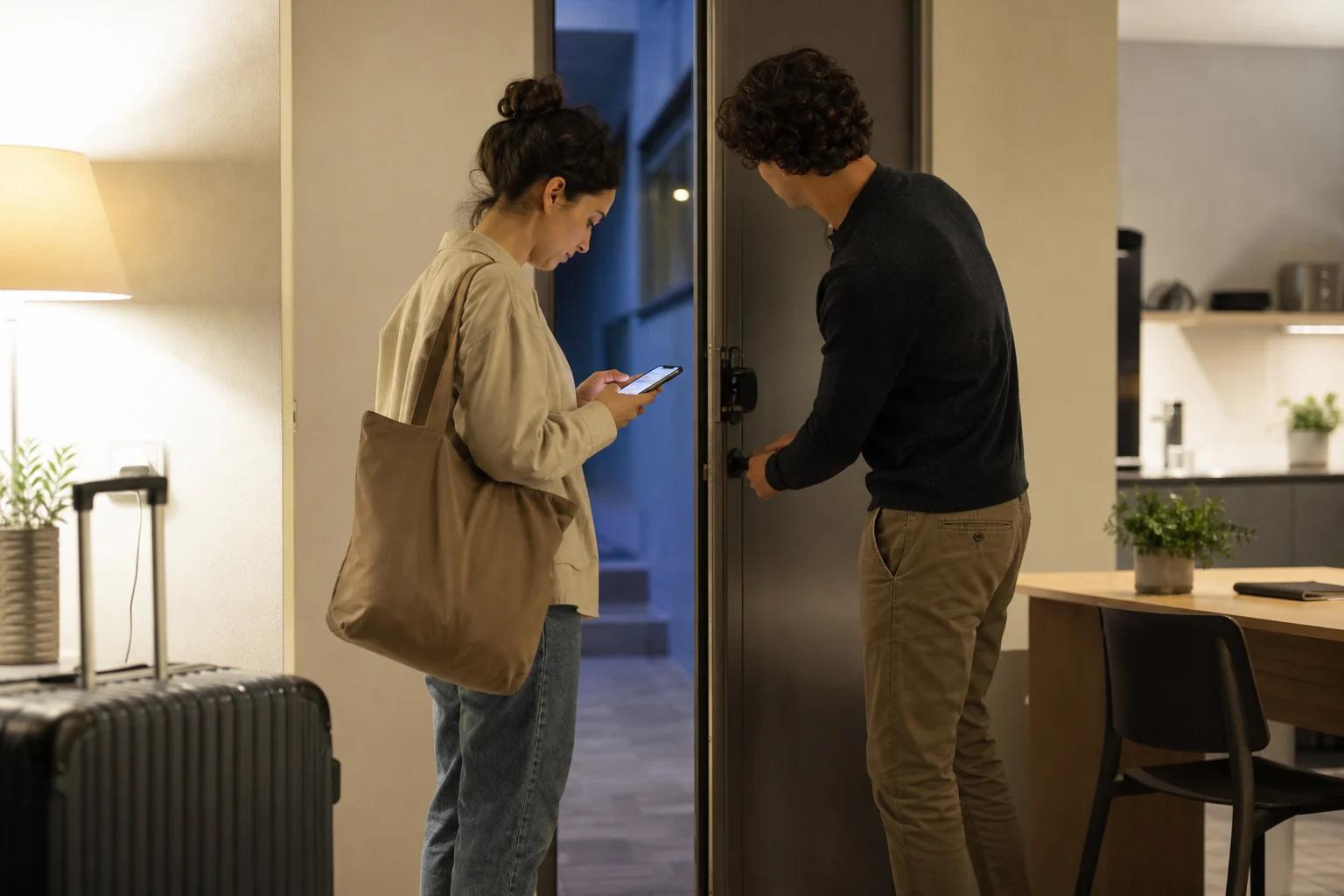
If you are looking for temporary accommodation for stays with digital access and clear service hours, a large part of the process is already decided before arrival. Especially when time is tight, not only the accommodation itself matters, but also the question of how you actually get in on the day you arrive, whom you can reach if you have questions, and what happens in an emergency. The clearer these points are in advance, the lower the risk that a small uncertainty turns into a loss of time.
Before booking or immediately after confirmation, you should therefore clarify these questions:
- How exactly does the access work: by code, key box, handover, or another solution?
- Is there a digital check-in or self-check-in, and which steps do you need to complete beforehand?
- Who provides the key or access code?
- Until what time are the service hours valid, and which contact options are available after that?
- Is there a clearly named emergency contact for problems outside regular hours?
- What information do you need for the first night so you do not have to search for it on site?
These questions may sound banal, but in practice they are crucial. Anyone arriving late after a long journey or needing to continue early the next morning needs a process that works without further questions. This is exactly where you can tell whether an accommodation is only marketed digitally or whether the arrival process is truly well prepared.
How do you recognize whether access is really practical under time pressure?
Not every digital solution is automatically suitable for everyday use. The decisive factor is whether the process is described in such a way that you can carry it out safely even when you are tired, under time pressure, or arriving late. A practical access solution not only answers the question of how you get in, but also what happens if something does not work.
The process is described in steps
The more precisely access is explained, the better you can plan your arrival. It is good if you know in advance whether you enter a code, use a key box, or need to check in in person at a certain time. Unclear or ambiguous wording, on the other hand, is a sign that you will need to ask on the day of arrival.
Responsibility is clearly assigned
It should be clear who provides access and who responds if there are problems. If several parties are involved, it is especially important that you know whom to contact first. Otherwise, time is lost through forwarding, even though the problem is actually small.
The arrival time fits the access arrangement
If you arrive late, you need to check whether the access solution also works when a personal handover is no longer possible. This is especially relevant if your train is delayed, an appointment runs longer, or you only arrive after work. A well-planned process takes such shifts into account in advance.
There is a contact option that can be planned in case of disruptions
If a code does not work or a door does not open, you need a contact path that does not have to be searched for laboriously. It is therefore important not only that help exists, but also that you know how to reach it in an emergency. This information belongs just as much to travel preparation as the address itself.
What do you need for the first night and the first workday?

Anyone arriving for project-related, professional, or transitional reasons usually needs above all peace and orientation on the first evening. The next morning often brings additional requirements: Wi-Fi, the ability to work, short distances, and the certainty that you will not have to search for a long time if you have questions. That is why you should know before arrival which information you will have immediately at hand.
These points are especially helpful:
- Where do you find the access data for Wi-Fi or other necessary information?
- Which instructions apply for the first evening, for example regarding use of access or house rules?
- Is there a reachable contact if something comes up outside the service hours?
- Which amenities are important if you want to start working right away the next morning?
- Do you still need to bring anything yourself so that the start runs smoothly?
For the first workday, what matters most is that you do not have to organize in the morning what could have been clarified the evening before. Anyone working directly after arrival should therefore not only think about the sleeping space, but about the entire process up to the next morning. This also includes having the most important information collected in one place and not spread across several messages.
How do you compare an apartment, serviced apartment, and hotel sensibly?
For longer stays, it is worth comparing concrete criteria rather than relying on preconceptions. An apartment, a serviced apartment, or a hotel can each be suitable depending on location, services, and the access solution. What matters is not the category alone, but whether it fits your schedule and your organizational needs.
Therefore compare these points:
Access and arrival process
How do you get in, and how well does that work even if you arrive late? Especially when you have little time, a clear access arrangement is often more important than a particularly elaborate reception process.
Service hours and availability
Not every accommodation is organized the same way around the clock. Check therefore when you can expect support and how to get help outside these times. This is especially relevant if your daily schedule is irregular.
Location in relation to your schedule
The best amenities are of little use if the route to your workplace, the station, or an appointment takes too much time. That is why the location should always be considered together with the arrival and work process.
Transparent total costs
Compare not only the type of accommodation, but also which cost items are clear in advance. For longer stays, it is important that you can understand the total costs and do not have to explain additional items later.
Amenities and practicality for everyday life
For the first night and the first workday, practical details matter: How well is the start organized, what is already prepared, and what do you have to coordinate yourself? This makes the comparison between different types of accommodation more concrete and useful.
How can myroom24 help with exactly this topic?
myroom24 is an online booking platform where commercial accommodation providers offer accommodations for private and business users. For longer stays, it is especially relevant that the long-term stays offered cover 28 to 179 nights. You can specify your destination and length of stay and filter available long-term accommodations by criteria such as price, location, and amenities.
This is especially useful for this topic if you do not want to leave your arrival process to chance. You can therefore choose not only based on the accommodation itself, but also on the organizational framework that fits your time window.
It is also practical that accommodations marked as instant booking can be booked without prior approval from the host, if available. So if you need a clear plan for arrival and the start of work, you can narrow the search to suitable options before deciding on a specific accommodation.
Which checklist helps you directly before booking?

If you are close to making a decision, go through the following points in a structured way:
- Access: Is it clearly described how you get into the building and the unit?
- Provision: Do you know when and from whom you will receive the key or access data?
- Service hours: Are availability and contact paths clearly stated?
- Emergency contact: Is there a specific point of contact for problems outside regular hours?
- First night: Is the most important information prepared so that you can use it immediately?
- First workday: Does the process fit your schedule for the next morning?
This list does not replace a careful review of the accommodation, but it makes the most important organizational points visible. Especially when time is limited, this is helpful because you can see early whether the process fits your time window or whether questions are still open.
What is the next sensible step?
If you want to plan arrival carefully in advance, start with the points access, availability, and emergency contact. Then you can narrow the suitable options by location, amenities, and length of stay. Take a look at the myroom24 accommodation and specifically check the offers for your planned period.
Frequently asked questions
Which details should I have confirmed in writing before arrival?
The most important points are the exact access solution, the time of provision, the service hours, and an emergency contact for the day of arrival.
How do I know whether digital access will really work for my late arrival?
If the process is described in clear steps, an alternative solution is named, and you have a contact for disruptions, the planning is more reliable.
What must I have under control for the first night?
You should know how to get in, where to find the most important information, and whom you can reach if problems arise outside service hours.
How do I sensibly compare an apartment, serviced apartment, and hotel for longer stays?
Compare access, service hours, location, amenities, and understandable total costs. That way you decide based on the process, not just the category.